
Solar Panels vs Solar Shingles: Cost, Roof Fit, and Performance
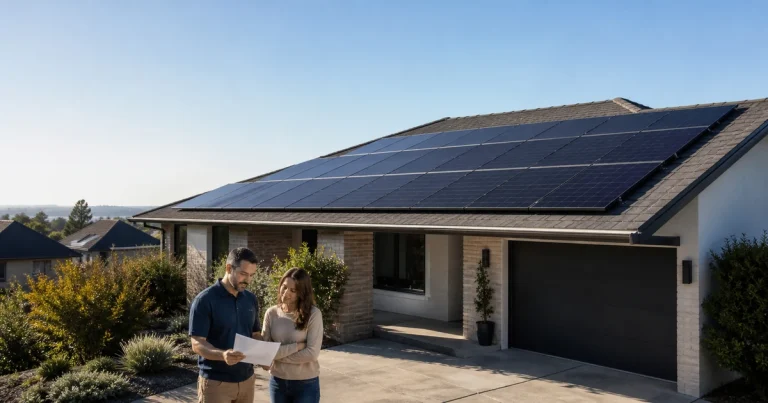
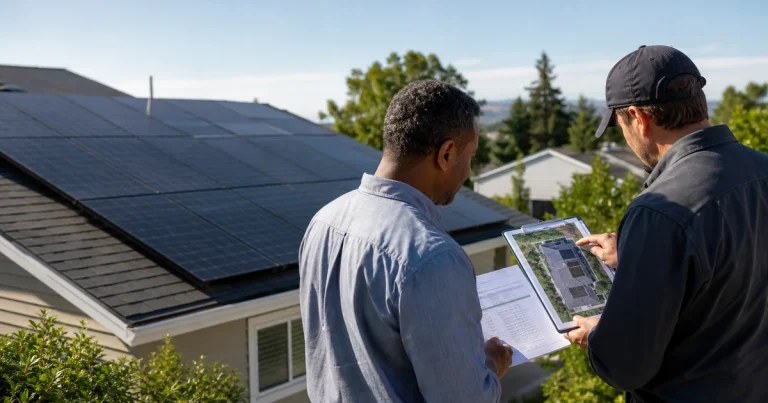
Solar panels vs solar shingles becomes a costly decision when one quote assumes a sound existing roof and another includes part of a new roof. Standard panels are usually the clearer value on a roof with adequate remaining life and usable sunlit area. Solar shingles deserve a full comparison when reroofing or new construction is already part of the plan. The safer next step is to compare three complete scopes, verify the product documents, and require the same annual-energy assumptions before approving either proposal.
Key Takeaways
- Rack-mounted panels usually suit a sound roof with enough usable, low-shade area.
- Solar shingles are building-integrated PV, so they should be compared with a conventional reroof plus panels when replacement is already needed.
- A valid comparison matches roof work, active solar area, electrical scope, first-year modeled kWh, warranty remedies, exclusions, and quote date.
- Product efficiency and nameplate watts are inputs. They are not household energy forecasts.
- The former federal residential credit is unavailable for property placed in service after December 31, 2025. This is not tax advice.
Table of Contents
- What Is the Real Difference Between Solar Panels and Solar Shingles?
- Which Option Costs Less After You Compare the Right Scopes?
- Which Roofs Favor Panels and Which Favor Solar Shingles?
- Which Produces More Electricity on a Limited Roof?
- Are Performance and Temperature Claims Directly Comparable?
- Do Warranties and Serviceability Change the Decision?
- How Should You Compare Two Proposals Before Signing?
- Which Should You Choose?
- Frequently Asked Questions
- Are solar shingles worth it?
- Are solar shingles more expensive than solar panels?
- Can solar shingles power an entire house?
- Do solar shingles work on an existing roof?
- Do solar shingles produce less electricity than panels?
- Do solar panels need to come down for roof replacement?
- What warranty should I ask for?
- Can I claim a federal solar tax credit in 2026?
- Sources and references
What Is the Real Difference Between Solar Panels and Solar Shingles?
Solar panels add an electrical system above an existing roof. Solar shingles are building-integrated photovoltaics, or BIPV, that combine electricity generation with part of the roof-surface function. Both still need a suitable roof, electrical equipment, approvals, and a design that reflects the site’s sun and shade.
Panels and shingles therefore solve different construction problems. A panel project usually preserves the current roof assembly. A solar-shingle project coordinates roofing materials, weather protection, active PV areas, non-active matching areas, wiring, and the future service path in one scope.
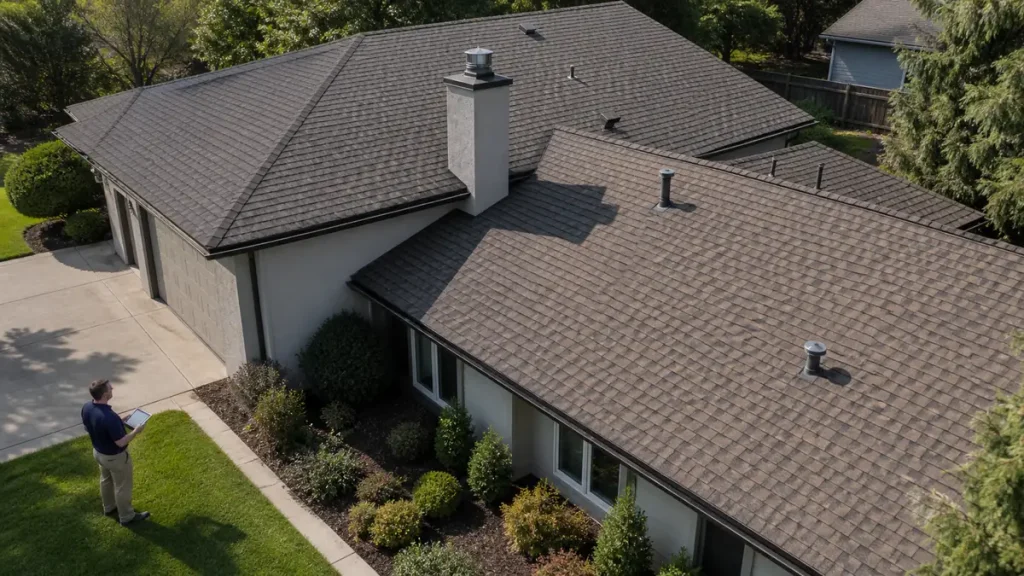
The right comparison starts with the roof, not with a product label. A good roof plan identifies productive planes, obstructions, shade, pathways, access, and the exact area that can carry active PV. For a parallel explanation of those inputs, see how solar panels work.
Which Option Costs Less After You Compare the Right Scopes?
Panels normally cost less when the existing roof is sound. A solar-roof proposal needs a conventional reroof-plus-panels baseline when replacement is already due. Otherwise, the panel baseline excludes a needed roofing cost.
Use three proposals with the same target energy goal. The first is panels on the sound existing roof. The second is a conventional reroof plus panels. The third is the integrated solar-roof proposal. Each should show materials, labor, electrical work, permits, inspection, roof-interface work, exclusions, financing terms, and the quote date.
Current consumer-market ranges are useful only as a screen. They cannot predict a local project’s cost because roof geometry, tear-off work, electrical upgrades, labor market, system size, and product availability change the final scope. Do not turn a national range into a promised payback or savings result.
One current market comparison reports that solar shingles can cost roughly 60% to 190% more than panels for equivalent output. A separate comparison, updated July 8, 2026, reports broad installed ranges of $18,400 to $36,400 for panels and $21,000 to $50,000 for shingles. These figures are market screens, not local forecasts.
Use this worksheet when quotes arrive:
| Quote field | Panels on sound roof | Conventional reroof plus panels | Integrated solar roof |
|---|---|---|---|
| Roofing materials and labor | State what is excluded | Itemize | Itemize active and non-active roof materials |
| PV equipment and electrical scope | Itemize exact SKU and inverter | Use the same energy goal | Itemize exact active product and electronics |
| Usable active area | Show roof planes and obstructions | Show roof planes and obstructions | Show active versus non-active roof area |
| First-year modeled kWh | State weather, shade, and loss assumptions | Use matching assumptions | Use matching assumptions |
| Service and warranty labor | Identify claimant and exclusions | Identify claimant and exclusions | Identify claimant and exclusions |
The tax date needs separate care. The former federal residential clean-energy credit covered qualifying property placed in service through December 31, 2025. It is not available for property placed in service after that date. State and local programs depend on the address and program rules, so confirm them with the responsible administrator and a licensed tax professional.
Which Roofs Favor Panels and Which Favor Solar Shingles?
Panels usually fit a sound, compatible roof with enough remaining life and usable solar exposure. Their route is often simpler because the PV system is added above a roof that is not yet due for replacement.
Solar shingles can make sense when a full reroof or a new build is already committed. Their integrated appearance can carry legitimate value where design requirements matter. Compare that value with active coverage, installed scope, compatibility, availability, and future service access.
A small, complex, or shaded roof has no automatic winner. Dormers, hips, valleys, chimneys, vents, roof planes, tree shade, access paths, and required setbacks can limit productive area for either format. A shingle system should not be assumed to use every visible roof surface for generation.
Product fit is also specific. One current integrated-shingle technical sheet requires a minimum 2:12 roof pitch, but that rule does not apply to every solar-roof product. Request the exact installation manual and data-sheet revision before treating any roof as compatible.
For a field-by-field roof screen, use solar panel dimensions and roof space. The result is only a planning screen. A qualified team still needs to confirm roof condition, structure, mounting, electrical design, permits, and interconnection.
Which Produces More Electricity on a Limited Roof?
The better option is the one that produces more modeled annual kWh from the usable, low-shade area. A single panel or shingle rating cannot decide that outcome by itself.
Watts, efficiency, watts per active area, and annual kWh answer different questions. Watts describe rated DC capacity at stated test conditions. Efficiency helps compare power density. Annual kWh comes from the whole design, including orientation, irradiance, temperature, shade, inverter behavior, system losses, availability, and age.
Conventional panels can offer more power per available roof area in many current product comparisons. That pattern is not a house-specific conclusion. A limited roof still needs the exact SKU, active area, roof layout, and a matched annual model. Only then can a buyer compare expected generation.
One current integrated-shingle data sheet lists 46W per energy shingle and about 32 energy shingles, or 1.46kW, per roofing square. That is a product example, not a universal shingle benchmark. It also cannot be compared directly with a panel-system total without matching active area and layout.
Use panel ratings versus real output to separate data-sheet values from annual production. Then ask the designer to show the weather source, roof planes, shade study, inverter selection, system losses, and first-year kWh for each complete proposal.
Are Performance and Temperature Claims Directly Comparable?
Performance claims are comparable only when they use the same test conditions and project assumptions. A higher label in a different roof format is not proof of more household energy.
Published electrical values are commonly stated under Standard Test Conditions, such as 1,000W/m2 irradiance, 25C module temperature, and air mass 1.5. Those values make product data sheets comparable. They do not reproduce the temperature, sunlight, shade, or equipment behavior of a specific home.
Fixed solar shingles follow the roof plane. Panels can sometimes use mounting choices that alter the final layout. Neither fact establishes a generic output advantage. The proposal should document the same target consumption, usable area, shading assumptions, DC-to-AC ratio, losses, and weather data before its projected production is compared.
Request the exact model, data-sheet revision, dimensions, rated power, efficiency, temperature coefficient, installation instructions, active area, and annual model. The solar panel specification checklist is a useful record for making those fields traceable.
Do Warranties and Serviceability Change the Decision?
Warranty and service terms can change the decision because a long duration does not guarantee the same remedy. The homeowner needs to know who handles roof weatherization, active PV, electrical equipment, labor, and future troubleshooting.
Two current integrated-solar-roof warranty documents show why the exact terms matter. Tesla Solar Roof states 25-year product and weatherization coverage. Its warranty states at least 95% rated peak power at year five. It then permits no more than 0.5% annual decline for 20 years under stated test conditions.
GAF Timberline Solar starts at 98% in year one, allows no more than 0.55% annual decline afterward, and lists 84.8% in year 25. These are product-specific warranty commitments, not forecasts of annual household output.
The remedy matters as much as the headline term. Later warranty years can have prorated compensation, labor limits, installer-qualification conditions, or exclusions for roof components and electronics. Review the current proposal documents before assuming that a roof warranty, PV warranty, workmanship warranty, and service call are handled by one party.
Ask for these records before signing:
- Exact product and installation-manual revision.
- Applicable safety listing, fire classification, and local-code evidence.
- Product, weatherization, workmanship, and performance warranties.
- Labor coverage, proration, exclusions, and warranty claimant.
- Inverter, rapid-shutdown, monitoring, and service-provider responsibility.
- A written process for roof repairs, component replacement, and post-repair commissioning.
How Should You Compare Two Proposals Before Signing?
Compare two proposals only after the roof and electrical assumptions match. A module-only price, a shingle count, or a claimed efficiency figure cannot establish whole-project value.
Start with the same annual electricity goal. Then request active area, productive roof planes, weather data, shade assumptions, losses, system size, first-year kWh, roof scope, electrical scope, and warranty path. If one proposal excludes a roof item or uses a different energy target, mark the comparison incomplete.
The most useful question is simple: what changed besides the product format? Record changes in active area, roof planes, inverter, shade assumptions, roof scope, and labor coverage. Those differences belong in the comparison table.
The three-scope rule: A solar-shingle proposal is not ready for a price verdict until it is compared with panels on the existing roof and with a conventional reroof plus panels. The same roof, electrical, and production assumptions must be visible in all three scopes.
Which Should You Choose?
Choose rack-mounted panels when the current roof is sound, the layout meets the energy goal, and the complete panel route has a clear service path. This is often the lower-complexity route when reroofing is not otherwise needed.
Choose solar shingles only after the project treats roofing and PV as one coordinated scope. They can suit a planned reroof, new construction, or a documented visual constraint. The active coverage, model, cost scope, warranty terms, and service pathway must support the premium.
Pause the choice when the roof plan, exact SKU, installation instructions, warranty document, or annual model is missing. A complete record is more valuable than a fast answer when the proposal combines a roof and a power plant.
Frequently Asked Questions
Are solar shingles worth it?
Solar shingles can be worth evaluating when a full reroof or new build is already planned and an integrated appearance has documented value. Compare their complete scope against both panels on the existing roof and a conventional reroof plus panels before deciding.
Are solar shingles more expensive than solar panels?
Solar shingles often have a higher upfront project cost, but the fair comparison changes when a reroof is already necessary. Separate roofing cost, PV cost, electrical work, labor, and exclusions before calling either option more expensive.
Can solar shingles power an entire house?
Solar shingles can contribute to a grid-tied home system, but coverage depends on usable active area, roof orientation, shade, electricity use, design, equipment, and local interconnection. A production model is needed to estimate the portion of consumption a proposal can cover.
Do solar shingles work on an existing roof?
Solar shingles generally replace part of the roofing assembly, so they are usually evaluated during reroofing or construction. Confirm the exact product’s installation instructions instead of assuming that it installs over every existing roof.
Do solar shingles produce less electricity than panels?
Solar shingles can have less power per active area in many current comparisons, but the final result depends on the exact products and roof layout. Compare matched annual kWh models rather than a single watt rating or a generic efficiency claim.
Do solar panels need to come down for roof replacement?
Panels may need removal and reinstallation when a roof beneath them is replaced. The quote should state who does that work, how roof and electrical warranties are handled, and whether recommissioning is included.
What warranty should I ask for?
Ask for product, weatherization, workmanship, power-output, labor, inverter, roof-interface, exclusion, proration, installer-qualification, and claim-process documents. Read the exact version that applies to the proposed model and location.
Can I claim a federal solar tax credit in 2026?
The former Residential Clean Energy Credit is unavailable for property placed in service after December 31, 2025. This is not tax advice. Confirm any state or local program and your personal tax treatment with the responsible administrator and a licensed tax professional.
Sources and references
- Internal Revenue Service. Residential Clean Energy Credit
- U.S. Department of Energy. Expanding Solar Energy Opportunities: From Rooftops to Building Integration
- EnergySage. Solar Shingles: Is The Look Worth The Price?
- Angi. Solar Panels vs. Solar Shingles: Which Is the Better Fit for Your House?
- GAF Energy. Timberline Solar Technical Data Sheet
- GAF Energy. Timberline Solar Shingle and Accessory Limited Warranty
- Tesla. Solar Roof Limited Warranty, USA
- Tesla. Understanding System Performance