
How Much Electricity Does a Solar Panel Generate?
How much electricity does a solar panel generate when a quote only shows a 400W or 430W label? The honest answer is a range, because wattage is a laboratory power rating rather than a daily energy promise. A panel on a sunny, unshaded roof can produce far more kWh than the same panel on a shaded or poorly oriented roof. Before approving a quote, use a transparent screening calculation, then compare the complete address-specific production model and every assumption behind it.
Key Takeaways
- A panel’s watt label is rated DC power under controlled test conditions. Daily electricity is measured in kWh over time.
- A rough estimate is
panel watts x peak sun hours x performance factor / 1,000.- A 400W panel with four peak sun hours and a 0.86 planning factor estimates about 1.38 kWh per day.
- Location, roof direction, shade, temperature, soiling, inverter behavior, and aging can change annual output.
- A battery stores electricity. It does not make the PV modules generate more electricity.
- Compare first-year system kWh and model inputs across quotes, not panel wattage alone.
For the relationship between a module label and real production, start with the solar cell efficiency formula. It explains why Pmax and efficiency help compare modules, but cannot predict a particular roof’s annual kWh by themselves.
Table of Contents
- How much electricity does one solar panel generate?
- Use this formula for a rough daily kWh estimate
- Convert daily output into monthly and annual production
- Why identical panels can produce different kWh
- Check a 400W or 430W panel example without turning it into a promise
- Audit the production estimate in a solar quote
- Does a battery or a higher wattage label increase solar generation?
- Use an address-specific model before choosing a panel
- Frequently Asked Questions
- How much electricity does a 400W solar panel generate per day?
- How many kWh does one solar panel produce per year?
- Does a 400W solar panel make 400W all day?
- Do solar panels generate electricity on cloudy days?
- Does a solar battery make the panels generate more electricity?
- Are south-facing panels always best?
- Does a higher-efficiency panel produce more annual electricity?
- What is the most accurate way to estimate solar output?
- Turn a watt label into a comparable quote
- Sources and references
How much electricity does one solar panel generate?
One panel can generate a useful amount of electricity, but there is no accurate national daily figure for every 400W or 430W module. The result depends on sunlight at the address, the hours and angle at which light reaches the array, and the losses between the module and usable AC electricity.
A 400W panel is rated to produce 400 watts of direct-current power at Standard Test Conditions. Those conditions use controlled irradiance and a 25°C cell temperature. They make it possible to compare modules fairly. They do not mean a rooftop panel produces 400W for every daylight hour.
Energy is different from power. Watts describe the rate of generation at a moment. Watt-hours and kilowatt-hours describe how much energy accumulates over time. Your utility bill uses kWh, so that is the unit to request in a production estimate.
Current residential modules often fall in the 400W to 460W range, according to the quote-market data discussed by EnergySage. That is useful market context, but it does not turn any one rating into a production guarantee. Compare the exact module data sheet with solar panel specifications before deciding what that watt label means for your system.
Use this formula for a rough daily kWh estimate
Use one transparent equation to screen a proposal before you treat it as a forecast:
daily kWh = panel watts x peak sun hours x performance factor / 1,000
Peak sun hours do not mean hours of visible daylight. They express the day’s solar resource as equivalent hours at a standard intensity. The performance factor is a planning allowance for losses such as soiling, shade, mismatch, wiring, connections, inverter conversion, and availability. It must be replaced by the actual project’s model inputs.
For a simple 400W example, assume four peak sun hours and a 0.86 performance factor. The estimate is:
400W x 4.0 x 0.86 / 1,000 = 1.376 kWh per day
Rounded for planning, that is 1.38 kWh per day. It becomes about 41 kWh in a 30-day month or about 502 kWh in a 365-day year only if the same daily conditions held throughout the period. Real seasons do not behave that way, so use those extensions only to understand the arithmetic.
Illustrative calculation. The 0.86 planning factor is a round screening assumption, not a current tool default, a project loss value, or a yield guarantee. Replace it with the documented losses in the address-specific production model.
Do not multiply the panel’s efficiency percentage by its wattage. Rated watts already express the module’s output at its stated test point. Efficiency is mainly useful when you need to fit more DC capacity into a limited area.
Convert daily output into monthly and annual production
Multiply a daily screening estimate by the number of days only when you need a quick sense check. A project decision should use monthly and annual weather data, because solar resource, temperature, and shading vary throughout the year.
The National Laboratory of the Rockies PVWatts calculator estimates output for grid-connected PV systems and reports a range based on historical weather data. Enter the address, array DC size, roof tilt, azimuth, mounting type, and loss assumptions. Then keep the results beside the quote so you can compare like with like.
Use these short formulas only for a basic worksheet:
monthly kWh = daily planning kWh x days in the monthannual kWh = sum of monthly modeled kWharray annual kWh = one-panel annual estimate x panel count, only when every module has the same orientation and shading conditions
The last formula becomes weak when a roof has multiple faces or obstructions. A north-facing group, a chimney shadow, or a different string design can change the answer. For a roof-fit check before you settle on panel count, see the solar panel dimensions reference.
Why identical panels can produce different kWh
Location and roof design often explain more output difference than the headline wattage. A good production model names the conditions instead of hiding them behind a single annual number.
Solar resource and season matter first. Solar radiation changes by geography, time of day, season, weather, and local landscape. A clear-day figure from one state cannot validate a proposal in another state.
Orientation and tilt shape the annual total. In the northern hemisphere, a south-facing array near the local latitude is a useful reference for annual production. East and west roofs can still be valid designs, especially when afternoon or morning load timing matters. Ask the estimator to state the azimuth and tilt, not just describe the roof as “good for solar.”
Shade needs a method, not an adjective. Trees, chimneys, neighboring buildings, and row spacing can reduce usable light. Request the shade-obstruction method and whether the model accounts for it by month or hour.
Heat and system losses remain part of production. Modules tend to operate hotter than their laboratory test temperature. Dirt, snow, wiring, mismatch, availability, and inverter limits also affect delivered energy. A realistic output figure identifies which losses are modeled and which are excluded.
Check a 400W or 430W panel example without turning it into a promise
A published example can make the calculation easier to follow, but it cannot replace a local model. EnergySage gives a California example in which a 430W panel with a production ratio of 1.5 is estimated to produce 645 kWh per year, or about 1.77 kWh per day. The location and production ratio are what make that number interpretable.
Compare that with the 400W worksheet above. It assumed four peak sun hours and a 0.86 performance factor, leading to 1.38 kWh per day. The two numbers are not competing universal answers. They show that stated assumptions determine the estimate.
That distinction matters when reading a quote. A larger panel can add capacity, but it may also be physically larger. A higher-efficiency module can help a constrained roof, but it does not remove shading or change the local solar resource. Use good-efficiency decision criteria to decide when power density solves a real roof constraint.
Audit the production estimate in a solar quote
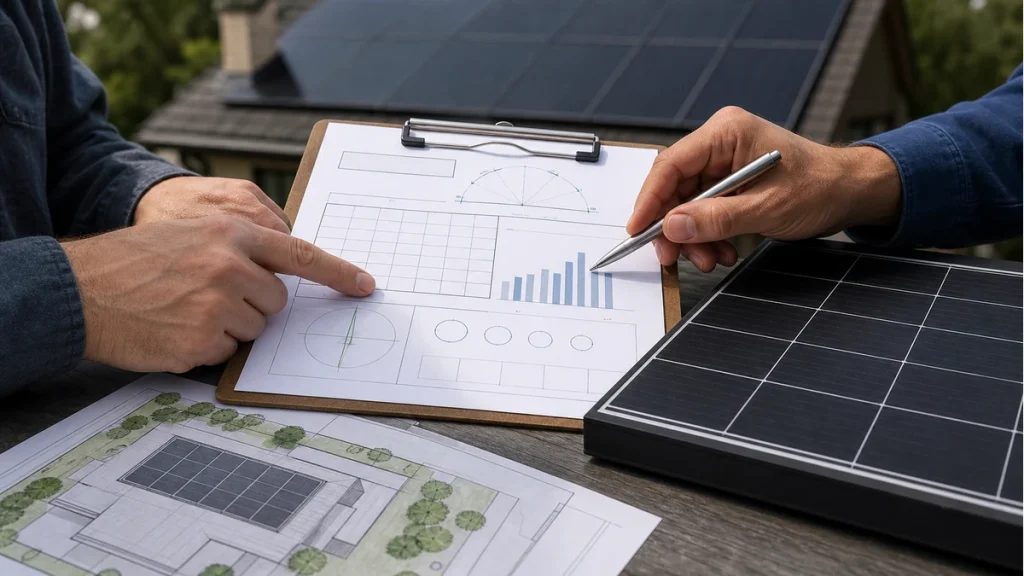
An annual kWh number is useful only when the proposal names the system and modeling assumptions behind it. Ask every bidder to provide the same input fields so the comparison does not collapse into a contest of panel labels.
| Ask for this field | Why it matters | Question to put on the quote review |
|---|---|---|
| Exact module SKU and data-sheet revision | A watt label alone does not identify dimensions, temperature behavior, or listing evidence. | Which exact module and revision are you proposing? |
| Module count and array kWdc | These show how the system adds up. | How many modules create the stated DC system size? |
| Inverter model and AC rating | DC module capacity and AC delivery are different parts of the design. | What inverter is modeled, and what DC-to-AC ratio is assumed? |
| Address or weather dataset | Solar resource needs a geographic basis. | Which address and weather data file produced the annual kWh? |
| Tilt, azimuth, and mounting type | These conditions shape the sunlight received by the array. | What roof angle and direction are included for each array group? |
| Shade treatment and losses | A generic loss factor may omit a material site issue. | How were shade, soiling, wiring, and availability modeled? |
| First-year kWh and degradation assumption | The buyer needs a dated baseline before discussing later years. | What first-year kWh is predicted, and what degradation input is used? |
| Monitoring and warranty-service owner | Production issues need a clear measurement and remedy path. | Who monitors the system and who owns each warranty claim path? |
Hongyu can provide module documentation and clarify product fields within the scope of a module quote. A qualified local installer or PV designer must approve structural capacity, electrical design, permitting, utility interconnection, and the final site-specific output model. For the document-control side of a purchase, use the solar panel procurement guide.
Does a battery or a higher wattage label increase solar generation?
A battery changes when solar energy is stored or used. It does not make sunlight deliver more energy to the photovoltaic cells. Charging and discharging also have their own losses, so battery capacity should not be added to a panel’s daily kWh estimate.
A higher-wattage module can increase array capacity if it fits the roof and the electrical design. It can also be larger. A higher-efficiency module can place more rated watts in the same area. Neither change makes the panel immune to heat, shade, orientation, or inverter limits.
The practical decision is to compare complete designs on the same basis: module dimensions, total kWdc, inverter choice, modeled first-year kWh, assumptions, installed scope, certification evidence, warranty terms, and service responsibility. The solar PV panel comparison provides a wider technology framework before you narrow the choice to a specific model.
Use an address-specific model before choosing a panel
The rough formula should make a quote easier to question, not replace engineering. Before selecting a panel or accepting a production figure, collect the last 12 months of utility kWh, ask for an itemized first-year estimate, and reproduce the proposal’s main inputs in PVWatts or another documented model.
If your independent result differs, do not assume one number is wrong. Check the address, module count, DC size, roof faces, tilt, azimuth, shade method, losses, inverter rating, and weather data. A difference usually becomes explainable when these fields are visible.
For a specification-matched module inquiry, provide the project destination, usable roof constraints, required documents, target array size, and the production-model assumptions you need the installer to evaluate. Hongyu engineering review is still required before a module is selected or a project is approved.
Frequently Asked Questions
How much electricity does a 400W solar panel generate per day?
A 400W panel may generate roughly 1 to 2 kWh per day in a simple planning example, but its actual output depends on local solar resource, orientation, shade, temperature, and system losses. Use 400 x peak-sun-hours x performance-factor / 1,000 for a transparent screen, then model the exact location.
How many kWh does one solar panel produce per year?
Annual kWh depends on the same site variables and on seasonal weather. Multiply a day only for a rough estimate. For a quote decision, use monthly modeled output and add the months together rather than assuming every day matches a single example.
Does a 400W solar panel make 400W all day?
No. A 400W rating is measured at Standard Test Conditions, not every outdoor moment. The panel’s DC power rises and falls with irradiance and temperature, while the system’s AC output also reflects inverter and electrical losses.
Do solar panels generate electricity on cloudy days?
Yes. PV cells can generate electricity from diffuse daylight, but less usable light usually means less output. The size of that reduction varies by weather, cloud conditions, site geometry, and system design, so use location-specific data rather than a fixed cloudy-day percentage.
Does a solar battery make the panels generate more electricity?
No. A battery stores some electricity the panels already generated for later use. It can change self-consumption and backup capability, but it does not increase the sunlight or DC generation at the modules.
Are south-facing panels always best?
South-facing arrays are a common northern-hemisphere reference for annual production, but they are not an automatic winner for every home. East and west arrays may fit the roof or a household’s demand pattern better. Compare the modeled result and the assumptions, not direction alone.
Does a higher-efficiency panel produce more annual electricity?
It can produce more energy from the same usable roof area because it packs more rated power into that area. It does not guarantee more annual kWh when the system design, shade, orientation, inverter, or module count changes at the same time.
What is the most accurate way to estimate solar output?
Use a documented, address-specific model that identifies the exact array size, roof configuration, shade treatment, weather data, losses, and inverter assumptions. A qualified local PV professional should verify that result for the permitted design.
Turn a watt label into a comparable quote
A solar panel does not have one universal daily output. Its wattage starts the calculation, while local sunlight and system conditions finish it. A clear estimate lets you see what a proposal assumes and compare it fairly with another design.
- Use panel watts, local peak sun hours, and disclosed losses for an initial screen.
- Ask for a first-year kWh model that names every roof and inverter assumption.
- Verify the exact module documents and site design before deciding on price or expected output.
Sources and references
- U.S. Department of Energy. Solar Photovoltaic Cell Basics. https://www.energy.gov/cmei/systems/solar-photovoltaic-cell-basics
- U.S. Department of Energy. Solar Radiation Basics.https://www.energy.gov/cmei/systems/solar-radiation-basics
- U.S. Department of Energy. Solar Photovoltaic System Design Basics.https://www.energy.gov/cmei/systems/solar-photovoltaic-system-design-basics
- National Laboratory of the Rockies. PVWatts Calculator. Current tool.https://pvwatts.nlr.gov/
- EnergySage. How much energy does a solar panel produce? https://www.energysage.com/solar/solar-panel-output/
- SolarReviews. How much energy does a solar panel produce? https://www.solarreviews.com/blog/how-much-electricity-does-a-solar-panel-produce