
Solar Panel and Installation Costs: Module Price, Labor and Other Project Costs
The average cost of solar panels and installation covers the photovoltaic modules, inverter, mounting hardware, labor, permits, and interconnection work needed to bring a system online. In the first half of 2026, the median U.S. residential solar quote was $2.57 per watt, while the U.S. Department of Energy modeled $2.95 per DC watt for an 8 kW rooftop system. Treat those installed figures as a baseline for comparing local quotes—a factory supplier’s module-only price covers a much narrower scope.
Table of Contents
- How much do solar panels cost on average?
- How do you calculate solar module price per watt?
- Panel Price vs. Total Installed Solar Cost
- How Much Do Solar Panels Cost for a 2,000 sq ft vs. 3,000 sq ft House?
- What is included in solar panel installation costs?
- How do you compare two solar installation quotes?
- Comparing 5kW, 8kW, 10kW and 25kW Solar System Cost (With & Without Battery Storage)
- Frequently Asked Questions
- How many solar panels make up an 8 kW or 10 kW system?
- How can I estimate my solar panel installation cost before requesting a quote?
- Is there a standard labor cost per solar panel?
- How should I compare solar quotes with a battery?
- What is the difference between solar cost per watt and cost per kilowatt-hour?
- What is the typical price per watt for wholesale solar panels vs. installed residential systems?
- Do higher-wattage panels like 500W–550W reduce total installation cost?
- How much does adding LiFePO4 battery storage increase solar installation cost?
- What affects custom OEM solar panel pricing and lead times?
- Are solar panel warranties included in the purchase price?
How much do solar panels cost on average?
Based on published U.S. benchmarks, an 8 kW residential rooftop system costs $23,600 at the U.S. Department of Energy’s modeled 2026 Q1 market price of $2.95 per DC watt (in 2024 dollars, excluding battery storage and incentives), or about $20,560 at EnergySage’s H1 2026 median quote of $2.57/W. Real quotes vary by roof geometry, installer labor, electrical upgrades, and equipment selection. DOE solar cost benchmarks, Table 2
| U.S. reference | Reported price | What it measures |
|---|---|---|
| EnergySage, H1 2026 | $2.57/W | Median residential quote on one marketplace |
| DOE, Q1 2026 | $2.95/Wdc | Modeled market price for an 8 kWdc rooftop PV-only system, in 2024 dollars |
| Berkeley Lab, 2024 installations | $4.00/Wdc | Median reported installed price for host-owned residential PV without storage, in 2024 dollars. Includes cash and loan-financed systems. |
Berkeley Lab’s 2024 residential sample ranged from $3.00/Wdc at the 20th percentile to $5.20/Wdc at the 80th percentile. The three references above use different periods and methods. Use each to understand its own segment and measurement. Berkeley Lab installed-price distributions, slide 35
How do you calculate solar module price per watt?
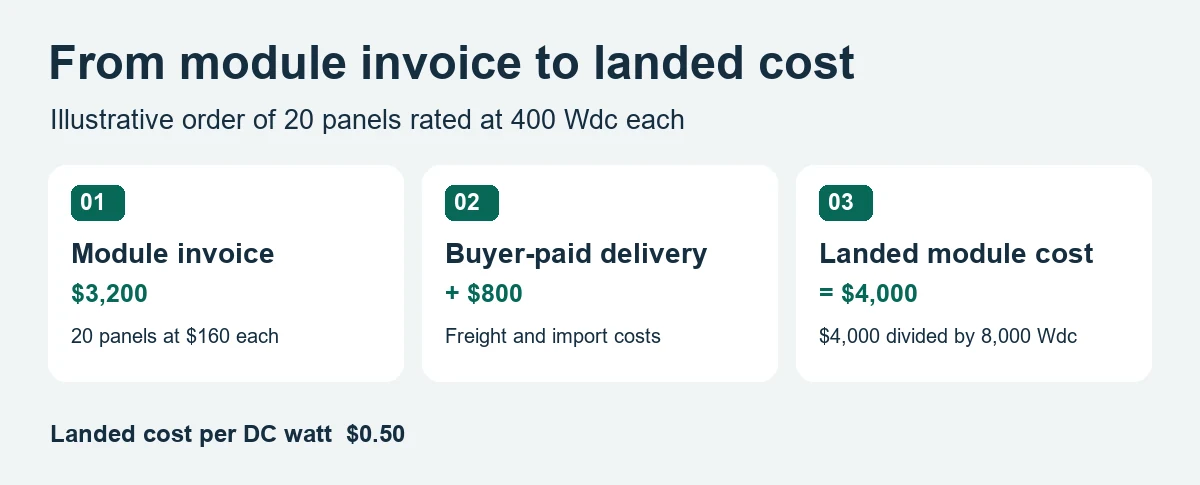
Divide the panel price by its rated DC wattage to calculate the module-only price per watt. For a shipment, divide the full module invoice by the total rated wattage. Then add buyer-paid freight, insurance, import charges, and inland delivery as applicable to calculate landed module cost.
For example, an illustrative order of 20 panels rated at 400 W each has 8,000 Wdc of nameplate capacity. At $160 per panel, the module invoice is $3,200, or $0.40/Wdc. If buyer-paid delivery and import costs total $800, the landed module cost is $4,000, or $0.50/Wdc.
Commercial benchmarks can provide context for procurement. SEIA and Wood Mackenzie reported a module price of $0.34/Wdc in their Q1 2026 U.S. commercial system pricing analysis. That figure applies to the report’s commercial pricing model. Get a model-specific quote for a small order, a custom panel, or delivery to another market. SEIA and Wood Mackenzie Q2 2026 report
Panel Price vs. Total Installed Solar Cost
A solar panel price can refer to a single module, a kit or a finished installation. Ask the supplier or installer to identify which of these three scopes the quote covers.
Module only: Compare the quoted price, rated watts, model and delivery terms. Kit: Check the bill of materials for the inverter, battery, mounting hardware and protection equipment. Installed system: Check whether design, labor, permits, interconnection and any roof or electrical work are included.
Compare the same system capacity and scope before using price per watt. For equipment-only requests, start with the listed solar panel kit configurations and ask for the project-specific bill of materials.
How Much Do Solar Panels Cost for a 2,000 sq ft vs. 3,000 sq ft House?
Solar installers size arrays from annual electricity use (kWh) and local peak sun hours rather than floor area alone, so two houses with identical square footage can need different array sizes. As a practical sizing benchmark, a 2,000 square foot house often pairs with a 6 kW to 8 kW array (15 to 20 modules at 400 W each), while a 3,000 square foot home commonly requires 9.6 kW to 12 kW (24 to 30 modules at 400 W each).
| Home size / panel count (illustrative) | Typical DC array size (400W panels) | Estimated installed PV-only range ($2.57–$2.95/W) | Key variables that shift the quote |
|---|---|---|---|
| 2,000 sq ft house | 6.0 kW – 8.0 kW (15–20 panels) | $15,420 – $23,600 | Electric heating/AC load, EV charging, roof shade |
| 24 solar panels (example array) | 9.6 kWdc (24 × 400W panels) | $24,672 – $28,320 | Roof pitch, service panel upgrade, local labor rates |
| 3,000 sq ft home | 10.0 kW – 12.0 kW (25–30 panels) | $25,700 – $35,400 | Multi-zone HVAC, pool pumps, battery backup scope |
Note: The dollar ranges above multiply the cited EnergySage H1 2026 median ($2.57/W) and DOE Q1 2026 benchmark ($2.95/Wdc) by rated DC watts for PV-only installations before incentives or battery storage. Want a quick estimate from your actual monthly kWh or electric bill? Run your numbers in our solar panel calculator before requesting quotes.
What is included in solar panel installation costs?
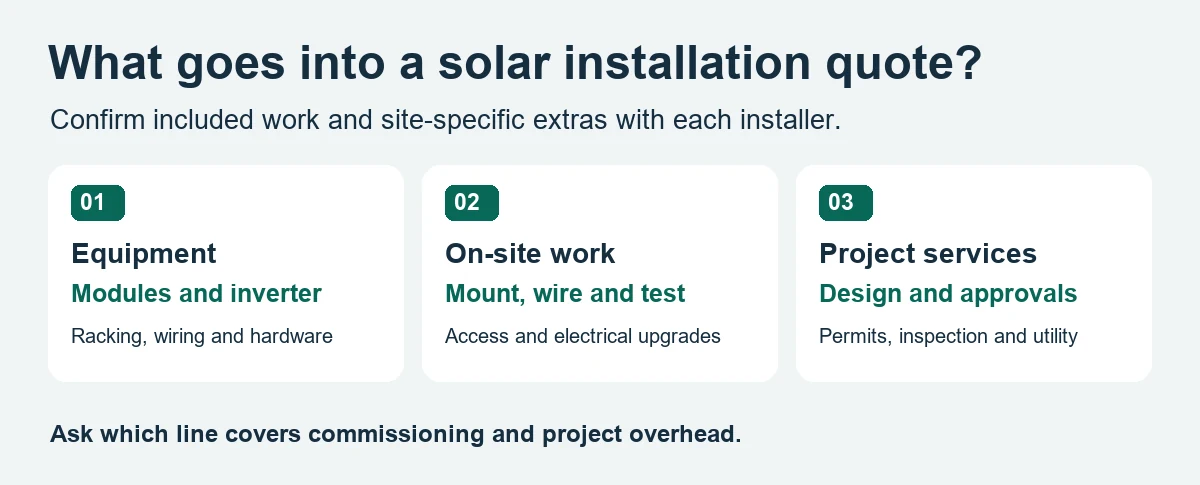
An installed solar quote typically covers modules, solar inverters, mounting and electrical hardware, field labor, and the work needed to obtain approvals and commission the system. Ask the installer to identify site upgrades separately, since those costs depend on your building and utility connection. DOE solar cost categories
| Quote item | What to verify |
|---|---|
| Modules | Model, count, rated watts, and total DC system size |
| Inverter and monitoring | Inverter model, AC rating, monitoring equipment, and any recurring service fees |
| Racking and electrical materials | Roof attachments or ground supports, wiring, conduit, grounding, and disconnects |
| Field labor | Mounting, wiring, testing, and whether lift or scaffolding is included |
| Engineering and approvals | Design, structural review, permit fees, inspections, and utility interconnection paperwork |
| Site work | Roof repairs, electrical service upgrades, trenching, and any utility-required work |
| Contractor overhead and margin | Whether project management, overhead, and profit are bundled into the cash price |
A steep roof or several small roof planes can increase crew time and require more mounting hardware. A long cable run adds materials and electrical work. If the installer flags the main service panel as a potential upgrade, ask for the cost and when the installer will confirm whether it is required.
How do you compare two solar installation quotes?
Compare the cash price for the same DC system size and included work. Divide that price by the array’s rated DC watts. Price batteries and optional work separately, and compare loan fees and total payments on their own terms.
Suppose both installers quote an 8 kWdc rooftop array. Quote A costs $22,400 and excludes a required $2,000 electrical service upgrade. Quote B costs $24,000 and includes that upgrade. With the same required work included, A totals $24,400 or $3.05/Wdc, and B totals $24,000 or $3.00/Wdc. These figures illustrate the comparison method.
Check the residential roof layout, inverter sizing, and workmanship warranty coverage before choosing between similar totals. If the arrays differ in layout or shading, compare their estimated annual generation in kWh using the same assumptions.
For a bulk module quote, send the destination, order quantity, desired wattage and dimensions, and any market-specific documentation requirements. Ask suppliers to state the named delivery point and which charges the buyer pays. Honray Energy’s range includes standard and OEM solar panels.
Comparing 5kW, 8kW, 10kW and 25kW Solar System Cost (With & Without Battery Storage)
A 5kW, 8kW, 10kW, or 25kW solar system cost quote is only comparable when every proposal uses the same DC capacity basis, location, currency, and included scope. Calculate PV cost per watt from the defined PV price divided by rated array watts, and separate battery storage from the base PV total so you can see both hardware and installation costs clearly.
| System size | Module count (at 400W) | PV-only benchmark ($2.57–$2.95/W) | Battery storage & equipment notes |
|---|---|---|---|
| 5 kW (small home) | 12–13 panels | $12,850 – $14,750 | Often paired with 5–10 kWh LiFePO4 backup; see our 5kW home solar system |
| 8 kW (typical home) | 20 panels | $20,560 – $23,600 | DOE Q1 2026 baseline size; add 10–15 kWh storage for overnight autonomy |
| 10 kW (larger home) | 25 panels | $25,700 – $29,500 | The cost of a 10kW solar system with battery storage adds usable kWh capacity, hybrid inverter output, and backup transfer wiring |
| 25 kW (estate / small commercial) | 62–63 panels | Compare commercial $/W quotes | Often uses higher-wattage modules and 3-phase inverters; see commercial solar systems |
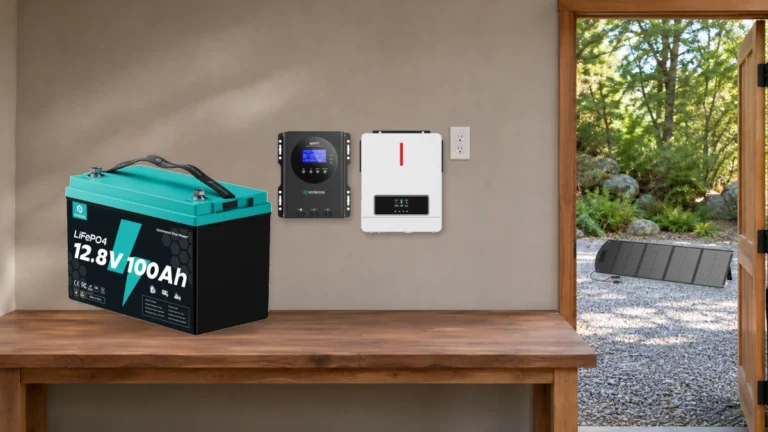
A 10kW off-grid solar power system or a hybrid home system with battery storage requires a separate storage and operating-mode assessment. Price usable battery energy (kWh), inverter output (kW), critical-loads subpanel work, and protection equipment against your required autonomy hours. Explore home solar systems with LiFePO4 battery storage or review our off-grid system planning page before requesting a dated, itemized quotation.
Frequently Asked Questions
How many solar panels make up an 8 kW or 10 kW system?
An 8 kWdc system uses 20 panels if each module is rated at 400 Wdc, while a 10 kWdc system uses 25 of those same 400 Wdc panels (or 18–20 higher-wattage 500–550 W commercial modules). Divide the target DC watts by your module’s nameplate rating and confirm the layout fits your usable roof area—our solar panel dimensions guide helps verify roof clearance.
How can I estimate my solar panel installation cost before requesting a quote?
Start by estimating the required system wattage from your monthly electricity bill or daily kWh consumption using our solar panel calculator. Then multiply that target kW size by local benchmark pricing ($/W) and request separate itemized lines for any LiFePO4 battery storage or main-panel upgrades.
Is there a standard labor cost per solar panel?
Solar installation labor has no universal cost per panel. Crew access, roof geometry, cable routing, and electrical work all affect the estimate. For an itemized comparison, ask which tasks the field-labor line covers and which are listed under engineering or approvals.
How should I compare solar quotes with a battery?
Ask for a separate installed battery price with the battery capacity, power rating, and backup scope specified. Compare the PV-only totals first. For the storage line, confirm whether the quoted capacity is usable and whether backup controls and electrical work are included.
What is the difference between solar cost per watt and cost per kilowatt-hour?
Solar installation cost per watt measures the upfront price divided by the array’s rated DC capacity. Cost per kilowatt-hour (used for residential electric bill payback and utility-scale solar LCOE comparisons) measures the cost of energy produced or consumed over time, which depends on local irradiance, degradation, and lifetime maintenance.
What is the typical price per watt for wholesale solar panels vs. installed residential systems?
Wholesale solar module prices cover only the factory hardware (FOB/CIF) and scale with order volume, wattage tier, and cell technology, whereas installed residential prices ($2.57–$4.00/W in U.S. benchmarks) bundle inverters, racking, labor, permitting, and contractor margin. Request a formal quotation from Honray wholesale solar panels for container or distributor pricing.
Do higher-wattage panels like 500W–550W reduce total installation cost?
Yes, for ground mounts and commercial roofs, using higher-wattage modules reduces the total panel count, mounting rails, clamps, and string wiring labor needed to reach a target kW size. For residential roofs with tight setbacks or vents, check our solar panel dimensions guide to confirm larger modules fit efficiently.
How much does adding LiFePO4 battery storage increase solar installation cost?
Adding LiFePO4 storage increases project cost based on usable kWh capacity, hybrid inverter sizing, and backup transfer switchgear—for instance, pairing a 5 kW array with 5.12 kWh to 15.36 kWh of 51.2V 100Ah Server Rack LiFePO4 batteries or a 51.2V 314Ah (16.07 kWh) wheeled ESS unit. Compare itemized PV-only and battery-added quotes separately.
What affects custom OEM solar panel pricing and lead times?
Custom module cost depends on power range—from small custom panels (0.1W–100W) for IoT devices to standard and C&I modules (100W–700W)—plus lamination materials (glass vs. ETFE), connectors, and certification scope. Standard sample lead times run 7–15 days, standard bulk orders 15–25 days, and custom or full-container orders 25–40 days, with MOQ confirmed on the formal quotation.
Are solar panel warranties included in the purchase price?
Yes, factory module warranties are built into the panel price—Honray standard rigid modules carry a 12-year product warranty and a 25–30 year linear power warranty (≥80%), while flexible/portable lines carry model-specific terms. Always confirm whether site removal labor and replacement shipping are excluded in your installer’s contract.
OEM & ODM Customization
100% Dual EL Tested
Export to 50+ Countries
TÜV · UL · CE · UN38.3
Looking for wholesale pricing or custom OEM/ODM solutions?
Connect directly with our engineering team for a tailored quote within 24 hours.