
How to Charge a LiFePO4 Battery: Solar MPPT vs AC Charger Settings
To charge a LiFePO4 battery, use a compatible solar charge controller or AC-powered battery charger and follow the battery manufacturer’s voltage, current and temperature limits. An MPPT controller charges from solar panels as sunlight allows. An AC charger converts power from a wall outlet, shore connection or compatible generator into regulated DC charging power.
Key Takeaways
- Check the battery manual for absorption voltage, maximum charge current and permitted charging temperature before choosing a preset.
- On a solar MPPT, verify both the panel array’s input ratings and the controller’s battery-side settings.
- With solar and AC charging the same bank, check the combined current with all loads switched off.
Table of Contents
- Solar MPPT vs AC charging at a glance
- Which LiFePO4 charging settings should you use?
- How to charge a LiFePO4 battery with solar MPPT
- How to charge a LiFePO4 battery with an AC charger
- Can solar and AC charge a LiFePO4 battery at the same time?
- How long does it take to charge a 100 Ah LiFePO4 battery?
- Why is the LiFePO4 battery charging slowly or showing zero amps?
- Frequently asked questions
- Can I use a lead-acid charger for a LiFePO4 battery?
- Can I charge LiFePO4 below freezing?
- Can a generator charge a LiFePO4 battery?
- Can a solar panel charge a LiFePO4 battery directly?
- Does a LiFePO4 battery need to reach 100% after every charge?
- Why does my LiFePO4 battery monitor show less than 100% when the charger says it is done?
- Can I leave an AC charger connected to a LiFePO4 battery overnight?
- Can a 12 V charger charge a 24 V LiFePO4 battery bank?
- Why does the MPPT show a higher voltage than the LiFePO4 battery terminals?
- Can I charge a LiFePO4 house battery while driving?
Solar MPPT vs AC charging at a glance
Choose solar MPPT when you want to recharge from panels throughout the day. Use an AC charger when an outlet or shore connection is available and you need a more predictable charging window. Both devices must follow the same battery limits, even when their menus use different names for the charging stages.
| Solar MPPT controller | AC battery charger |
|---|---|
| Source. DC from solar panels. | Source. AC from an outlet, shore connection or compatible generator. |
| Input. Check array voltage, current and startup requirements. | Input. Check AC voltage, frequency and supply capacity. |
| Output. Set battery voltage, profile and maximum DC current. | Output. Match the battery voltage and profile. Check the DC current rating. |
| Charge time. Sun, shade, charge stage and loads affect the rate. | Charge time. The current setting, charge stage and loads affect the rate. |
| Typical use. Daily off-grid charging. | Typical use. Shore power or backup after poor solar days. |
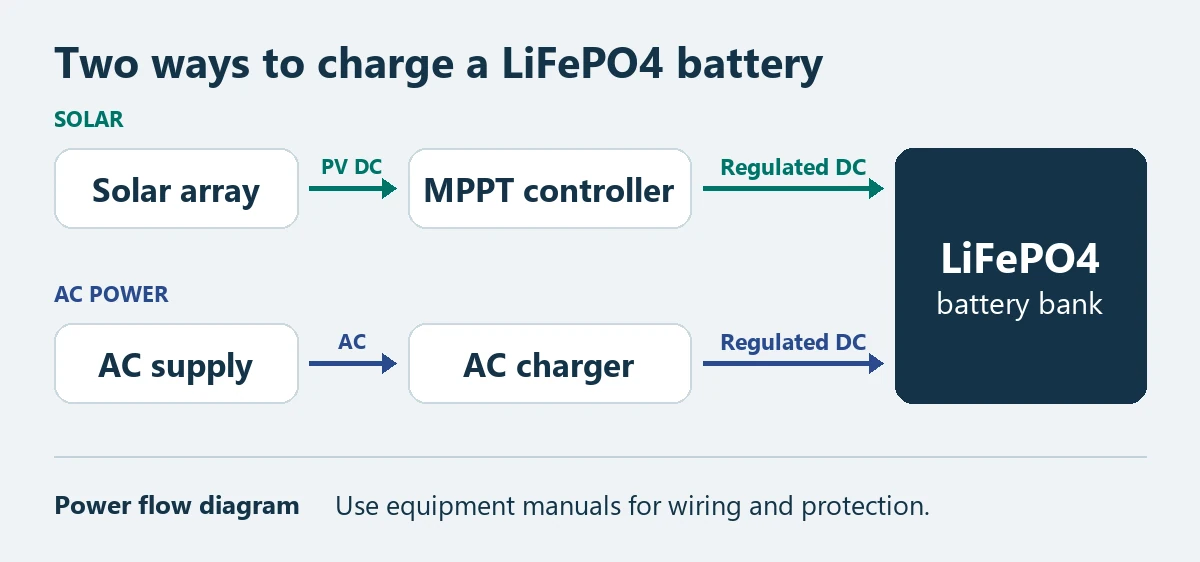
MPPT stands for maximum power point tracking. It helps the controller draw power from the array as conditions change. The solar controller then regulates the DC output to the battery. A standalone AC charger, RV converter/charger or inverter/charger can serve the AC side if its charge profile and output match the battery. To understand the differences between MPPT and PWM, read our guide on MPPT vs. PWM solar charge controllers.
Which LiFePO4 charging settings should you use?
Use the values for your exact battery or bank. Start with the model number and nominal voltage, then look up the recommended charging profile, the maximum continuous charge current, and the permitted battery temperature during charging. A battery management system (BMS) can interrupt charging at a protection threshold. Configure the chargers to operate within the battery’s normal limits.
| Charger setting | What to enter or verify |
|---|---|
| Battery type and system voltage | Choose a compatible LiFePO4 preset or an approved custom profile. Confirm the nominal bank voltage on the charger. |
| Bulk/absorption voltage | Enter the manufacturer’s target. A controller may call this boost voltage. During bulk, available current brings the battery up to the target. During absorption, voltage holds near the target as current tapers. |
| Absorption end condition | Use the specified time or end-current threshold where supported. Follow the battery maker’s balancing instructions. |
| Maximum charge current | Set a limit within the battery, equipment and installation ratings. Check the sum if more than one charger can operate. |
| Float or storage | Follow the battery maker’s guidance. A charger may omit float or use a lower maintenance or storage voltage. |
| Equalization and reconditioning | Disable lead-acid equalization, desulfation and reconditioning modes. |
| Temperature compensation and charge cutoff | Disable lead-acid voltage compensation. Configure or verify the separate battery-temperature protection for charging. |
For a 24 V or 48 V-class system, confirm the actual bank voltage and the charging limits for that model or approved series configuration. For a rack battery communicating with an inverter/charger, follow the approved integration guide and confirm the charger is receiving the BMS charge limits.
How to charge a LiFePO4 battery with solar MPPT
Match the panels to the controller’s PV input and the battery to its DC output. Confirm both sides before bringing the array online.
- Check the solar array’s cold-weather open-circuit voltage (Voc) against the controller’s absolute PV voltage limit. Use the panel temperature coefficient and the site design temperature. Verify the array’s operating and startup voltage, permissible input current and array sizing rules in the controller manual.
- Follow the manufacturer’s installation and power-up order with the PV supply isolated as directed.
- Confirm the detected bank voltage and select the correct battery profile. Set the charge-current ceiling and check absorption, float and equalization. If the MPPT uses a low-temperature cutoff, confirm it receives valid battery-temperature data.
- Enable PV per the manual and check the first charge cycle. Read PV voltage, battery voltage, output current and charge stage. If the controller shows output but a battery monitor reports less current entering the bank, check what the active DC loads are drawing.
How to charge a LiFePO4 battery with an AC charger
Use an AC-powered charger that supports your battery’s voltage class and charging profile. Check the DC output current on its label or settings screen. That output current is the figure to compare with the battery’s charge-current limit.
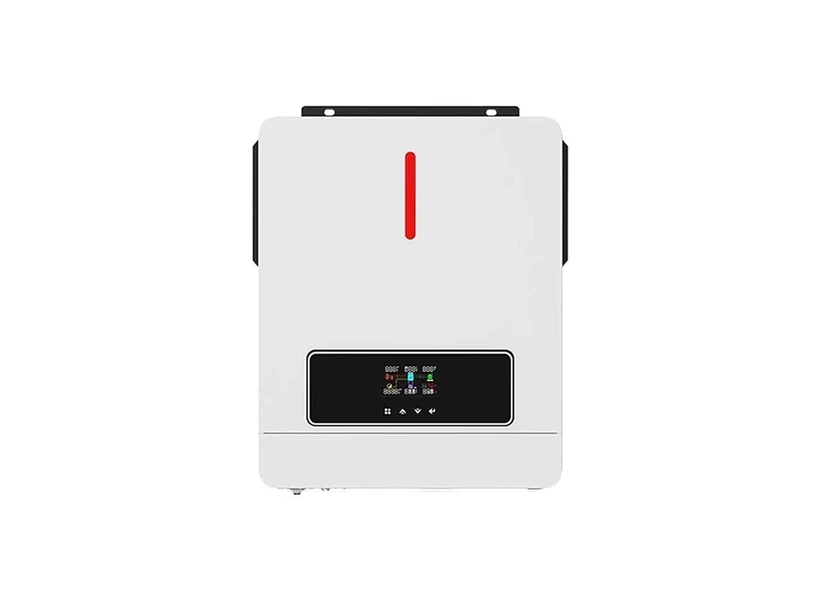
Product shown: Honray all-in-one solar inverter charger. This is an example of equipment with a built-in AC charger. Check the battery voltage and charging profile for the specific model.
- Match the charger’s AC input voltage and frequency to the available supply. For a fixed converter or inverter/charger installation, follow the equipment’s wiring and protection requirements.
- Follow the charger’s connection sequence with the supply isolated as directed. Use the approved DC leads or installed wiring and verify polarity.
- Select the compatible LiFePO4 mode and set the output current as allowed by the battery and installation. On an inverter/charger, check the AC input limit separately. A shore-power input limit and a DC battery charge-current limit control different parts of the system.
- Watch voltage, current and charge stage during the first session. If the unit stays connected after charging, verify how it handles standby or storage and whether that behavior suits the battery.
Can solar and AC charge a LiFePO4 battery at the same time?
Yes, if the equipment and battery support it and the combined charge current stays within the bank’s limits. Set each charger for the same battery’s requirements. Check any coordination features and confirm that battery temperature protection can stop both sources when required.
Suppose a 100 Ah battery permits 40 A of total charge current. A solar controller limited to 20 A and an AC charger limited to 30 A could together supply 50 A when loads are off. If the equipment permits, limit one source so the sum is within 40 A, or use a supported shared current limit or source-priority setting. A daytime load may switch off without warning, so size the limits for the no-load case.
How long does it take to charge a 100 Ah LiFePO4 battery?
From 30% to 90% state of charge (SOC), a nominal 100 Ah battery needs about 60 Ah of net charge. At a steady 20 A into the battery, that is about 3 hours. If the charger supplies 20 A and DC loads draw 5 A, the net is 15 A and the same estimate becomes 4 hours.
For the solar estimate, start with power measured or estimated at the controller. For example, 150 W at the PV input, with an assumed 95% conversion efficiency and 14.0 V at the battery side, yields about 10.2 A before subtracting any loads. With a 5 A load, about 5.2 A reaches the battery in that moment. Sunlight and charge current vary through the day, so that snapshot cannot predict a full solar recharge. Taper near the charge target and equipment limits can also extend the time.
Why is the LiFePO4 battery charging slowly or showing zero amps?
Start with the charger stage, battery temperature and BMS status. The source may be delivering less power, the battery may be tapering current, or the battery may have paused charging for protection.
| What you see | First checks |
|---|---|
| Solar controller shows PV voltage but no charging | Check whether PV voltage meets the controller’s startup requirement, then check shade, charge stage, battery temperature and BMS status. |
| Charger reports output, but battery current is low | Check active loads and compare output current with the battery monitor’s net current. |
| Charging stops as voltage rises | Check the stage display, battery fault history and cell-voltage information if available. Repeated BMS trips warrant a review of charger settings, cell balance and sensing. |
| Charger cannot detect a deeply discharged battery | Check the battery maker’s BMS recovery procedure and whether the charger supports it. Contact the maker if the documented procedure fails. |
For equipment selection, compare Honray LiFePO4 solar batteries and request charging specifications for the exact model. Include the bank voltage, charger models and lowest expected battery temperature.
Frequently asked questions
Can I use a lead-acid charger for a LiFePO4 battery?
Use an existing charger only if its documented or measured profile meets the battery manufacturer’s requirements and incompatible modes can be disabled. Check absorption, float, maximum current and any automatic equalization, reconditioning or desulfation cycle. A dedicated LiFePO4 profile is easier to verify.
Can I charge LiFePO4 below freezing?
Charge only within the exact battery model’s permitted charging temperature range. Some limits are above freezing. A self-heating battery may have a documented cold-start procedure. Check its manual for when the cells can accept charge.
Can a generator charge a LiFePO4 battery?
Yes. Use a generator as the AC input to a compatible battery charger or inverter/charger. Confirm the generator’s voltage, frequency and continuous capacity against the charger’s input requirements. For an inverter/charger, account for any AC loads sharing the generator supply.
Can a solar panel charge a LiFePO4 battery directly?
Use a compatible charge controller between a bare solar panel and a LiFePO4 battery. For a portable power station with a built-in controller, connect a compatible panel to the station’s specified solar input and verify its voltage and current limits.
Does a LiFePO4 battery need to reach 100% after every charge?
Daily charging to 100% is generally unnecessary for LiFePO4. Follow the battery maker’s recommended schedule for full charges or time at absorption voltage. Some BMS designs balance cells near the top of charge, so ending every session early can prevent the battery from getting the balancing time its manufacturer specifies.
Why does my LiFePO4 battery monitor show less than 100% when the charger says it is done?
The charger and battery monitor can use different criteria to decide when a charge is complete. On a shunt-based monitor, verify the charged voltage, tail current and detection time settings against the monitor and battery instructions. A charging cycle can end before the monitor meets its synchronization criteria.
Can I leave an AC charger connected to a LiFePO4 battery overnight?
You can leave a compatible charger connected overnight if the battery and charger manuals permit unattended use and the installation meets their requirements. Check the mode the charger enters after absorption and whether it will restart automatically. The battery’s charging temperature limits still apply while the charger is connected.
Can a 12 V charger charge a 24 V LiFePO4 battery bank?
A charger with only a 12 V battery output cannot charge a 24 V LiFePO4 bank through the bank terminals. Use a charger that supports the bank’s nominal voltage and can meet its specified charging profile.
Why does the MPPT show a higher voltage than the LiFePO4 battery terminals?
When charging current is flowing, resistance in the cables, fuse holders or connections can make the voltage at the MPPT higher than at the battery. Compare the two readings while the system is charging. If the drop is excessive, check wiring size and connections against the equipment manual before changing the absorption target.
Can I charge a LiFePO4 house battery while driving?
Yes, with an alternator-charging setup approved for the vehicle and battery. A compatible DC-to-DC charger can limit alternator draw and apply the house battery’s LiFePO4 charge profile. Check the vehicle charging system, the battery’s permitted charge current and the DC-to-DC charger’s input and output ratings.
OEM & ODM Customization
100% Dual EL Tested
Export to 50+ Countries
TÜV · UL · CE · UN38.3
Looking for wholesale pricing or custom OEM/ODM solutions?
Connect directly with our engineering team for a tailored quote within 24 hours.