
What Affects Solar Panel Lifespan? Degradation, Service Life and Replacement
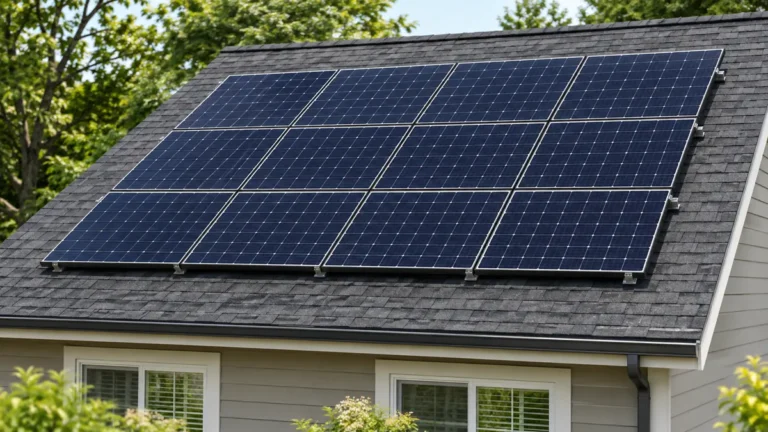
Solar panel lifespan depends on how the module is built, the climate it operates in, how it was installed, and whether it suffers physical or electrical damage. For fixed solar panels, 25 to 35 years is a useful planning range. A panel can serve longer if it remains safe and produces enough electricity for your needs. Storm damage or an electrical fault can shorten that service life.
Key Takeaways
- Fixed glass-and-aluminum solar panels typically serve 25 to 35 years, often retaining ≥80% of original STC power under a 25–30 year linear performance warranty (with Honray standard rigid modules carrying a 12-year product warranty and 25–30 year linear power warranty).
- Lightweight flexible ETFE solar panels have a shorter expected service life (for example, 5–10 years on Honray flexible solar modules under proper mounting without foot traffic).
- Check inverter downtime, shading, soiling, and loose MC4 connections before assuming lower kWh output is caused by irreversible cell aging.
Table of Contents
- How long do solar panels last in practice?
- What does 0.5% annual degradation mean?
- What shortens solar panel service life?
- How can you tell whether the panels are aging?
- When should you replace solar panels?
- Frequently Asked Questions
- Do solar panels stop working when the warranty ends?
- Can you replace just one solar panel?
- Can cleaning restore lost solar panel output?
- Do flexible and portable solar panels have the same lifespan?
- Does 80% of rated power mean a solar panel needs replacing?
- Does a drop in output on a hot day mean a solar panel is degrading?
- Should you replace solar panels after a hailstorm?
- Can you replace an inverter and keep the old solar panels?
- Can you reuse old solar panels after replacing the roof?
- What does IEC 61215 qualification tell you about solar panel lifespan?
How long do solar panels last in practice?
Many fixed crystalline-silicon panels can still generate electricity after 25 years. The U.S. Department of Energy’s homebuilder guide says modules are expected to last at least 25 years while retaining more than 80% of their original power. That figure describes an expectation for module power under comparable conditions. Each installation has its own operating history.
Degradation is the loss of a panel’s ability to produce power under the same test conditions as it ages. Service life is how long you can use the panel safely while it meets your energy needs. A performance warranty sets the minimum power the manufacturer promises at specified points in time, under the written terms. The product warranty covers the defects set out in its own terms.
What does 0.5% annual degradation mean?
A panel that loses 0.5% of its original 400 W rating each year would lose 2 W a year. Under that simple assumption, its power would be about 350 W after 25 years, or 87.5% of its starting rating, under the same test conditions. A historical review by Dirk Jordan and Sarah Kurtz found a median degradation rate of 0.5% per year across published measurements of modules and systems. Individual panels can age at different rates, and the rate can change over time.
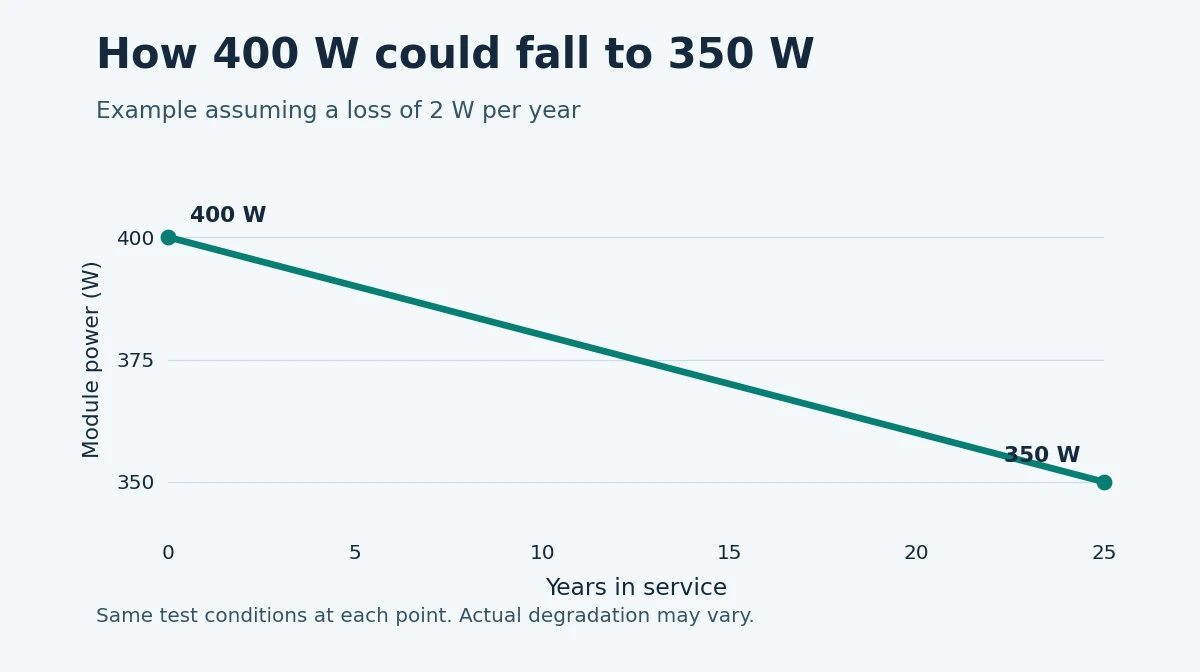
The example uses watts, which measure power. Your monitoring app usually reports kilowatt-hours, which measure energy generated over time. Cloud cover, new shade, and inverter downtime can reduce annual kilowatt-hours even when the modules are in good condition.
What shortens solar panel service life?
Temperature changes and moisture. The daily cycle of warming and cooling puts repeated stress on solder joints and the thin metal ribbons that connect the cells. If moisture enters a module, it can corrode electrical contacts. UV exposure can also age some of the polymers used to protect the cells. The effect depends on the materials and the conditions at the site.
Mechanical loads and handling. Hail can break front glass, and wind or snow puts loads on the module and its mounts. Poor handling or incorrect clamping can contribute to cell cracks that are difficult to see through the glass. For a new array, use the module maker’s mounting instructions and check that the design accounts for local wind and snow loads.
Module materials and construction. The glass, encapsulant that surrounds the cells, rear layer, and electrical connections all affect how a module holds up. When comparing replacement modules, ask for the datasheet, mounting instructions, and warranty for the exact model. For exposed locations, ask what testing covers the conditions the panels will face.
How can you tell whether the panels are aging?
Start with the shape of the drop in your monitoring data. Compare the same months across years and account for changes in sunlight, shading, and system downtime. If your system shows panel- or string-level readings, compare groups with similar orientation and sun exposure. A string is a group of panels wired in series. The pattern helps you decide where to investigate first.
| What you see | What to check first |
|---|---|
| A slow decline across comparable months | Compare sunlight and look for changes in shade or soiling. If the trend persists, ask an installer to assess module condition and output. |
| One panel or string suddenly trails its peers | Check monitoring alerts and look for new shading from a safe location. Have the installer check the affected module, wiring, and any optimizer or microinverter. |
| The whole array drops out or the app stops reporting | Check the inverter status, monitoring connection, and outage history. Ask the installer to confirm whether generation stopped or only the reporting failed. |
| Cracked glass, burn marks, or repeated electrical fault alerts | Keep clear of damaged equipment and arrange a professional inspection. Have the installer determine whether the affected equipment can stay in service. |
If the cause is still unclear, ask a qualified solar installer to review the monitoring history and inspect the equipment. They can use electrical tests to assess power and insulation, and thermal imaging to help locate abnormal heating. Save dated photos, inverter alerts, and the module model and serial number if you may need to make a warranty claim.
When should you replace solar panels?
Replace a panel when an inspection finds it unsafe to keep in service and a suitable repair is unavailable, or when the extra energy from replacing it justifies the cost. For a working array, compare what it produces today with what you need from the site. Account for any roof work that would require removing the array anyway.
- Keep the array if it remains safe and its production still meets your needs. Use recent monitoring records to estimate what keeping it will deliver.
- Repair the affected part if the installer traces the loss to an inverter, connector, or other replaceable component. If a module has failed, ask about a compatible replacement and review the warranty before approving the work.
- Consider a full upgrade if you need more energy from limited roof space or are already planning a roof replacement. Ask for the expected additional annual kWh and a quote that includes removal, any racking or inverter changes, labor, and handling the old equipment.
For an upgrade, get two estimates using the same roof and weather assumptions. If the current system is expected to deliver 4,500 kWh per year and a new system is expected to deliver 6,000 kWh, the upgrade adds an estimated 1,500 kWh per year. Its value depends on how much of the added generation you use on site and what you receive for exported power. For retired modules, ask the installer which local programs accept solar panels and whether any working units qualify for reuse.
Frequently Asked Questions
Do solar panels stop working when the warranty ends?
Solar panels can keep generating electricity after the performance warranty ends. The end date marks the end of the coverage described in the warranty. Use an inspection and recent production history to decide whether the array can keep serving your home.
Can you replace just one solar panel?
Yes, if your installer can source a panel that works with the existing array. The installer should check voltage and current, inverter or optimizer limits, connector compatibility, and the module’s size and approved clamp positions. Ask them to confirm fit using the replacement model’s datasheet and installation manual.
Can cleaning restore lost solar panel output?
Cleaning can recover output lost to dirt on the glass. Permanent losses from corrosion, cracked cells, or other material damage require separate assessment. Check the manufacturer’s care instructions and arrange professional cleaning if the panels are difficult to reach safely.
Do flexible and portable solar panels have the same lifespan?
No, flexible and portable solar panels generally have a shorter service life than glass-and-aluminum rigid panels—for example, Honray’s ETFE flexible solar panels specify a 5–10 year expected service life with a 30° maximum curve and no foot traffic, compared with the 25–30 year linear power warranty on standard monocrystalline rigid modules. Always confirm the exact model’s warranty sheet (or custom OEM module specs) rather than assuming fixed-glass timelines apply.
Does 80% of rated power mean a solar panel needs replacing?
A solar panel at 80% of its original rated power can remain in service if it is safe and still meets the site’s energy needs. If rated power falls below the minimum for the panel’s age, check the performance warranty and ask the installer how the manufacturer verifies a claim.
Does a drop in output on a hot day mean a solar panel is degrading?
A solar panel can produce less power on a hot day because its cells are warmer. That immediate temperature effect can reverse as the cells cool. To check for long-term degradation, compare output under similar sunlight and cell temperatures.
Should you replace solar panels after a hailstorm?
Arrange an inspection if you see damage from the ground or notice a sudden production drop or fault alert after hail. Some damage is hard to spot from the ground. A qualified installer can inspect the panels and mounts and run electrical tests to determine which equipment needs repair or replacement.
Can you replace an inverter and keep the old solar panels?
Yes, you can replace a failed inverter and keep the solar panels if they are safe and compatible with the replacement inverter. Ask the installer to check the array’s voltage and current against the new inverter’s input limits. For a system with power optimizers, confirm that the replacement inverter supports them.
Can you reuse old solar panels after replacing the roof?
Yes, if the solar panels pass inspection and the installer can remount them on the new roof. Before roofing work begins, ask for a quote that includes removing and reinstalling the array and replacing any mounting parts that cannot be reused. Compare that cost with installing new equipment while the array is off the roof. U.S. Department of Energy rooftop solar replacement guide
What does IEC 61215 qualification tell you about solar panel lifespan?
IEC 61215 qualification shows that a module design passed the applicable tests for long-term outdoor use. The standard leaves the expected service life to be assessed from the module design, site conditions, and how the panels will operate. Ask for the test documentation for the exact model you intend to buy.
OEM & ODM Customization
100% Dual EL Tested
Export to 50+ Countries
TÜV · UL · CE · UN38.3
Looking for wholesale pricing or custom OEM/ODM solutions?
Connect directly with our engineering team for a tailored quote within 24 hours.