
Solar Panel Buying Checklist: How to Compare Specifications and Suppliers
Before you buy solar panels for a project or resale, confirm that the exact model fits the installation and meets the destination market’s requirements. Then compare suppliers on what they can document for that model, how they handle defects, and what it costs to receive the order at the same destination.
Two quotes for 450 W panels can describe modules with different dimensions, voltage limits, connector types, and warranty terms. Ask both suppliers to quote against the same requirements, and have your system designer clear the proposed module before you compare price.
Solar panel buying checklist
- Match the full model code and suffix across the quote, current datasheet, module label, and applicable certificate or listing.
- Clear the layout, mounting and electrical checks before approving a sample or placing an order.
- Agree who handles warranty claims and what records come with the production lot.
- Compare delivered cost per watt at the same destination and on the same tax basis.
Table of Contents
- Start with the installation and the order
- Compare solar panel specifications on the same basis
- Compare module wattage against the layout
- Verify the model, certificate and warranty provider
- Tie the approved sample to the production lot
- Compare landed cost per watt at the same destination
- What to request in every solar panel quote
- Frequently Asked Questions
- What is the first thing to check when buying solar panels?
- Should I buy the highest-wattage or highest-efficiency solar panel?
- Can two 450 W solar panels have different voltage or current ratings?
- How can I verify that a solar panel certificate covers my order?
- Should I buy a sample before placing a bulk solar panel order?
- Who pays shipping and labor on a solar panel warranty claim?
- How do I compare solar panel quotes that use different shipping terms?
- What MOQ and production lead times should B2B buyers expect for bulk or custom solar panels?
- What warranty terms should be verified on a wholesale solar panel datasheet?
- Can Honray supply both small custom IoT panels and standard C&I wattage modules?
Start with the installation and the order
Send each supplier the application, destination market, quantity, delivery location and required date. Attach the installation drawing or usable dimensions, plus the solar inverter or charge controller model if selected. For a distributor stocking modules for several installers, specify which mounting systems and equipment the stock needs to support.
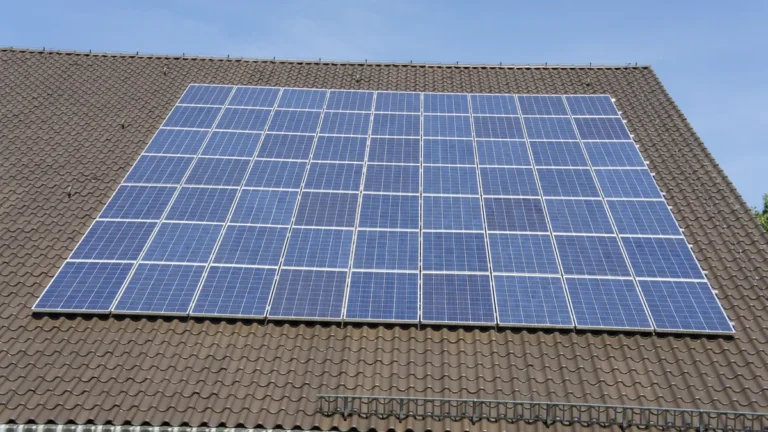
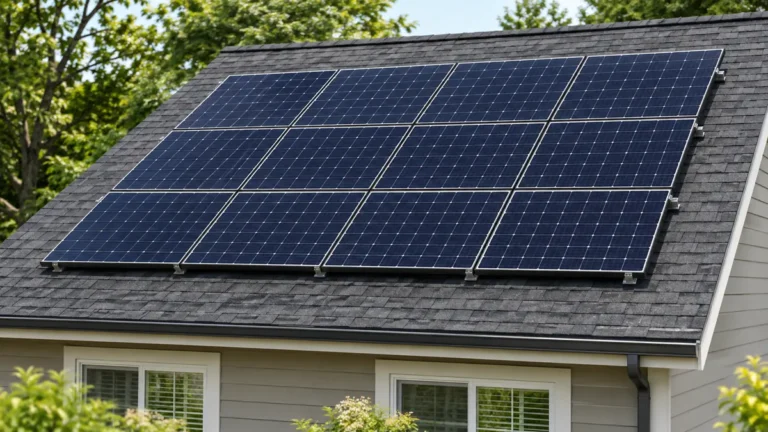
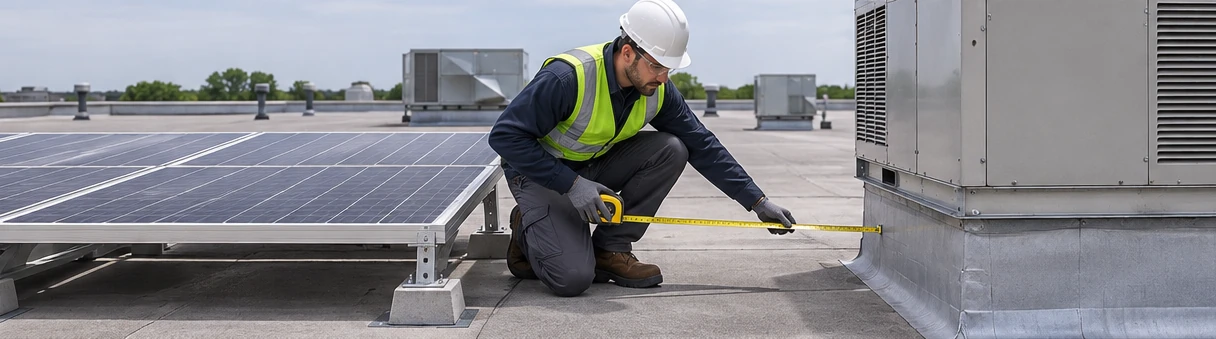
Measure the space available for whole modules after allowing for obstructions, access paths and required clearances. Check weight, frame depth, clamp zones and cable reach against the actual mounting plan. A module can fit within the roof outline and still conflict with an HVAC curb or place its clamps outside the approved zones. Solar panel dimensions and layout planning
Compare solar panel specifications on the same basis
Ask for a dated datasheet and installation manual for each quoted model. Start with one row per exact model, including suffixes, and keep each value tied to its test conditions. Standard Test Conditions (STC) use 1,000 W/m² irradiance, a 25°C cell temperature and a reference AM1.5 spectrum. STC power provides a common nameplate rating. Site energy yield depends on conditions such as irradiance, module temperature and shading.
| Datasheet field | What to compare | How it affects the order |
|---|---|---|
| Rated power (Pmax) and power tolerance | Watts at STC and the permitted range around nameplate power | Use the quoted rating for total nameplate capacity. Agree on the tolerance and how the supplier will demonstrate it. |
| Module efficiency and outer dimensions | Efficiency at the same rating conditions, length, width and frame depth | Check how many complete modules fit and how much rated power that layout gives you. |
| Voc and Vmp | Open-circuit voltage and voltage at maximum power | Have your designer check cold string Voc against the equipment’s maximum DC input and operating Vmp against the MPPT voltage range. |
| Isc and Imp | Short-circuit current and current at maximum power | Check the equipment’s short-circuit and operating input limits separately, accounting for parallel strings and the applicable design method. |
| Temperature coefficients | Coefficients for Pmax and Voc, with units such as %/°C or V/°C | Use the power coefficient for output estimates and the Voc coefficient for the cold-voltage check. |
| Mounting and connections | Weight, clamp zones, approved load configurations, cable length and connector make and model | Confirm the module works with the racking, specified load conditions and approved mating connectors. |
| Electrical limits | Maximum system voltage and maximum series fuse rating | Give these limits to your designer for protection and string layout checks. |
MPPT means maximum power point tracking. Ask your designer to check the proposed series and parallel grouping, including operating voltage when the modules are hot. Some equipment specifies a separate startup voltage. For bifacial modules, note the front-side rating and ask which rear irradiance assumptions support any quoted gain. Carry those assumptions into the energy estimate.
Compare module wattage against the layout
If a layout fits ten 450 W modules, it gives you 4.50 kW of rated DC capacity. If the same usable space fits only eight larger 500 W modules, the layout gives you 4.00 kW. These are hypothetical STC totals. When you compare energy yield, model the actual layout and local operating conditions for each offer.
Verify the model, certificate and warranty provider
Start with the supplier’s legal name, the manufacturer, the production site and the company named on the warranty. A distributor can be the right counterparty if you can verify its access to the specified modules and you know who will handle a claim. Ask for the full certificate and model schedule where applicable. Cross-check the certificate number, holder, model suffix and any factory or construction details covered by the document.
IEC 61215 covers design qualification for terrestrial PV modules. IEC 61730 covers module safety qualification. IEC 61215 testing does not predict a specific service life. Check the destination market’s own requirements for your application. For example, an Australian project seeking Small-scale Renewable Energy Scheme eligibility should check the quoted model against the Clean Energy Council’s approved PV module list.
Request the written product warranty and performance warranty for the proposed model. Review the product warranty for covered defects and exclusions. For the performance warranty, record the guaranteed output schedule, its reference power and the test procedure for a claim. Then ask who pays for testing, freight, removal and reinstallation, and what remedy applies if the model is discontinued.
Tie the approved sample to the production lot
Use a sample to verify dimensions, mounting details, connector type, labels and packaging against the approved documents. Record the sample’s model and serial number. Put the agreed datasheet revision, drawing and substitution approval process in the purchase order so production can be checked against what you approved.
Agree on inspection scope before production or dispatch. Ask which modules will have flash-test records, which will receive electroluminescence (EL) inspection, and how the supplier will link results to serial numbers. Flash testing records electrical output under controlled conditions. EL images can reveal some cell cracks and inactive areas. Write down the sampling plan, acceptance criteria and remedy for a failed lot with the supplier or inspection provider.

At receiving, photograph packaging damage, reconcile quantities and match the model and serial numbers against the packing list. Record visible defects and keep the affected units separate until you agree on how to handle them. Check the notification deadline for freight damage and the process for receiving discrepancies before the goods ship.
Compare landed cost per watt at the same destination
Calculate landed module cost per watt by dividing the total cost to bring the modules to the agreed destination by their total quoted STC watts. Use the same currency and tax treatment. Include freight, insurance, duties, handling and inspection when applicable. Count each charge once and identify which costs are still estimates. For international quotes, record the trade term, named port or place, and rule version. Check the contract separately for payment milestones and acceptance terms.
In this example, both offers cover 100 compliant 450 W modules, or 45,000 W. The figures are hypothetical, in US dollars, and assume both orders arrive at the same warehouse.
| Cost item | Supplier A | Supplier B |
|---|---|---|
| Module subtotal | $9,000 | $9,500 |
| Added costs through warehouse delivery | $1,800 | $900 |
| Total landed module cost | $10,800 | $10,400 |
| Landed cost per STC watt | $0.240/W | $0.231/W |
Supplier A’s module subtotal is $500 lower. Once both orders are priced through warehouse delivery, Supplier B costs $400 less. If the models fit different quantities on the roof or require different mounting hardware, also compare the cost of the installed layouts. Keep estimated energy production and the warranty exposure visible alongside those costs.
What to request in every solar panel quote
Copy the request below into your request for quotation (RFQ). Give every supplier the same drawing, destination and deadline. Ask for a written response against each line so omissions are easy to spot.
- Quote the exact model and suffix, quantity, minimum order quantity, and sample and production lead times.
- Attach the current datasheet, installation manual, module label and applicable certificates or listing references.
- Confirm compliance with the stated dimensions, mounting, voltage, current and connector requirements. List any exceptions.
- Identify the seller, manufacturer, production site and warranty provider. Attach product and performance warranty terms and the claim procedure.
- Explain how the sample matches production. State what changes require buyer approval and provide an example of serial-linked inspection records.
- Confirm packaging, shipment schedule, delivery term with named place, inclusions, exclusions, quote validity and payment milestones.
- State the pre-shipment and receiving checks, acceptance criteria, damage reporting deadlines and remedies for nonconforming goods.
When requesting a quote for Honray Energy solar panels, share the application, destination, mounting envelope, equipment model and order quantity. Ask for the datasheet, applicable certificates and warranty terms for the proposed model.
Frequently Asked Questions
What is the first thing to check when buying solar panels?
Check whether the exact model fits the installation, works with the electrical equipment and qualifies for the destination market. A dated datasheet, installation manual and applicable model listing give you a starting point for all three checks.
Should I buy the highest-wattage or highest-efficiency solar panel?
Choose the module that gives the required capacity within your usable space and equipment limits. Higher efficiency can help when space is tight, but frame dimensions and the number of whole modules that fit determine your final layout.
Can two 450 W solar panels have different voltage or current ratings?
Yes. Two 450 W panels can have different Voc, Vmp, Isc and Imp values. Use the exact model’s datasheet when checking string voltage and current against inverter or charge controller limits.
How can I verify that a solar panel certificate covers my order?
Match the complete model code and suffix to the certificate and its model schedule. Verify the document with the issuer where possible, check factory scope if applicable, and confirm any required local listing for the exact model.
Should I buy a sample before placing a bulk solar panel order?
A sample is useful for checking fit, connectors, labels and agreed construction before you commit to a bulk order. Record the approved build and agree on production-lot inspections so the sample approval carries through to the shipment.
Who pays shipping and labor on a solar panel warranty claim?
The written warranty and sales agreement determine who pays for freight, diagnosis, removal and reinstallation. Ask the warranty provider to confirm those costs in writing and explain how to file a claim from your market.
How do I compare solar panel quotes that use different shipping terms?
Reprice each quote through the same destination in the same currency. Add applicable charges that the supplier excludes and use the same tax basis. Divide the resulting cost by the total STC watts for the quoted modules.
What MOQ and production lead times should B2B buyers expect for bulk or custom solar panels?
Minimum order quantities depend on the specific module line and are confirmed on the formal quotation; standard sample runs typically ship in 7–15 days, standard bulk orders in 15–25 days, and custom OEM or full-container shipments in 25–40 days. Review Honray wholesale solar panels for container options.
What warranty terms should be verified on a wholesale solar panel datasheet?
Confirm both product defect coverage and linear power output coverage separately—for example, Honray standard rigid monocrystalline solar panels carry a 12-year product warranty and a 25–30 year linear power warranty (≥80%), while flexible and portable lines carry model-specific terms.
Can Honray supply both small custom IoT panels and standard C&I wattage modules?
Yes—Honray manufactures small custom solar panels from 0.1 W to 100 W for IoT sensors and outdoor devices alongside standard and C&I solar modules from 100 W to 700 W, allowing OEM buyers to source custom dimensions and connectors from one factory.
OEM & ODM Customization
100% Dual EL Tested
Export to 50+ Countries
TÜV · UL · CE · UN38.3
Looking for wholesale pricing or custom OEM/ODM solutions?
Connect directly with our engineering team for a tailored quote within 24 hours.