
MPPT vs PWM: How to Choose a Solar Charge Controller
Choose MPPT when the solar array operates well above battery voltage, installation space limits panel capacity, or cable distance makes a higher-voltage array useful. PWM can suit a small, closely matched system where the daily load is modest and the lower purchase cost matters. Both choices still require correct battery charging settings and verified electrical limits.
For installers, distributors and equipment buyers, the useful comparison is the complete panel–controller–battery combination. A controller label alone cannot confirm compatibility. Start with the module datasheet, battery manual and expected operating conditions.
Table of Contents
- Key Takeaways
- MPPT vs PWM at a glance
- How do PWM and MPPT controllers work?
- When is MPPT worth the extra cost?
- When is PWM a reasonable choice?
- A worked example: why charging current differs
- Check these specifications before choosing a controller
- 1. Battery voltage and charging profile
- 2. PV voltage at the coldest and hottest conditions
- 3. Input current, output current and permitted PV power
- 4. Temperature, enclosure and service access
- Choose by application, then validate the sample
- Frequently Asked Questions
- How should buyers choose between an MPPT vs PWM solar controller for LiFePO4 batteries?
- Can a PWM controller charge a LiFePO4 battery?
- Does MPPT always deliver 30% more energy than PWM?
- Can an MPPT controller charge a higher-voltage battery from a lower-voltage panel?
- Will MPPT solve partial shading?
- Can I replace PWM with MPPT without changing the panels?
- What is the maximum PV Voc and wattage of Honray’s 60A MPPT solar charge controller?
- Can an MPPT controller step down high-voltage residential panels to charge a 12V battery?
- What size wire should you use between a 60A MPPT controller and the battery?
- Can you connect two MPPT solar charge controllers to the same LiFePO4 battery bank?
Key Takeaways
- MPPT separates panel operating voltage from battery charging voltage; PWM connects the array near battery voltage during charging.
- Compare maximum PV voltage, PV short-circuit current and battery-side charge current as separate limits.
- Check cold-weather open-circuit voltage and hot-weather operating voltage before approving a panel string.
- Choose the battery charging profile separately from the MPPT or PWM technology.
MPPT vs PWM at a glance
| Selection factor | PWM | MPPT |
|---|---|---|
| How it uses panel output | Pulls array voltage close to battery voltage during charging | Tracks a power point and converts the input to battery charging voltage |
| Panel matching | Needs an array designed to match the battery system | Allows greater voltage separation within model limits |
| Likely fit | Small, simple systems with adequate energy margin | Space-limited arrays, higher-voltage modules and longer PV cable runs |
| Cost decision | Often lower initial controller cost | Compare added controller cost with usable energy and wiring savings |
| Battery compatibility | Depends on available charge settings | Depends on available charge settings |
| Main checks | Array voltage matching, input current and charge profile | Cold Voc, operating voltage range, PV current and output current |
How do PWM and MPPT controllers work?
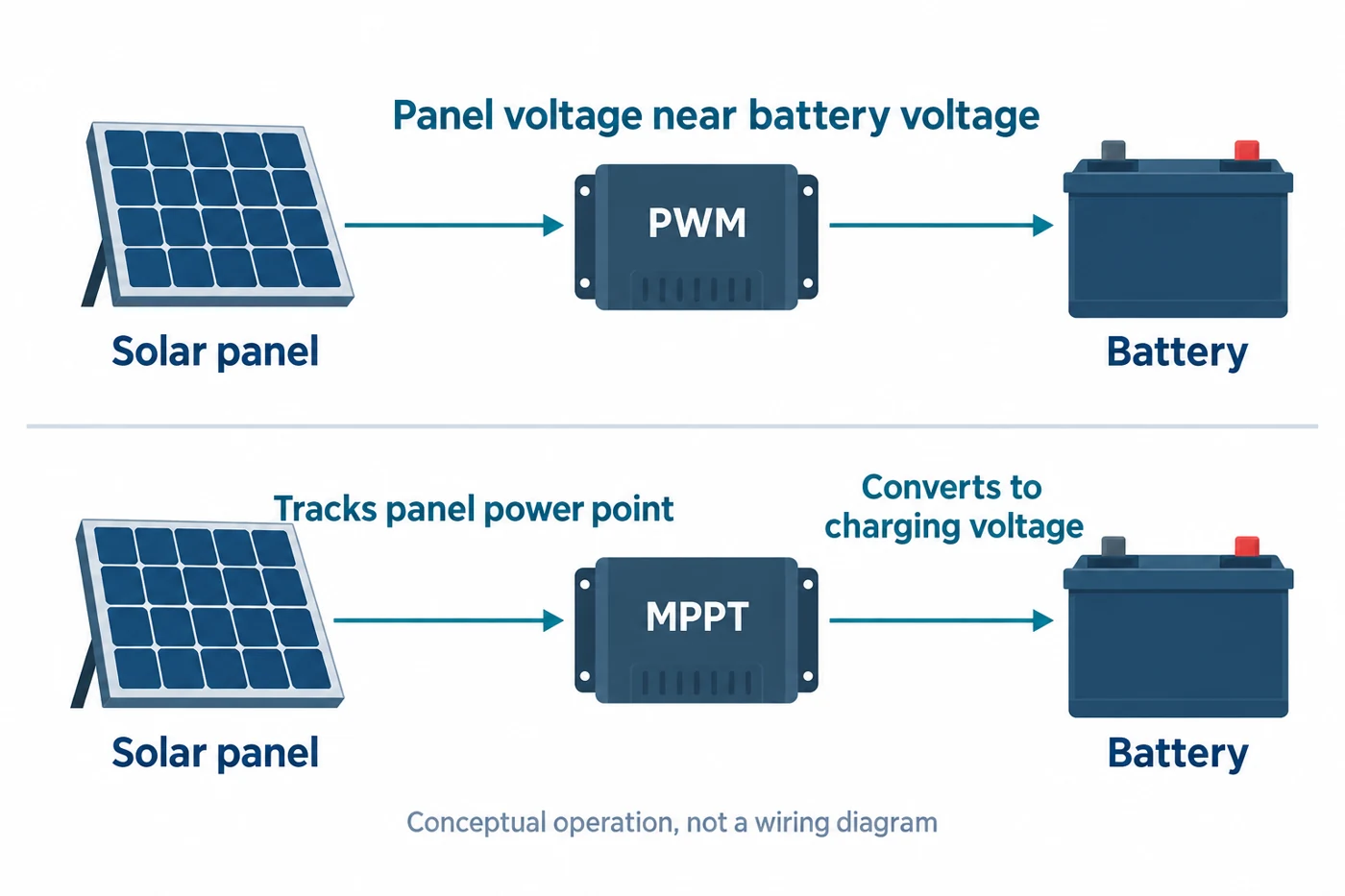
A pulse-width modulation (PWM) solar controller regulates charging by switching the connection between the panel and battery. When connected, panel voltage sits near battery voltage. A module rated at a higher maximum-power voltage therefore usually operates away from its rated power point.
Maximum power point tracking (MPPT) adjusts the PV operating point and uses DC-to-DC conversion to supply the battery. Most conventional MPPT solar chargers step voltage down. The battery-side current can exceed the panel-side current because the output voltage is lower. Conversion losses still apply.
The distinction is about how much available panel power reaches the charging system. Neither technology creates extra sunlight.
When is MPPT worth the extra cost?
MPPT is worth evaluating when recovering additional usable energy or simplifying the PV wiring offsets the controller premium. This is especially relevant on an RV roof or compact equipment enclosure where adding another module is difficult.
A higher-voltage PV string can reduce current for a given power. Since cable loss follows current squared times resistance, this can reduce PV cable losses. Final conductor selection still depends on ampacity, voltage drop, protection and installation requirements. The battery-side cables must handle the higher charging current.
Request a seasonal energy estimate that includes the load schedule, battery acceptance and shading. Extra potential production has little value when the battery is already full and the loads cannot use it. Comparing controller conversion efficiency alone will miss that distinction.
For a procurement comparison, ask suppliers to price the same panel capacity and battery system. Include cable, protective equipment, monitoring and installation labor. Treat projected daily energy as an estimate with documented assumptions, rather than a guaranteed percentage improvement.
When is PWM a reasonable choice?
PWM can be reasonable when a small array matches the battery voltage, cable runs are short and the system already meets its seasonal energy requirement. A simple maintenance charger can have different priorities from a continuously loaded remote device.
At very low power, controller self-consumption and part-load performance can affect the result. Warm modules also operate at lower voltage, which can narrow the harvesting advantage of MPPT in a well-matched system.
There is no universal wattage at which PWM becomes wrong. Check worst-season energy balance and recovery after cloudy days. A low purchase price offers little benefit if the battery repeatedly fails to recharge.
A worked example: why charging current differs
Consider a hypothetical panel delivering 200 W at a maximum-power voltage of 20 V and current of 10 A. Assume the battery is charging at 14 V. These are illustrative operating values, not a Honray product specification or measured test.
| Calculation | Illustrative result | What it means |
|---|---|---|
| Panel maximum power: 20 V × 10 A | 200 W | Available power at the assumed operating point |
| MPPT output: 200 W × 0.95 ÷ 14 V | About 13.6 A | Assumes 95% conversion efficiency at this operating point |
| PWM output: 14 V × 10 A | About 140 W | Assumes panel current remains 10 A near battery voltage; ignores wiring losses |
Actual PWM current must come from the panel’s current–voltage curve at the operating voltage. Actual MPPT efficiency changes with operating conditions. The example explains voltage conversion; it does not predict daily yield or establish a fixed MPPT advantage.
Check these specifications before choosing a controller
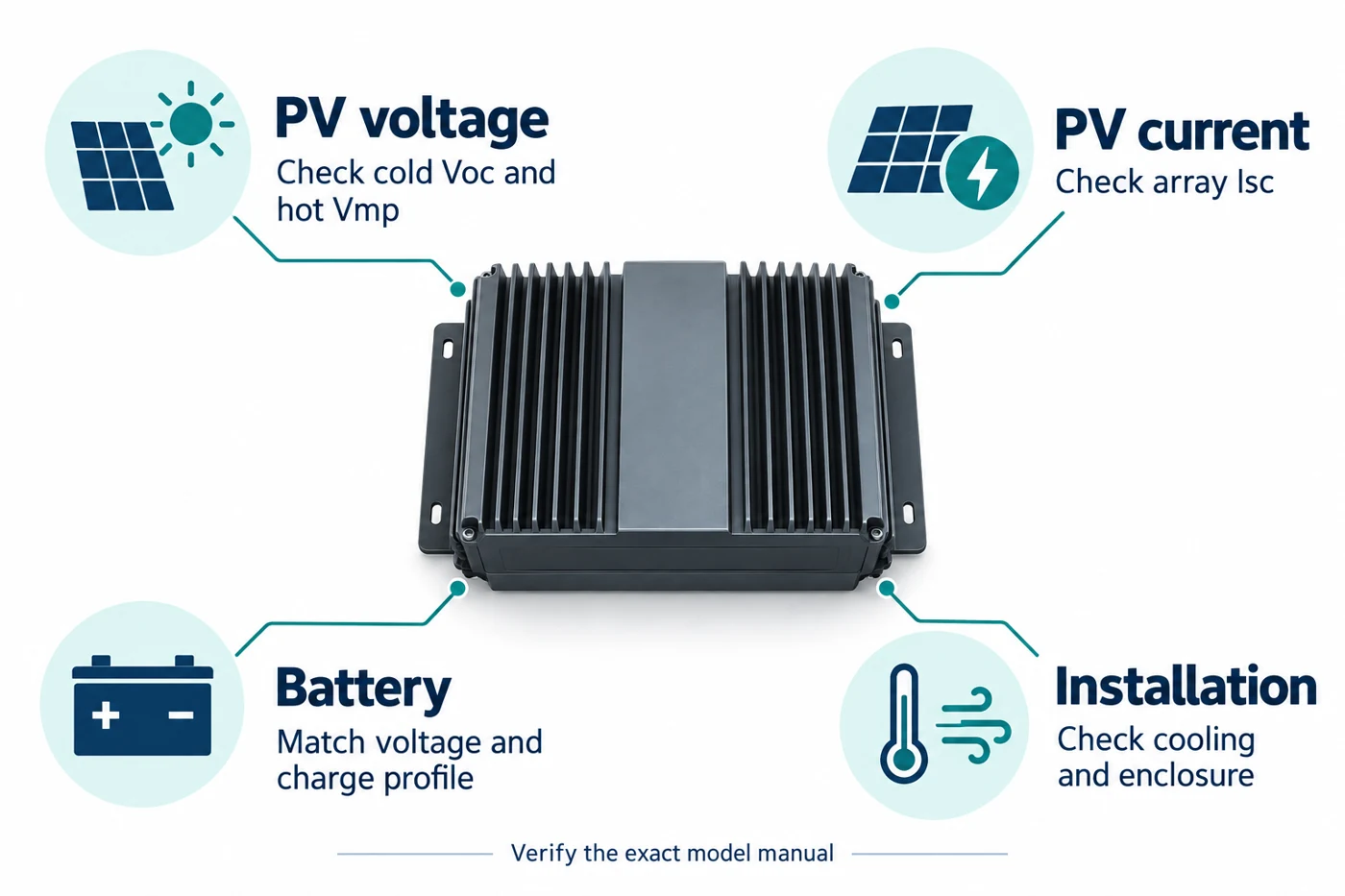
1. Battery voltage and charging profile
Confirm nominal battery voltage, chemistry, permitted charge current and manufacturer-approved charge settings. For LiFePO4 lithium-ion batteries, check absorption behavior, float requirements, low-temperature charging protection and battery management system (BMS) coordination. Disable lead-acid equalization unless the battery manufacturer explicitly permits the relevant procedure.
2. PV voltage at the coldest and hottest conditions
Cold weather raises module open-circuit voltage (Voc). Multiply the temperature-corrected module Voc by the number of series-connected modules, then check the controller’s absolute PV voltage limit. Allow the margins required by the manufacturer and applicable design rules.
For example, assume module Voc is 24 V at 25°C and its Voc temperature coefficient is −0.28%/°C. At an assumed cell temperature of −10°C, estimated module Voc is 24 × [1 + 0.0028 × 35] = 26.35 V. Three in series reach approximately 79.1 V before tolerances and required margins. These hypothetical values cannot approve a real string design.
At the hot end, verify that string maximum-power voltage (Vmp) remains sufficient for the controller to start and operate while charging the battery.
3. Input current, output current and permitted PV power
For an MPPT controller, estimate battery-side current using available PV power divided by battery charging voltage, allowing for conversion loss. Check the manufacturer’s permitted array power at the selected battery voltage as well. A 30 A output rating does not mean every 30 A PV array is acceptable.
Parallel strings add current, so compare array short-circuit current (Isc) with the controller’s separate PV input limit. Apply the required current design factors. For PWM, do not size the input simply by dividing panel watts by battery voltage; use the array current ratings and manufacturer’s sizing method.
Some MPPT models allow specified PV oversizing and clip output at their charge-current limit. That permission does not allow excess open-circuit voltage or an exceeded PV short-circuit-current limit.
4. Temperature, enclosure and service access
Review output derating, ventilation clearance, terminal capacity and environmental protection for the actual mounting location. Include monitoring needs and access for inspection. An enclosure suitable inside a dry equipment cabinet may require additional protection on a boat battery system or outdoors.
Choose by application, then validate the sample
| Application | Starting point for evaluation | Evidence to request |
|---|---|---|
| Small battery maintainer | Evaluate matched PWM and low-power MPPT | Winter energy balance and controller standby consumption |
| RV or boat with limited panel area | Evaluate MPPT first | Panel layout, shading behavior and battery charge compatibility |
| Remote equipment with a longer PV cable run | Evaluate a higher-voltage array with MPPT | Cable-loss calculation, cold Voc and input protection |
| OEM product using a custom module | Compare the complete charging architecture | Module voltage curves, charging electronics limits and sample test results |
For an OEM comparison, send the supplier a single requirements sheet: module Voc/Vmp/Isc/Imp, string layout, battery model, daily load in Wh, site temperatures and cable distances. Ask for a completed compatibility check against an identified controller model and manual revision.
During sample evaluation, log PV voltage and current alongside battery charging voltage and current. Compare energy over a representative operating period under comparable conditions. A single noon reading cannot establish seasonal performance or recovery after several poor-weather days.
When reviewing Honray solar panels with the solar charge controller range, request the current model datasheets before confirming the combination. For a quotation, include the battery manual, installation location, load profile and expected order quantity.
Frequently Asked Questions
How should buyers choose between an MPPT vs PWM solar controller for LiFePO4 batteries?
When comparing an MPPT vs PWM solar controller—and specifically MPPT vs PWM for LiFePO4 battery banks—an MPPT regulator converts higher module voltage (such as 24V/36V nominal or high-Voc panels) down to 12.8V/25.6V/51.2V charging current with programmable absorption/float setpoints tailored to LiFePO4 lithium batteries. For higher-current 12V–48V arrays, compare specs on our 60A MPPT solar charge controller or view all MPPT charge controllers.
Can a PWM controller charge a LiFePO4 battery?
A PWM controller can charge a LiFePO4 RV or marine battery if its charging settings and protection behavior meet that battery’s requirements. MPPT is not a battery chemistry setting. Verify current limits, equalization behavior, low-temperature protection and BMS requirements for the exact combination.
Does MPPT always deliver 30% more energy than PWM?
No. MPPT energy gain depends on panel voltage, temperature, irradiance, battery state and load demand. A controller’s conversion-efficiency rating is also different from the gain over PWM. Use a site-specific energy comparison rather than a universal percentage.
Can an MPPT controller charge a higher-voltage battery from a lower-voltage panel?
A conventional step-down MPPT solar charger needs sufficient PV voltage above battery charging voltage. A lower-voltage panel requires a controller explicitly designed for boost operation. Check the input operating range and startup requirements instead of relying on the MPPT label.
Will MPPT solve partial shading?
MPPT cannot recover sunlight blocked by shade. Tracking behavior, bypass diodes and string layout affect how much remaining power the system can use. Review the layout and test the expected shading pattern before choosing a controller or combining differently oriented panels.
Can I replace PWM with MPPT without changing the panels?
Often, provided the existing array meets the replacement MPPT controller’s voltage, current and power requirements. Recheck cold Voc, hot Vmp, battery settings, cable protection and connection instructions. A controller replacement is a new compatibility check.
What is the maximum PV Voc and wattage of Honray’s 60A MPPT solar charge controller?
Honray’s 60A MPPT solar charge controller (ML60415) auto-detects 12V/24V/36V/48V banks, supports up to DC 150 V maximum PV open-circuit voltage, and handles rated PV charging power of 800 W (12V), 1,600 W (24V), 2,400 W (36V), or 3,200 W (48V).
Can an MPPT controller step down high-voltage residential panels to charge a 12V battery?
Yes, an MPPT controller acts as a DC-DC buck converter, stepping down higher panel voltage (for example, 35–42 V Vmp) to 14.4 V battery charging voltage while increasing output current—provided the cold-weather Voc stays below the controller’s max PV voltage rating.
What size wire should you use between a 60A MPPT controller and the battery?
For a 60 A controller such as the ML60415, Honray recommends 6 AWG (16 mm²) copper cable kept as short as practical between the controller battery terminals and the battery busbar, protected by a properly rated DC breaker or fuse.
Can you connect two MPPT solar charge controllers to the same LiFePO4 battery bank?
Yes, two MPPT controllers can charge one battery bank in parallel as long as both share matching LiFePO4 absorption/float voltage setpoints and their combined charging amps stay within the battery BMS’s continuous charge current limit (for example, 50 A on a 12V 100Ah pack or 100 A on a 12V 200Ah pack).
OEM & ODM Customization
100% Dual EL Tested
Export to 50+ Countries
TÜV · UL · CE · UN38.3
Looking for wholesale pricing or custom OEM/ODM solutions?
Connect directly with our engineering team for a tailored quote within 24 hours.