
What Does Li-Ion Mean on a Battery Label?
On a battery label, Li-ion stands for lithium-ion, identifying a rechargeable battery family that stores energy by moving lithium ions between two electrodes. Within that family, markings such as LiFePO4 (or LFP) tell you the exact cathode chemistry used in Honray’s deep-cycle LiFePO4 batteries for RVs, boats, and off-grid solar storage.
Key Takeaways
- Li-ion confirms the battery is rechargeable; LiFePO4 (LFP) specifies the long-life, thermally stable chemistry inside.
- Multiply nominal voltage by amp-hours to get nominal energy (for example, 12.8 V × 100 Ah = 1,280 Wh / 1.28 kWh).
- Before buying or charging a pack, verify BMS continuous charge/discharge amps, IP rating, and series/parallel limits on the exact datasheet.
Table of Contents
- What Does “Li-Ion” Mean on a Battery Label?
- How Does a Lithium-Ion Battery Work?
- Is LiFePO4 a Lithium-Ion Battery?
- How to Convert Label Ratings (V and Ah) Into Real Energy and Charge Limits
- What Should You Check Before Choosing a LiFePO4 Storage Battery?
- Frequently Asked Questions
- Why is a 12.8 V LiFePO4 battery sold as a 12 V battery?
- How much usable energy does a 100 Ah LiFePO4 battery provide?
- Can I use my existing lead-acid charger with a LiFePO4 battery?
- What is the difference between Li-ion and LiFePO4 on a label?
- Does a LiFePO4 battery label always show watt-hours (Wh)?
- What does continuous vs. peak discharge current mean on a BMS label?
- Can you charge a Li-ion or LiFePO4 battery below freezing?
- What does IP65 vs. IP21 mean on a LiFePO4 battery case?
- Can I wire two 48V LiFePO4 batteries in series for 96V?
- What warranty covers Honray LiFePO4 storage batteries?
What Does “Li-Ion” Mean on a Battery Label?
Li-ion tells you the pack is a rechargeable lithium-ion battery rather than a single-use lithium metal cell or a lead-acid battery. Because the lithium-ion family includes multiple chemistries with different voltage curves and safety profiles, storage battery labels usually add the specific formula.
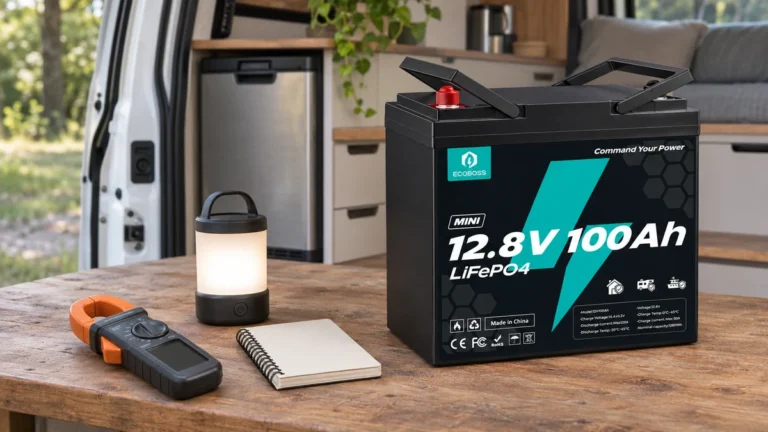
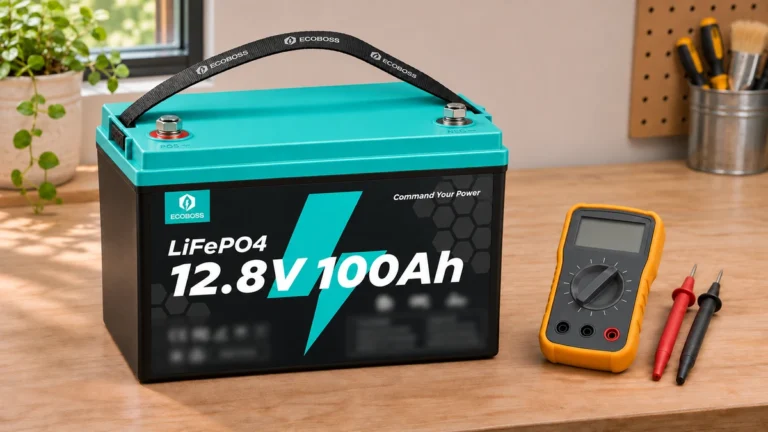
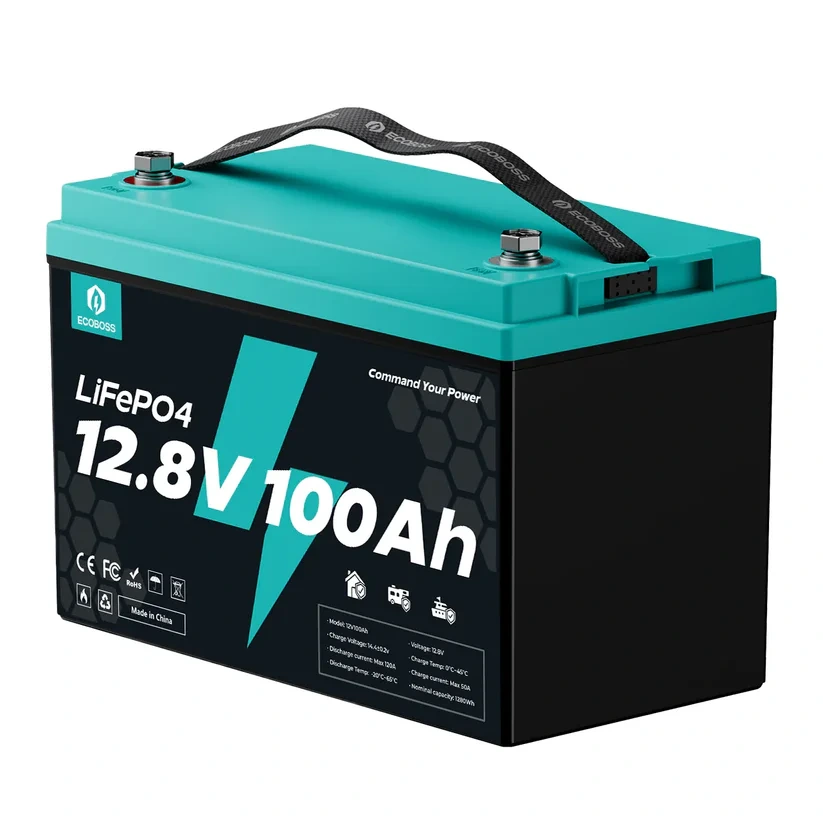
For example, the EcoBoss 12.8 V 100 Ah LiFePO4 battery prints LiFePO4, 12.8 V, and 100 Ah on its front housing. Together, those three markings tell you the chemistry, nominal voltage, and rated charge capacity at a glance.
| Label or Datasheet Field | What It Tells You | Why It Matters in Practice |
|---|---|---|
| Li-ion / UN3480 | Rechargeable lithium-ion family. | Confirms rechargeability and transport classification. |
| LiFePO4 (LFP) | Lithium iron phosphate chemistry (~3.2 V per cell). | Determines charge voltage (14.4±0.2 V for 12V class) and thermal stability. |
| 12.8 V / 25.6 V / 51.2 V | Nominal pack voltage. | Must match your inverter, MPPT controller, and DC bus. |
| 100 Ah / 200 Ah / 314 Ah | Rated charge capacity in amp-hours. | Used with nominal voltage to calculate total watt-hours (Wh). |
| 1.28 kWh / 5.12 kWh | Nominal stored energy (V × Ah ÷ 1,000). | Gives a baseline before subtracting inverter and wiring losses. |
How Does a Lithium-Ion Battery Work?
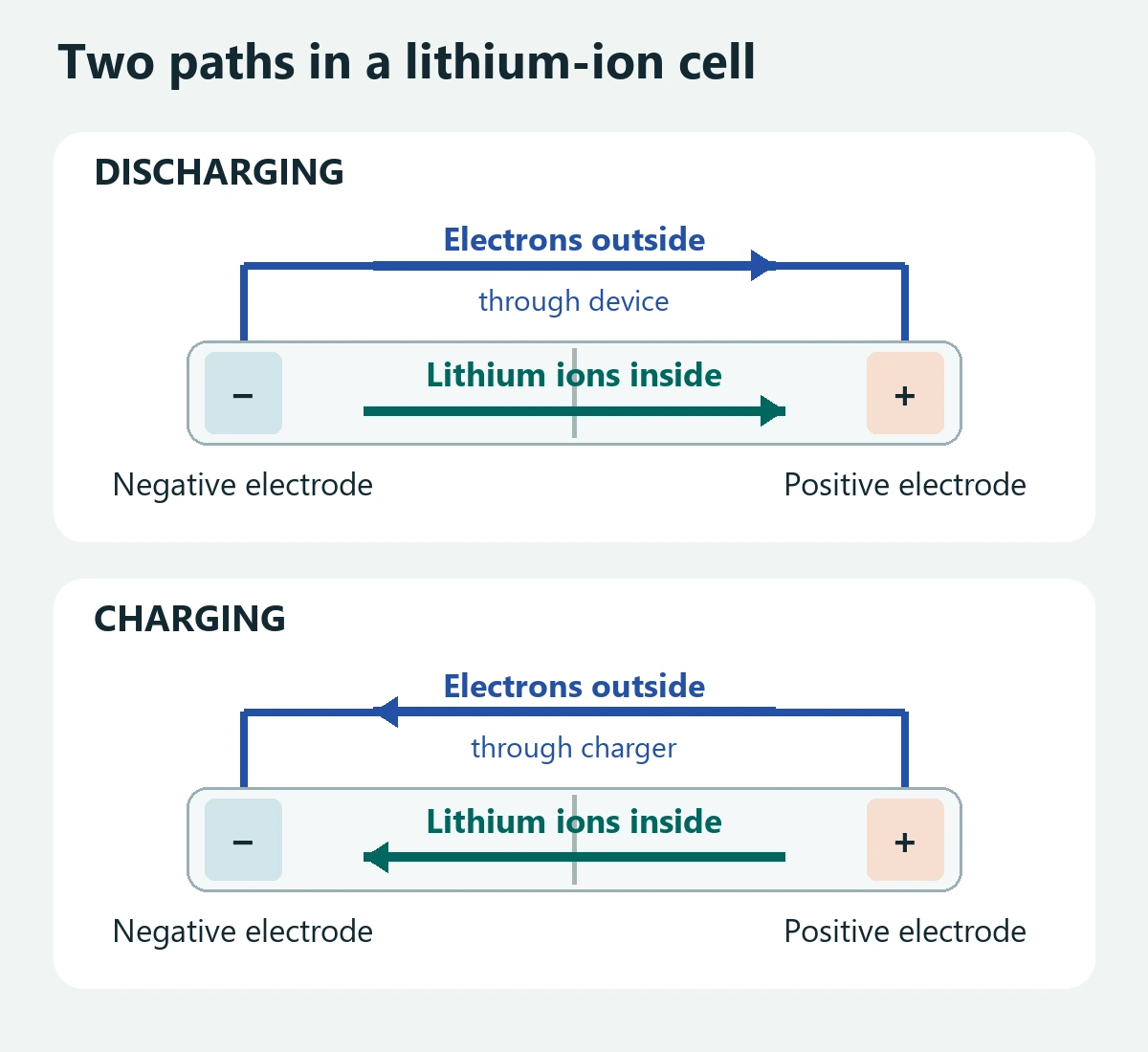
Inside a lithium-ion cell, lithium ions shuttle through an electrolyte between a negative electrode (anode) and a positive electrode (cathode), while electrons flow through the external circuit to power your load or receive charge.
During discharge, lithium ions move from the negative electrode to the positive electrode inside the cell, and electrons flow out through your inverter or DC appliances. During charging, an MPPT solar controller or AC charger pushes electrons back to the negative electrode while lithium ions return across a porous separator that keeps the two electrodes from touching.
Is LiFePO4 a Lithium-Ion Battery?
Yes—LiFePO4 (LFP) is a specific rechargeable chemistry inside the lithium-ion family. While consumer electronics often use NMC or LCO lithium-ion cells, stationary storage and mobile house banks favor LiFePO4 because its iron-phosphate crystal structure resists thermal runaway and handles thousands of deep cycles.
To see how LFP stacks up against cobalt/nickel cells and lead-acid banks, review our guide to lithium battery types and our LiFePO4 vs. NMC and lead-acid comparison.
How to Convert Label Ratings (V and Ah) Into Real Energy and Charge Limits
A battery label’s V and Ah ratings let you calculate nominal energy, but your usable AC runtime and charging speed depend on BMS current limits, inverter efficiency, and ambient temperature. Notice that Honray’s standard 12V–48V packs allow 0.25C to 0.5C continuous charging—not 1-hour 80% fast charging—so always size your charger to the datasheet.
| Honray Model Example | Nominal V × Ah | Nominal Energy | Continuous Charge / Discharge (Peak) | Charge / Discharge Temp & IP |
|---|---|---|---|---|
| EcoBoss 12V 100Ah ABS | 12.8 V × 100 Ah | 1,280 Wh (1.28 kWh) | 50 A / 100 A (200 A peak) | 0~45°C / -20~65°C · IP65 |
| EcoBoss 12V 100Ah Slim | 12.8 V × 100 Ah | 1,280 Wh (1.28 kWh) | 50 A / 100 A (200 A peak) | 0~55°C / -20~60°C · IP21 |
| EcoBoss 24V 200Ah ABS | 25.6 V × 200 Ah | 5,120 Wh (5.12 kWh) | 50 A / 100 A (200 A peak) | 0~45°C / -20~65°C · IP65 |
| EcoBoss 51.2V 100Ah Rack | 51.2 V × 100 Ah | 5,120 Wh (5.12 kWh) | 100 A / 100 A (150–200 A peak) | 0~55°C / -20~60°C · IP20/IP21 |
What Should You Check Before Choosing a LiFePO4 Storage Battery?
Before ordering a storage battery, match four specifications from the label and datasheet to your system:
- System voltage & expansion rules: Verify whether you need 12.8 V (up to 4P4S), 25.6 V (up to 4P2S), or 51.2 V (4P1S for ABS or up to 16P1S parallel-only for EcoBoss 51.2V Server Rack).
- Enclosure & footprint: Use IP65 ABS boxes (including 12V 100Ah Mini fitting Group 24 trays) for RV/marine bays, and keep IP20/IP21 metal-case Slim, Rack, or Wheeled units inside dry indoor spaces.
- Charge profile & controller: Match your solar charge controller or AC charger to the pack’s charge voltage (e.g., 14.4±0.2 V for 12.8 V packs, 29.0±0.2 V for 25.6 V, 58.4 V for 51.2 V) and avoid charging below 0°C unless low-temp heating is installed.
- Inverter communication & custom specs: For home solar backup, confirm CAN/RS485 protocol compatibility with your inverter model, or specify custom dimensions and protocols via Honray custom LiFePO4 battery packs.
Frequently Asked Questions
Why is a 12.8 V LiFePO4 battery sold as a 12 V battery?
The “12 V” label refers to the nominal system voltage class so buyers know it replaces a 12 V lead-acid bank. Inside, four 3.2 V LiFePO4 cells in series yield 12.8 V nominal, which you should use when calculating watt-hours (12.8 V × Ah) and configuring charger cutoffs.
How much usable energy does a 100 Ah LiFePO4 battery provide?
A 12.8 V 100 Ah LiFePO4 pack stores 1.28 kWh of nominal energy (or 5.12 kWh for a 51.2 V 100 Ah pack), while actual delivered energy depends on allowable depth of discharge and conversion losses. If powering AC appliances through an inverter, allow for inverter efficiency losses and DC cable drop.
Can I use my existing lead-acid charger with a LiFePO4 battery?
You can reuse an existing charger only if its absorption voltage, float behavior, and current limits match the LiFePO4 datasheet and it has no automatic desulfation pulse mode. High-voltage desulfation spikes or excessive float voltage can trigger BMS protection or shorten cell life.
What is the difference between Li-ion and LiFePO4 on a label?
Li-ion is the parent category that covers multiple rechargeable lithium chemistries, whereas LiFePO4 (LFP) names the exact iron-phosphate chemistry. Knowing it is LFP confirms a 3.2 V cell nominal voltage rather than the 3.6–3.7 V nominal voltage of NMC or LCO packs.
Does a LiFePO4 battery label always show watt-hours (Wh)?
Not always on the front graphic, though shipping labels and datasheets usually list watt-hours because UN3480 air/sea transport rules require Wh disclosure. When only V and Ah appear, multiply them together (for example, 25.6 V × 100 Ah = 2,560 Wh).
What does continuous vs. peak discharge current mean on a BMS label?
Continuous discharge current is the steady amp draw the BMS supports without tripping (such as 100 A on an EcoBoss 12.8 V 100 Ah pack), while peak current (200 A for a few seconds) covers brief motor or compressor startups. Sizing your inverter to the continuous rating prevents mid-load shutdowns.
Can you charge a Li-ion or LiFePO4 battery below freezing?
Standard Honray LiFePO4 packs specify a 0°C to 45°C (or 0°C to 55°C for metal-case models) charging window, meaning they must not be charged below 0°C unless equipped with low-temperature BMS cutoff or self-heating pads. Discharging is supported down to -20°C.
What does IP65 vs. IP21 mean on a LiFePO4 battery case?
IP65 indicates dust-tight protection against low-pressure water jets (typical of Honray ABS deep-cycle packs), whereas IP20/IP21 on Slim, Server Rack, and Wheeled metal enclosures only protects against finger contact and vertical drips in dry indoor locations. Neither rating permits full submersion.
Can I wire two 48V LiFePO4 batteries in series for 96V?
No—Honray 48V ABS (4P1S) and 51.2V Server Rack or Wheeled packs (16P1S) are rated for parallel expansion only. Connecting 48V/51.2V packs in series exceeds the internal BMS component voltage rating and voids warranty protection.
What warranty covers Honray LiFePO4 storage batteries?
Honray offers a 3–5 year warranty on 12V–48V deep-cycle packs (including RV and marine models) and a 5–10 year warranty on 51.2V Server Rack and Wheeled ESS models, subject to the formal SKU quotation and written warranty terms.
OEM & ODM Customization
100% Dual EL Tested
Export to 50+ Countries
TÜV · UL · CE · UN38.3
Looking for wholesale pricing or custom OEM/ODM solutions?
Connect directly with our engineering team for a tailored quote within 24 hours.