
How to Size Solar Panels for an Off-Grid Water Pump
To size solar panels for an off-grid solar water pump, divide the pump’s daily electrical energy use by the design month’s peak sun hours and a factor for power losses. That gives you a starting array size in watts. Before buying panels, confirm that the pump can deliver the required daily water volume at your site and that the proposed panel strings fit the pump controller’s electrical limits.
For example, a system that lifts 10 m³ of water per day through 40 m of total dynamic head comes out to about 870 W of solar panels at 3.5 peak sun hours under the assumptions below. Four 250 W panels meet that estimate on paper. Whether you can use them depends on the controller and the pump’s predicted output.
Table of Contents
- 1. Calculate daily water demand and total dynamic head
- 2. Estimate how much electricity the pump needs per day
- If you’re choosing a new pump
- If you already have a pump
- 3. Convert daily energy into solar panel watts
- 4. Check the panel count against the pump controller
- 5. Decide whether to store water or electricity
- Frequently Asked Questions
- What does pumping station inverter sizing require for an AC water pump?
- How many solar panels do I need for a 1 HP well pump?
- Can a single 400 W solar panel run a water pump?
- Will a solar-direct pump still deliver water on cloudy days?
- How do you calculate Total Dynamic Head (TDH) for solar water pump sizing?
- How many watts of solar panels do you need for a 24V or 48V DC solar borehole pump?
- Can a variable-frequency solar pump inverter run an existing AC well pump?
- Why do solar water pump systems usually store water in an elevated tank instead of batteries?
- Do you need an MPPT charge controller if the solar pump already has a built-in MPPT driver?
- How does hot weather affect solar panel sizing for an agricultural water pump?
1. Calculate daily water demand and total dynamic head
Start with the volume the pump must deliver each day during the months you need water. Record irrigation, livestock or household demand separately if they peak at different times. For a well, check that it can sustain the proposed pumping rate without drawing the water level below the pump’s operating limit.
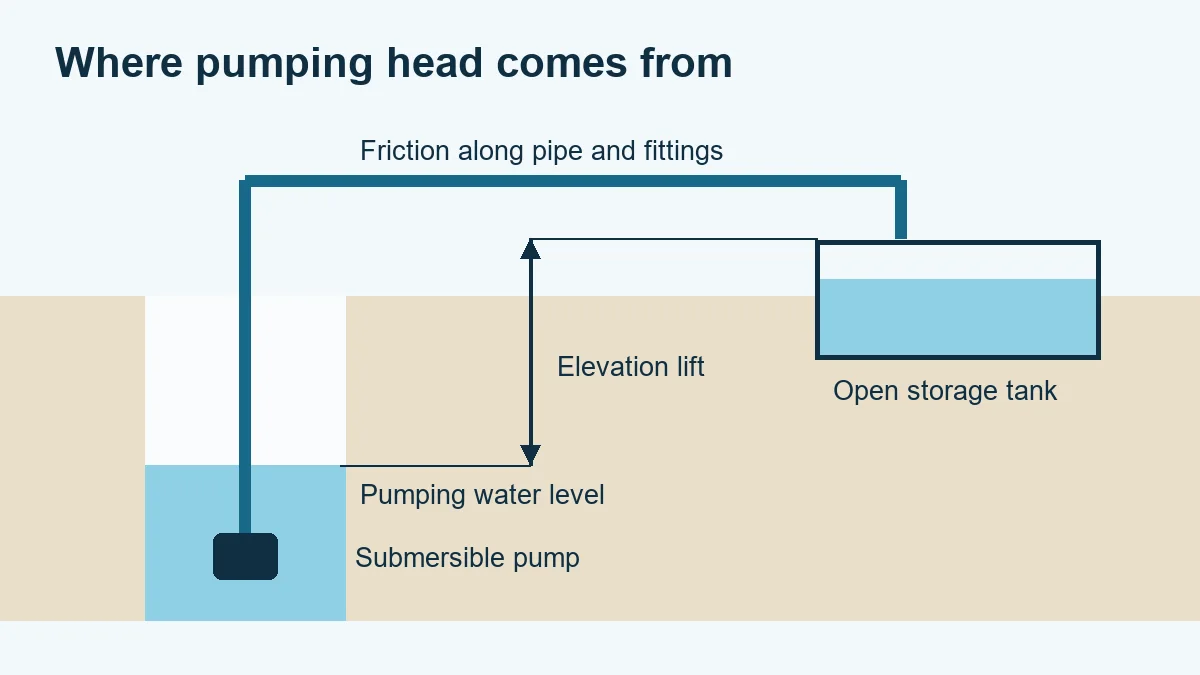
Total dynamic head (TDH) is the head the pump works against at the design flow. For a well feeding a tank or pressurized outlet, add:
- Elevation lift: the vertical distance from the water level while pumping to the discharge point. For a bottom-fed tank, account for the water level the pump must fill to.
- Friction head: losses through the pipe, fittings, valves and filters at the design flow. Pipe length and diameter affect friction even when the pipe runs horizontally.
- Required outlet pressure: convert any pressure the equipment needs at the outlet into an equivalent height of water. For fresh water, 1 bar is about 10.2 m of head. An open outlet has no added gauge pressure requirement.
Use the pumping water level from a drawdown test at a relevant flow. A pump may sit 60 m below ground while the water surface during pumping sits only 30 m below ground. The lift starts at that water surface. If the water level falls further in the dry season, recalculate TDH.
2. Estimate how much electricity the pump needs per day
If you’re choosing a new pump
Use the daily water volume and TDH to estimate hydraulic energy. For fresh water:
Hydraulic energy (Wh/day) ≈ 2.725 × daily volume (m³/day) × TDH (m)
Divide that result by the combined motor and pump efficiency to estimate electrical energy at the pump input. For example, 10 m³/day at 40 m takes about 1,090 Wh/day of hydraulic energy. At an assumed 45% motor and pump efficiency, that’s about 2,422 Wh/day of electrical energy. The 45% is an example input. Use manufacturer performance data at your duty point when you have it.
Check the pump curve at the expected head and flow. If a pump cannot deliver water at your TDH, a larger array will not make that pump suitable. A solar-direct pump may also change speed and flow throughout the day, so use the manufacturer’s sizing tool or performance data for the final daily-volume check.
If you already have a pump
Measure real electrical input power while the pump is delivering water at its usual head and multiply by its daily runtime. A pump drawing 600 W for four hours uses 2,400 Wh/day. If the load varies, use logged daily energy over representative operating days. Record where you measured it so you don’t count upstream losses twice. Motor horsepower describes shaft output; use measured electrical input or the manufacturer’s input data for energy sizing.
3. Convert daily energy into solar panel watts
Estimated array size (Wp) = daily electrical energy at the pump input (Wh/day) ÷ [design-month peak sun hours (h/day) × PV-to-pump delivery factor]
Peak sun hours (PSH) express a day’s solar energy as equivalent hours at 1,000 W/m² (the same metric used in our solar panel calculator). They do not tell you how many hours a pump will run. If the array plane receives an average of 3.5 kWh/m² per day in the design month, use 3.5 PSH. Use data for the panel tilt and direction. For a monthly irradiation total, divide by the number of days in the month.
Check the months when you need water, using each month’s demand and expected head where they change. A dry month with heavy irrigation can set the array size even if another month gets less sun. For a year-round supply, check the lowest-sun periods and decide how much reserve water or backup you need. A monthly average can hide several cloudy days in a row.
The delivery factor accounts for losses between the array’s rated output and the pump input, including module heat, soiling, wiring and power conversion. For a battery-backed setup, include losses along the battery and inverter path where applicable. The factor excludes motor and pump losses already counted in Step 2. If you start with a modeled electrical yield that already includes losses, avoid deducting the same losses again.
Using the example’s 2,422 Wh/day and an illustrative 0.80 delivery factor:
| Design-month sun | Estimated array | Minimum count by watts alone, at 250 W each |
|---|---|---|
| 3.5 PSH | 2,422 ÷ (3.5 × 0.80) ≈ 865 Wp | 4 panels (1,000 Wp) |
| 2.5 PSH | 2,422 ÷ (2.5 × 0.80) ≈ 1,211 Wp | 5 panels (1,250 Wp) |
These are hypothetical site conditions and module ratings. A pump controller may need a different panel count or a different module even when the estimated array watts are sufficient.
4. Check the panel count against the pump controller
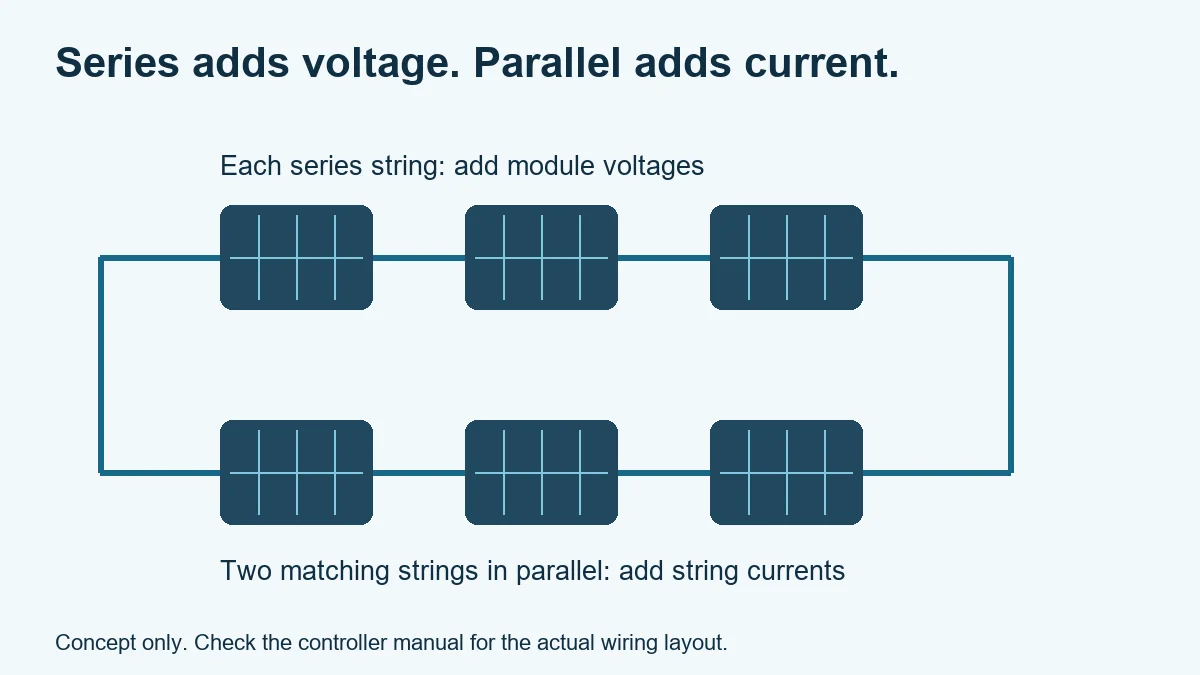
Divide the target array watts by the rated watts per module and round up to get a starting panel count. Then check the actual series and parallel layout against the solar controller’s manual. On a solar-direct setup, use the limits of the pump controller or solar pump drive. On a battery-backed setup, use the limits of the equipment that takes the PV input.
| Check | What to verify |
|---|---|
| Cold open-circuit voltage (Voc) | Calculate string Voc at the design low temperature using the module’s temperature coefficient. Stay below the controller’s absolute PV input voltage limit. |
| Operating voltage (Vmp) and start voltage | Check that hot-weather string Vmp stays high enough for the operating or MPPT window, and check the controller’s separate start requirement if specified. |
| Input current and PV power | Add the current from parallel strings. Check operating current, allowable short-circuit current and PV array power against the published limits, following the manual’s sizing rules. |
Five modules may clear the energy estimate but fail to form equal-length strings within the voltage and current limits. In that case, select a different module or controller, or use a permitted layout that meets both the energy and electrical requirements.
Finally, run the proposed pump, array, location and TDH through the pump manufacturer’s sizing tool. Check water delivered per day in the design month, particularly when the pump spends time below its start or useful pumping threshold.
5. Decide whether to store water or electricity
For daytime pumping, an open storage tank can supply water after sunset if gravity or a separate pressure system meets your needs. Size usable tank volume for the demand the reserve must cover, and check that the pump can refill it after a low-sun period.
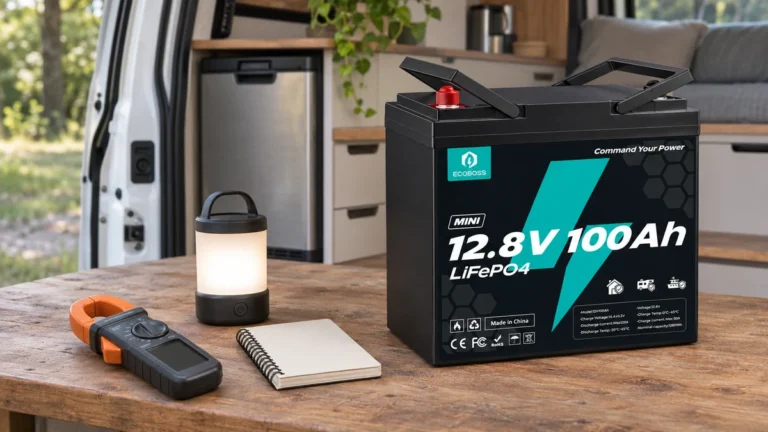
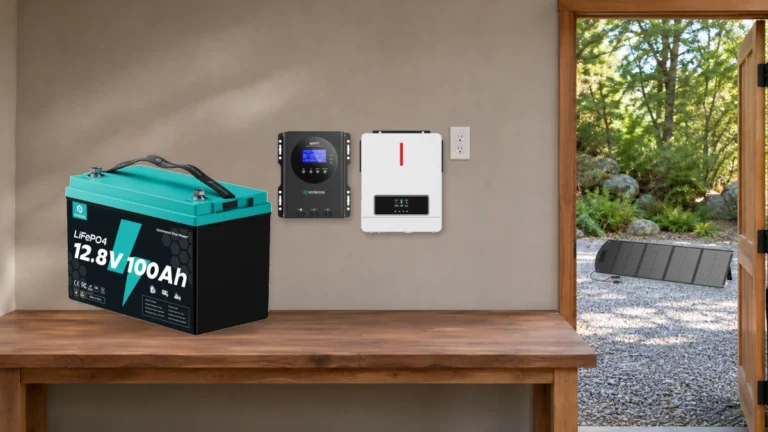
If the pump itself must run at night or maintain pressure when solar output is low, evaluate LiFePO4 battery storage or another backup power source. For an existing AC pump on batteries, check inverter voltage, phase, running load and motor starting surge. Check battery discharge current and usable energy as well. Size the array for both normal daily use and the recharge time you expect after a reserve event.
Frequently Asked Questions
What does pumping station inverter sizing require for an AC water pump?
For AC borehole or booster pumps that do not use a DC-direct solar pump driver, pumping station inverter sizing must account for motor locked-rotor inrush current (often 3× to 6× running watts on direct-on-line motors) or specify a soft-start VFD solar pump inverter. Size the inverter continuous wattage above pump rated power, confirm surge capacity and PV MPPT voltage window, and compare options across our solar inverters and 6000W hybrid solar inverter range.
How many solar panels do I need for a 1 HP well pump?
A 1 HP rating alone cannot determine the number of panels. Use the pump’s electrical input and runtime to estimate daily energy, then apply your site’s design-month sun and power-path losses. Check the inverter’s motor-starting capability or the pump drive’s input requirements before choosing a string layout.
Can a single 400 W solar panel run a water pump?
A single 400 W panel can run a compatible solar pump if it provides enough voltage and power for the pump to start and deliver water at the required head. Compare the module’s hot Vmp and cold Voc with the controller limits. Use the pump’s performance data to confirm daily water delivery from that one panel.
Will a solar-direct pump still deliver water on cloudy days?
A solar-direct pump can deliver water on cloudy days if the array still provides enough power and voltage for the pump to overcome the head. Output may fall or stop as sunlight drops. Use the manufacturer’s performance model and size your water reserve around the interruptions the site can tolerate.
When comparing Honray solar panels for an off-grid pump, have the pump and controller model, required daily volume, TDH, installation location and available mounting area ready. Request the module datasheet and check the proposed string before placing an order.
How do you calculate Total Dynamic Head (TDH) for solar water pump sizing?
Total Dynamic Head equals static vertical lift (from pumping water level to tank discharge) plus friction losses through pipe length, elbows, and valves, plus any required delivery pressure head. Always use dynamic drawdown depth rather than static well depth.
How many watts of solar panels do you need for a 24V or 48V DC solar borehole pump?
Size the solar array at roughly 1.3× to 1.6× the DC pump’s continuous input wattage so the pump starts earlier in the morning and runs closer to rated flow under warm field conditions—for example, pairing a 300 W pump with two 200W rigid monocrystalline panels (400 Wdc) or 450–500 Wdc on deeper wells.
Can a variable-frequency solar pump inverter run an existing AC well pump?
Yes, a dedicated solar pumping VFD or properly oversized hybrid inverter can drive an existing AC pump, provided the array’s cold-weather Voc and MPPT voltage stay within the inverter’s DC input window and the inverter handles locked-rotor startup surge.
Why do solar water pump systems usually store water in an elevated tank instead of batteries?
Water storage in a gravity tank is usually far cheaper per day of autonomy and needs less maintenance than a large battery bank. Add a LiFePO4 battery bank only when you must pump at night or deliver pressurized on-demand flow.
Do you need an MPPT charge controller if the solar pump already has a built-in MPPT driver?
No, direct-PV DC solar pumps integrate their own MPPT pump controller and should connect directly to the panels through a DC isolator. Only add an external 60A MPPT solar charge controller when charging an intermediate battery bank.
How does hot weather affect solar panel sizing for an agricultural water pump?
High afternoon cell temperatures reduce panel operating voltage (Vmp) and output power by roughly 10%–18% compared with STC ratings, so build temperature derating into your array wattage and verify minimum Vmp stays above the pump controller’s startup floor.
OEM & ODM Customization
100% Dual EL Tested
Export to 50+ Countries
TÜV · UL · CE · UN38.3
Looking for wholesale pricing or custom OEM/ODM solutions?
Connect directly with our engineering team for a tailored quote within 24 hours.