
Watts to Amps: How to Calculate Current and LiFePO4 Battery Runtime
For a DC circuit, convert watts to amps by dividing power by voltage: amps = watts ÷ volts. To estimate LiFePO4 battery runtime, divide the available battery energy in watt-hours by the average power drawn from the battery.
Keep the measurement location clear. A 300W appliance on an inverter’s AC output draws more than 300W from the battery once conversion losses and inverter consumption are included. Its AC current also differs from the battery’s DC current.
Key Takeaways
- Use DC voltage with DC-side watts to calculate DC current.
- For single-phase AC current, use RMS voltage and the load’s power factor.
- Convert battery Ah to Wh using nominal voltage, then allow for the available state-of-charge range.
- Calculate runtime using battery-side demand; include inverter losses and standby consumption once.
Table of Contents
- Start With the Ratings and the Measurement Location
- Step 1: Convert Watts to Amps on the DC Side
- Step 2: Keep AC Current Separate From Battery Current
- Step 3: Convert Battery Ah to Wh and kWh
- Step 4: Decide How Much Energy Is Available
- Step 5: Put Every Load on the Battery Side
- Worked Example: A Mixed AC and DC Load
- Handle Fridges and Other Loads That Cycle
- Check Current Limits Before Relying on the Runtime
- Frequently Asked Questions
- How Many Amps Is 1,000 Watts at 12 Volts?
- Can I Convert Watts to Amps Without Knowing Voltage?
- Is a 100Ah LiFePO4 Battery Equal to 1kWh?
- What Is the Difference Between kW and kWh?
- Can I Divide Battery Ah by Appliance Amps to Get Runtime?
- Should I Add Inverter Idle Power After Applying Efficiency?
- Does Power Factor Reduce Battery Runtime by the Same Percentage?
- Will a Higher-Voltage Battery Always Run Longer?
- Can These Formulas Size the Cable and Fuse?
- Why Is My Measured Runtime Shorter Than the Estimate?
- Calculation Basis and Editorial Notes
Start With the Ratings and the Measurement Location
Gather the battery’s nominal voltage and capacity, the load’s power consumption, and the inverter specifications. Record where each power figure is measured: at the appliance, at the inverter input, or at the battery.
For a first estimate, write down:
- Battery nominal voltage, rated Ah or Wh, starting state of charge and intended reserve.
- Each load’s running watts and operating hours.
- Whether the load is DC or supplied through an inverter.
- Inverter efficiency at the relevant load, its self-consumption and any startup requirements.
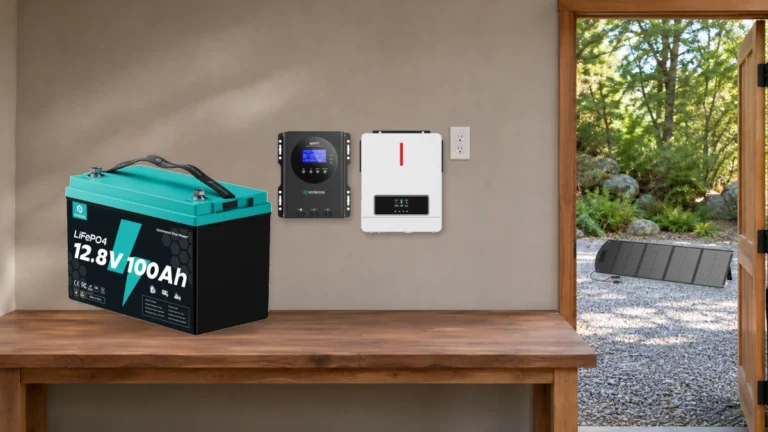
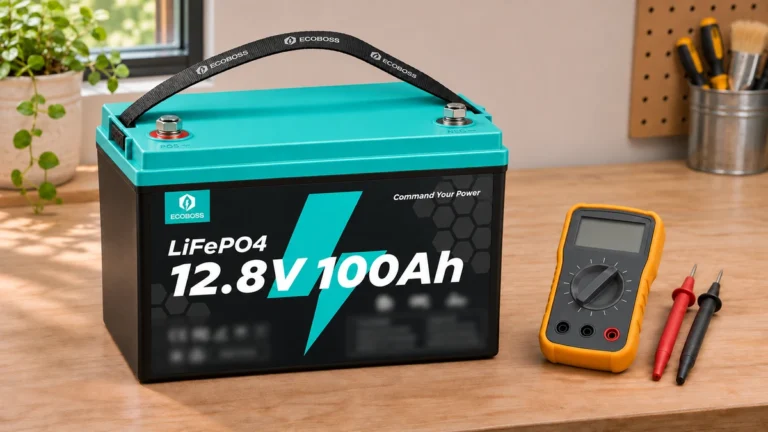
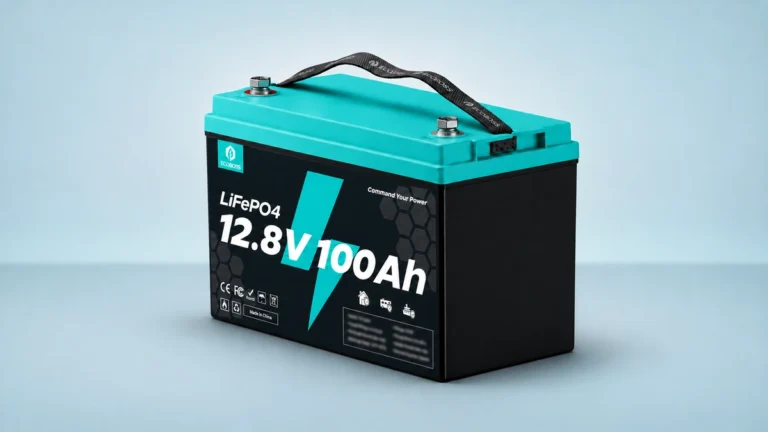
Use the exact product specifications. A marketing description such as 12V or 48V may identify a voltage class rather than the battery’s precise nominal voltage. Honray’s EcoBoss 12.8V 100Ah battery, for example, lists 12.8V and 1,280Wh.
If the chemistry is unfamiliar, start with how LiFePO4 compares with NMC and lead-acid. The calculations below use stated ratings and transparent assumptions, rather than a fixed runtime claim for every lithium battery.
Step 1: Convert Watts to Amps on the DC Side
For steady DC power, use I = P ÷ V, where I is current in amps, P is power in watts and V is voltage in volts. This rearranges the DC power relationship in Seattle Public Utilities’ electrical design formulas.
If the battery supplies 300W at 12.8V, the current is:
300W ÷ 12.8V = 23.44A
The following table uses power already measured or calculated on the DC side. It excludes additional conversion losses between the battery and an appliance.
| DC-side power | At 12.8V | At 25.6V | At 51.2V |
|---|---|---|---|
| 100W | 7.81A | 3.91A | 1.95A |
| 300W | 23.44A | 11.72A | 5.86A |
| 500W | 39.06A | 19.53A | 9.77A |
| 1,000W | 78.13A | 39.06A | 19.53A |
These are calculated examples at the stated voltages, rounded to two decimals. They are not cable-sizing values or battery output guarantees.
For an operating-current check, use the voltage at the point being assessed. At constant power, current rises as voltage falls. Nominal voltage is useful for planning, but it does not capture the lowest battery voltage under load or voltage drop along a cable.
Step 2: Keep AC Current Separate From Battery Current
For single-phase AC real power, use:
AC amps = watts ÷ (RMS volts × power factor)
Here, power factor is real power divided by apparent power. The Fluke electrical glossary explains the relationship between AC power, voltage, current and power factor. The simple watts-divided-by-volts result applies when power factor is 1.
Suppose an appliance uses 300W at 120V AC with a measured power factor of 0.8:
300 ÷ (120 × 0.8) = 3.125A AC
That is the appliance-side current. It is not the current leaving a 12.8V battery through an inverter.
Power factor and inverter efficiency answer different questions. Power factor helps determine AC current and apparent-power demand. Inverter efficiency relates AC output power to DC input power. When calculating battery demand from measured real watts, do not divide those watts by power factor again.
Use real input watts for energy calculations and check the inverter’s W, VA and startup limits separately. The formulas here cover DC and single-phase AC; three-phase equipment needs its corresponding calculation.
Step 3: Convert Battery Ah to Wh and kWh
Use nominal voltage to convert a rated battery capacity into nominal energy:
Nominal energy (Wh) = nominal voltage × rated Ah
Energy (kWh) = Wh ÷ 1,000
The US Energy Information Administration distinguishes watts, a rate of energy use, from watt-hours, energy used over time. A kilowatt-hour is 1,000 watt-hours.
| Illustrative battery rating | Nominal energy | Equivalent kWh |
|---|---|---|
| 12.8V, 100Ah | 1,280Wh | 1.28kWh |
| 25.6V, 100Ah | 2,560Wh | 2.56kWh |
| 51.2V, 100Ah | 5,120Wh | 5.12kWh |
These rows show why Ah alone cannot compare energy across different voltages. Honray’s 51.2V 100Ah rack battery lists 5.12kWh, while its 12.8V 100Ah model lists 1.28kWh.
Use the nameplate rather than automatically replacing every 48V label with 51.2V. Also keep the complete bank configuration clear: increasing system voltage by rearranging the same batteries does not create additional stored energy.
Step 4: Decide How Much Energy Is Available
Available energy depends on the starting charge level and where you intend to stop discharging. For an initial estimate:
Available energy ≈ nominal Wh × available state-of-charge fraction
For the worked example below, assume a fully charged 12.8V 100Ah battery and a 20% reserve. The available fraction is 100% minus 20%, or 0.80:
1,280Wh × 0.80 = 1,024Wh
The 80% allowance is an example choice, not a universal LiFePO4 depth-of-discharge recommendation. If the same battery starts at 70% and you retain a 20% reserve, the available fraction is 0.50, not 0.80.
This calculation approximates energy from the stated ratings. Temperature, battery condition, discharge rate, BMS limits and inverter shutdown can change the energy actually delivered. Use manufacturer data or a representative discharge measurement when those differences matter.
Step 5: Put Every Load on the Battery Side
The simplest runtime calculation uses average power measured at the battery while the intended loads operate:
Runtime (hours) ≈ available battery Wh ÷ average battery-side W
That battery-side measurement already includes the losses and equipment consumption downstream of the measurement point. Do not apply inverter efficiency to it a second time.
When battery-side measurements are unavailable, build an estimate from the individual loads. For an AC load and a separate battery-side DC load, a useful split model is:
Battery demand ≈ AC load W ÷ conversion efficiency + fixed inverter overhead W + DC demand W
This model treats conversion efficiency as excluding the separately added fixed overhead. If you use an overall inverter efficiency that already includes self-consumption at that operating point, omit the extra overhead term. Likewise, do not add idle consumption to a measured total inverter-input figure.
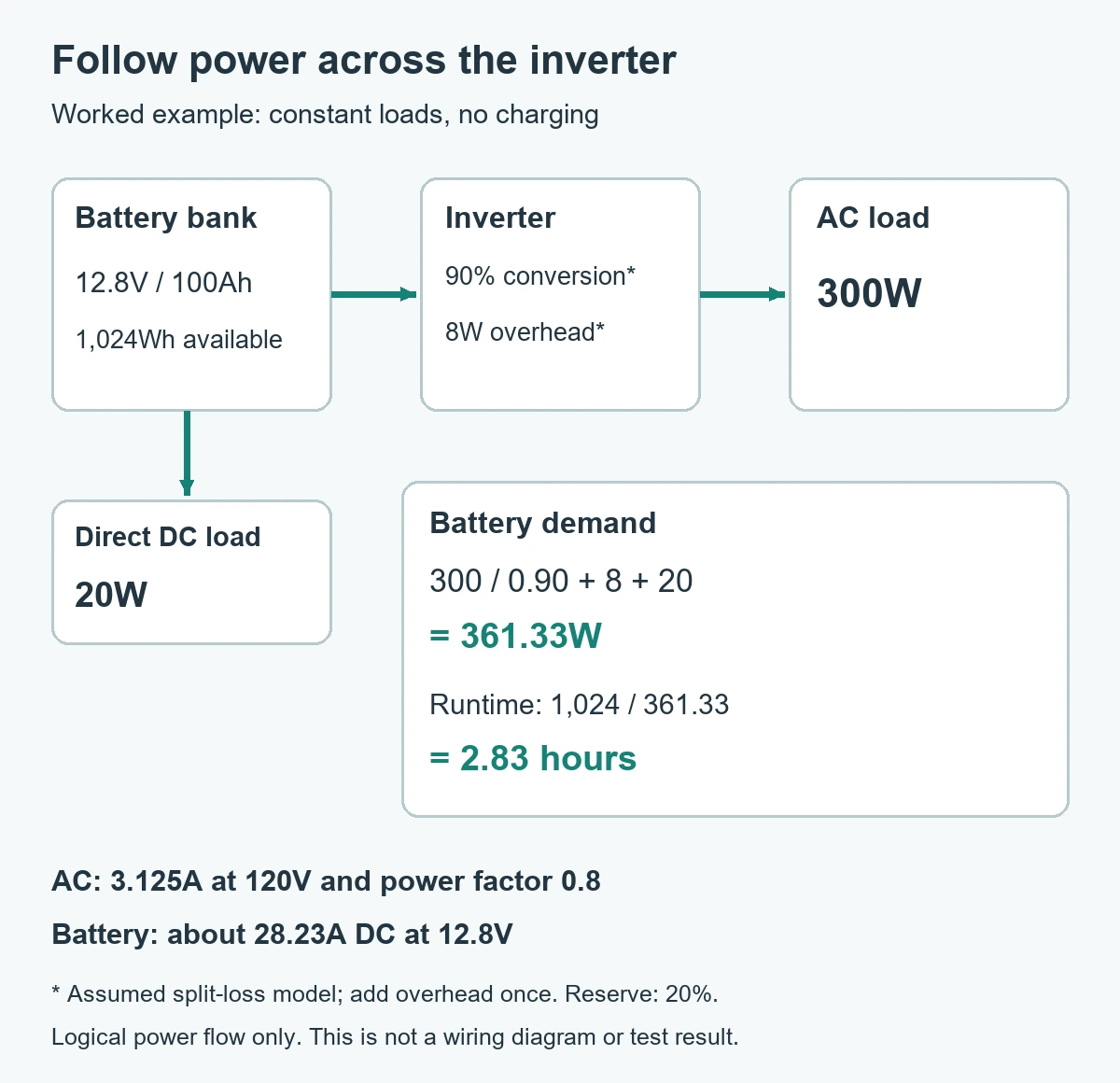
Calculation example only. The diagram shows power accounting, not an electrical wiring layout. Efficiency and overhead are assumed values.
Worked Example: A Mixed AC and DC Load
Assume the following constant loads, with no solar or other charging during the calculation:
| Input | Example value |
|---|---|
| Battery rating | 12.8V, 100Ah = 1,280Wh nominal |
| Starting charge / reserve | 100% / 20% |
| Available energy | 1,024Wh |
| AC load | 300W real output power |
| Conversion-only efficiency | 90%, written as 0.90 |
| Fixed inverter overhead | 8W, added once |
| Other battery-side DC demand | 20W |
First calculate average battery demand:
300 ÷ 0.90 + 8 + 20 = 361.33W
Then calculate estimated runtime:
1,024Wh ÷ 361.33W = 2.83 hours, or approximately 2 hours 50 minutes.
For a planning current at 12.8V:
361.33W ÷ 12.8V = 28.23A DC
Compare that with the earlier 3.125A AC example. Both can describe the same system at different locations; the battery-side figure also includes the separate DC load and assumed inverter losses.
The result is a calculated estimate, not an EcoBoss battery discharge test. The assumed 90% conversion efficiency and 8W overhead do not specify any particular inverter model.
Handle Fridges and Other Loads That Cycle
For a cycling appliance, estimate energy over a representative period instead of assuming its running watts continue all day. A fridge’s compressor label alone does not establish daily consumption.
As a hypothetical example, a 60W load operating for eight total hours in a day uses 60 × 8 = 480Wh. It averages 20W over the full 24 hours. That 20W figure helps estimate daily energy, but it does not replace the running-current or startup check.
For an AC fridge, include the inverter’s consumption during the time the inverter remains on. A fixed 8W overhead continuing for 24 hours would use 192Wh per day, even if the compressor operates for only part of the day. Use this separate-overhead method only when the conversion estimate excludes that overhead.
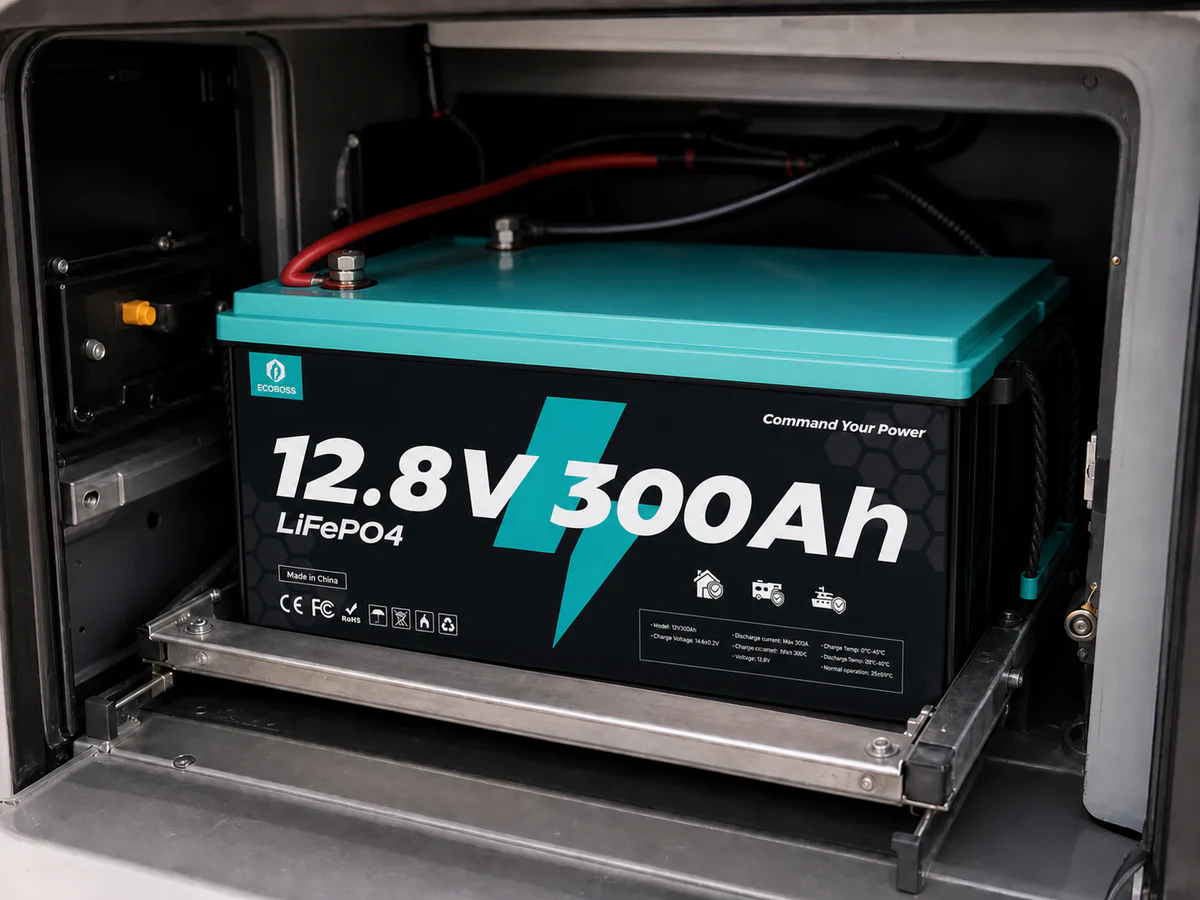
Honray scene photograph showing a 300Ah battery. It illustrates an RV installation context, not the 100Ah runtime example or measured appliance consumption.
For an RV energy budget, list lights, pumps and direct DC equipment separately from inverter-powered appliances. Use measured daily Wh where possible. The same load-inventory approach can support a review of RV solar and battery-system requirements.
If charging occurs while loads operate, calculate the net battery energy balance over time. A solar panel’s rated watts cannot simply be subtracted from the load for an entire day.
Check Current Limits Before Relying on the Runtime
Enough stored energy does not guarantee that the battery and inverter can supply the required power. Check continuous battery current, permitted surge duration, inverter W and VA ratings, and the rest of the DC circuit.
Consider a hypothetical 1,000W AC load at 90% overall inverter efficiency. Ignoring additional DC loads and cable losses, it draws about 92.6A at 12V. At 11V, the same calculation gives about 101.0A.
This illustrates why a nominal-voltage estimate can understate the highest operating current. It is not approval to discharge a particular battery to 11V or to operate continuously at a BMS threshold.
To ground those current limits in real hardware, Honray’s EcoBoss 12.8V 100Ah ABS pack supports 100 A continuous discharge (200 A peak) and 50 A continuous charge, whereas the 12.8V 200Ah pack doubles continuous discharge to 200 A (300 A peak, 100 A charge). Stepping up to 51.2V—such as the EcoBoss 51.2V 100Ah Server Rack (100 A continuous, up to 16P1S) paired with a 6.2 kW 48V all-in-one inverter charger (50/60 Hz auto adaptive)—cuts DC current by roughly four times for the same AC load.
Ask for the exact battery’s current limits and review its compatibility with the selected inverter. When comparing Honray inverter-charger models, match the model’s DC voltage and operating ratings to the battery bank. Do not select an inverter solely from a calculated number of runtime hours.
Frequently Asked Questions
How Many Amps Is 1,000 Watts at 12 Volts?
A 1,000W DC demand at exactly 12V draws approximately 83.33A. If 1,000W describes an inverter’s AC output instead, account for inverter losses before calculating battery current.
Can I Convert Watts to Amps Without Knowing Voltage?
No. A watts-to-amps calculation needs the voltage at the relevant point. Single-phase AC calculations also need power factor unless it is known to be 1. Identify whether you need appliance-side or battery-side current.
Is a 100Ah LiFePO4 Battery Equal to 1kWh?
Not necessarily. Nominal energy depends on voltage as well as Ah. A battery rated at 12.8V and 100Ah has 1.28kWh nominal energy. The usable amount depends on its condition, permitted discharge range and operating conditions.
What Is the Difference Between kW and kWh?
kW measures power, while kWh measures energy. A constant 0.5kW load operating for two hours uses 1kWh at that measurement point. Battery energy demand may be higher if conversion losses sit upstream of the measurement.
Can I Divide Battery Ah by Appliance Amps to Get Runtime?
You can make an approximate Ah-based estimate only when the current refers to the battery side and is reasonably constant. Do not divide a battery’s Ah rating by an inverter-powered appliance’s AC amps. Watt-hours and battery-side watts make mixed-voltage calculations clearer.
Should I Add Inverter Idle Power After Applying Efficiency?
Add idle or fixed overhead only if your efficiency model excludes it. If measured inverter input or overall efficiency already includes the equipment’s own consumption, adding it again would count the same loss twice.
Does Power Factor Reduce Battery Runtime by the Same Percentage?
No. Power factor determines the relationship between AC real power and apparent power; it is not an inverter-efficiency percentage. Use real watts for energy calculations, and assess inverter capability and actual efficiency at the load separately.
Will a Higher-Voltage Battery Always Run Longer?
A higher-voltage battery with the same Ah rating has more nominal energy, but compare complete banks in Wh. Rearranging the same batteries into a higher-voltage bank does not add energy. Equipment losses and compatibility can still change delivered runtime.
Can These Formulas Size the Cable and Fuse?
No. The formulas estimate current and energy, while cable and fuse selection also depends on installation conditions, conductor length, voltage drop, equipment instructions and applicable requirements. Use the calculated current as one input to that design.
Why Is My Measured Runtime Shorter Than the Estimate?
Measured runtime can be shorter because the initial charge, available capacity or efficiency was overestimated, or because load consumption was understated. Check actual battery-side energy, inverter shutdown behavior, temperature and the chosen reserve before changing the battery specification.
Calculation Basis and Editorial Notes
Prepared by Honray Energy from primary electrical references and manufacturer specifications. The examples are original calculations with stated assumptions, not comparative battery or inverter tests. Figures are rounded for readability.
To discuss a battery configuration, send Honray Energy the required runtime, measured load watts, system voltage and inverter model. Include both running and startup requirements.
OEM & ODM Customization
100% Dual EL Tested
Export to 50+ Countries
TÜV · UL · CE · UN38.3
Looking for wholesale pricing or custom OEM/ODM solutions?
Connect directly with our engineering team for a tailored quote within 24 hours.