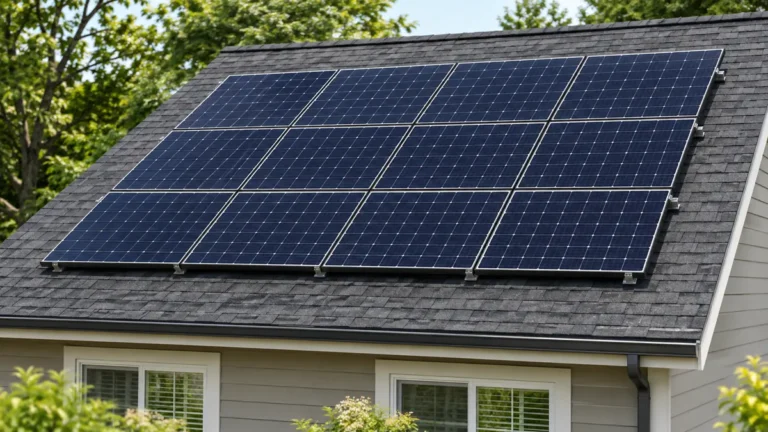

Solar Panel Efficiency Over Time: Technology Gains and Module Aging
Solar panel efficiency improves across new product generations, while an individual installed panel usually loses some output as it ages. These trends happen together. A better panel released next year does not increase the conversion efficiency of one already on your roof.
For buyers, the useful comparison combines starting efficiency, expected degradation and usable energy under site conditions. A higher nameplate efficiency can help where space is limited, but it does not establish long-term reliability.
Table of Contents
- Key takeaways
- What does solar panel efficiency over time actually mean?
- How Efficient Are Solar Panels?
- How has solar panel technology improved?
- Why installed solar panels lose performance
- How fast do solar panels degrade?
- A worked example: efficiency and power after 25 years
- Is lower production caused by aging or something else?
- What buyers should verify before ordering
- Should you replace older panels with more efficient ones?
- Frequently Asked Questions
- Do solar panels lose efficiency over time, and how fast do they degrade?
- Do solar panels become more efficient as they age?
- Does 90% power retention mean 90% efficiency?
- Do solar panels stop working after a performance warranty ends?
- Does a higher efficiency rating mean slower degradation?
- What is LID and LeTID degradation in solar panels?
- How much efficiency do solar panels lose in hot summer weather?
- Do bifacial solar panels maintain higher effective output over 25 years?
- Does Honray’s linear power warranty cover 25 or 30 years?
- Why can a 200W panel with 25% cell efficiency still measure ~21% module efficiency?
- Plan for useful output throughout the service period
Key takeaways
- Separate technology progress across different panels from degradation within the same panel.
- Compare module efficiency under the same test conditions; cell records and daily energy output are different measures.
- Treat an annual degradation assumption as a model input, not a guarantee for every product.
- Check temperature, soiling, shading and equipment faults before attributing lost production to aging.
What does solar panel efficiency over time actually mean?
Module efficiency is the fraction of incident sunlight converted into electrical power at a specified operating point. At standard test conditions, it is calculated from rated maximum power, module area and irradiance. Keep the area convention consistent when comparing datasheets.
Module efficiency (%) = rated power (W) ÷ [irradiance (W/m²) × module area (m²)] × 100.
For example, an illustrative 400 W panel with a total area of 2.0 m² has 20% efficiency at 1,000 W/m². This is an arithmetic example, not a Honray product specification.
| Measure | What changes over time? | How to compare |
|---|---|---|
| Technology progress | The starting efficiency of newly designed products | Compare different module generations at equivalent test conditions |
| Module degradation | The performance of the same physical panel as it ages | Compare measurements corrected for irradiance and temperature |
| System energy yield | Electricity delivered during a day or year | Account for weather, shading, downtime and system losses |
The U.S. Department of Energy explains standard test conditions using 1,000 W/m² irradiance and 25°C cell temperature. Outdoor cell temperature and available sunlight vary, so a nameplate rating is not an all-day output promise.
How Efficient Are Solar Panels?
Module efficiency describes how much of the sunlight falling on the module area becomes electrical power under the stated test conditions. For example, a hypothetical 400 W module with a 2 m² area at 1,000 W/m² has 20% module efficiency under those conditions. Compare complete-module ratings using the same test conditions and area basis.
When roof space is limited, compare both rated watts and module dimensions. For actual energy production, account for temperature, shading and the installed layout separately.
How has solar panel technology improved?
New designs improve conversion by reducing optical, electrical and recombination losses. Recombination occurs when generated charge carriers are lost before they can be collected. Better surface passivation, contacts and cell interconnection help more of the incoming light become usable power.
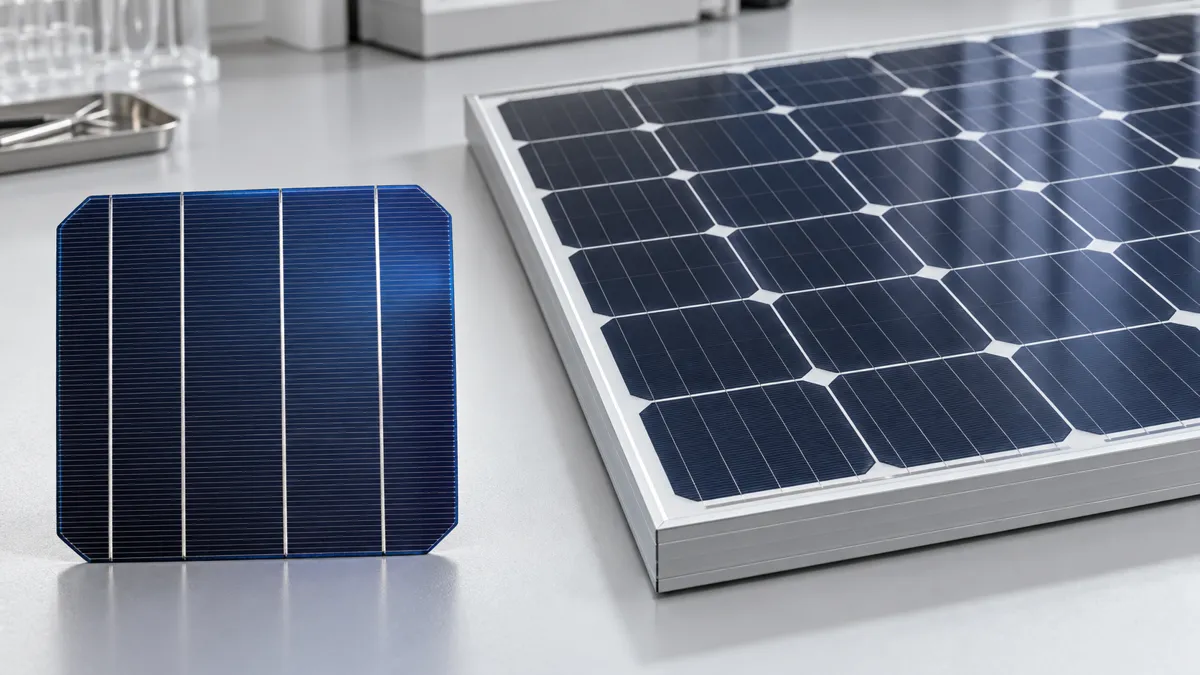
Fraunhofer ISE’s Photovoltaics Report, dated July 14, 2026, describes commercial silicon module efficiency development from about 17% to just under 25% over roughly ten years. This summarizes technology progress; the upper figure is not a market-wide average or a specification for every available panel.
PERC adds a passivated rear cell structure (see our monocrystalline vs. polycrystalline comparison for crystal and cell trade-offs). TOPCon uses a tunnel oxide passivated contact, while heterojunction combines crystalline silicon with thin amorphous-silicon layers. These approaches address different loss mechanisms. Their names alone do not establish the durability of a finished module.
Tandem cells stack absorbers that use different parts of the solar spectrum. Their laboratory potential is relevant to future products, but a cell record cannot be substituted for the efficiency, size or reliability of a commercial module.
Why installed solar panels lose performance
Exposure to light, heat, moisture and mechanical stress can change cells, encapsulation and electrical connections. The pattern depends on the cell design, materials, manufacturing quality and operating environment.
- Light-induced changes can affect susceptible cell designs during early exposure. Their size and timing are technology-specific.
- Thermal cycling can stress solder joints and interconnections. Mechanical damage can create cracks that reduce electrically active area.
- Moisture ingress, corrosion and encapsulant deterioration can affect electrical or optical performance.
- Potential-induced degradation can occur under certain voltage, material and environmental conditions. Diagnosis requires more than an energy-meter reading.
How fast do solar panels degrade?
There is no single annual rate that reliably predicts every module. Published field studies provide useful context, but the tested technologies, climates, measurement methods and observation periods matter.
A 2023 study reported by Sandia National Laboratories followed 834 modules representing 13 module types from seven manufacturers across three climates for five years. The median annual performance loss was 0.58%; changes were nonlinear over time. That early-life dataset is not a 25-year guarantee for today’s products.
For procurement, request evidence tied to the exact module family and bill of materials. Field results for another manufacturer or cell generation should not become an unsupported performance claim in your quotation.
A worked example: efficiency and power after 25 years
Assume a panel starts at 400 W and 20% module efficiency. For illustration only, assume it loses 0.5% of its remaining power each year, with no separate first-year loss. Keep module area and measurement conditions unchanged.
Remaining power after n years = 400 × (1 − 0.005)n. Under these assumptions, efficiency changes by the same relative proportion as maximum power.
| Elapsed years | Power retained | Equivalent maximum power | Equivalent efficiency |
|---|---|---|---|
| 0 | 100.0% | 400.0 W | 20.00% |
| 5 | 97.5% | 390.1 W | 19.50% |
| 10 | 95.1% | 380.4 W | 19.02% |
| 20 | 90.5% | 361.8 W | 18.09% |
| 25 | 88.2% | 352.9 W | 17.64% |
At year 25, the modeled efficiency is 17.64%, a fall of 2.36 percentage points from 20%. The relative loss is about 11.8%. Losing 0.5% of remaining power each year does not mean losing 0.5 efficiency percentage points each year.
Is lower production caused by aging or something else?
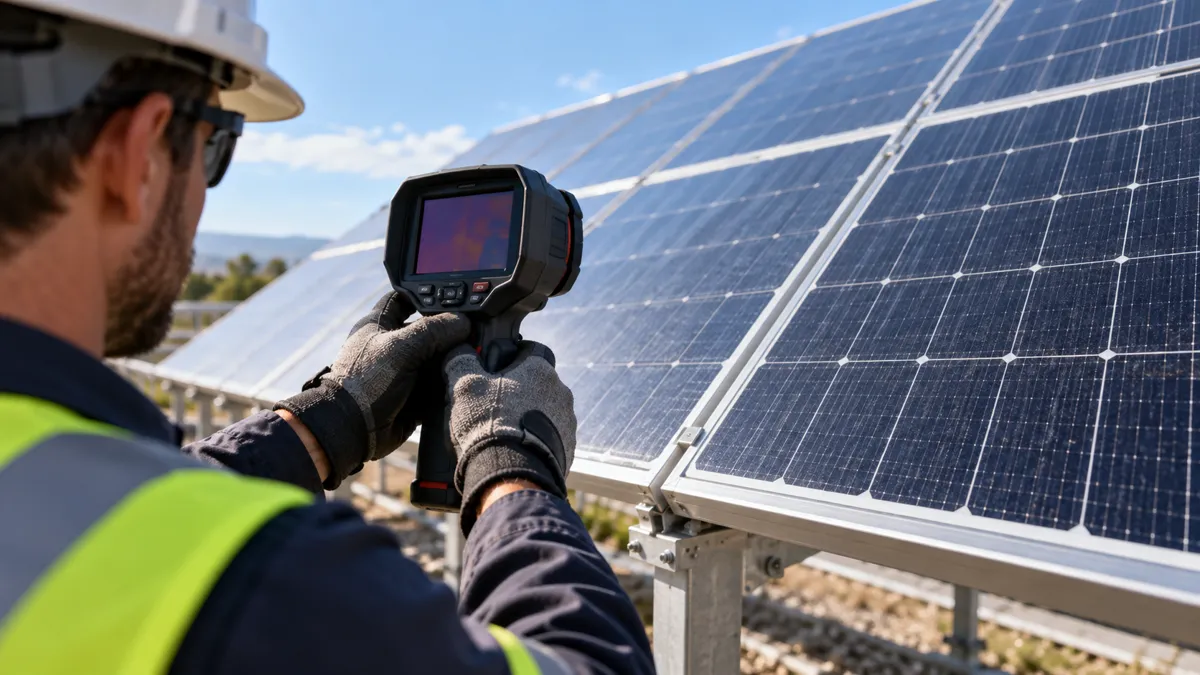
Lower production can reflect temporary operating conditions or a system fault rather than permanent module degradation. Start with the timing and pattern of the loss, then compare production under similar irradiance and cell temperatures.
| Observed pattern | Possible explanation | Useful next check |
|---|---|---|
| Output falls during hot afternoons | Temperature-related power reduction | Compare cell temperature and the module power temperature coefficient |
| Output improves after appropriate cleaning | Soiling loss | Review site conditions and the manufacturer’s cleaning instructions |
| A sharp drop or one string underperforms | Shading, a connection problem or equipment fault | Review monitoring and have a qualified technician inspect the affected circuit |
| A gradual persistent decline after corrections | Possible module or system degradation | Use calibrated electrical testing and weather-adjusted trend analysis |
For an illustrative temperature calculation, take a power coefficient of −0.35%/°C and a cell temperature of 55°C. Relative to 25°C, the estimated temperature effect is −10.5%. This hypothetical instantaneous loss is separate from aging and is not a specification for any Honray model.
Cleaning can recover soiling losses, but it cannot restore damaged cells to their original condition. Likewise, improved inverter operation can increase delivered energy without changing a panel’s intrinsic conversion efficiency.
What buyers should verify before ordering
Compare starting performance and long-term evidence together. A compact high-efficiency panel can fit a restricted mounting area, while a reliable module with a slightly lower starting efficiency may suit a different project better.
- Obtain the exact model datasheet: maximum power, dimensions, efficiency, power tolerance and temperature coefficient.
- Request the applicable product warranty and power-performance warranty. Check the baseline, first-year allowance, annual formula, exclusions and claim process.
- Match reliability documents to the module construction and intended environment. Ask how material or supplier changes are controlled.
- Record acceptance measurements and serial numbers. Retain baseline test data so later comparisons have a defensible reference.
- For an OEM device, test the panel with the actual charge controller, battery and load profile. Allow for poor-season sunlight, heat, shading and aging.
For a space-constrained device, Honray’s custom small solar panel service and 100W–700W custom solar panels provide relevant starting points for discussing dimensions and electrical output. Share the installation environment, available area and daily energy demand; confirm the proposed model’s specifications and test requirements before approval.
Should you replace older panels with more efficient ones?
Replacement makes sense when the additional useful generation or reliability benefit justifies the complete project cost. Efficiency improvement alone does not establish that case.
Compare the existing system’s measured, weather-adjusted output with the proposed replacement design. Include removal, mounting compatibility, electrical limits, labor and any inverter changes. Check whether available roof area, export limits or battery charging capacity restrict the value of higher panel power.
A healthy older array can remain useful even when newer modules produce more watts per square meter. Investigate a sudden performance drop before deciding that age requires replacement.
Frequently Asked Questions
Do solar panels lose efficiency over time, and how fast do they degrade?
Yes—when buyers ask do solar panels lose efficiency over time, gradual output decline happens through normal solar panel degradation over time caused by UV exposure, thermal cycling, and moisture stress. In practical procurement terms, this solar panel efficiency decrease over time (often referred to as solar panel efficiency loss) means a modern 22%–25% module produces slightly fewer kWh in Year 20–25 than in Year 1. Always compare photovoltaic efficiency over time against the datasheet’s linear degradation clause in our 25-year solar panel warranty guide.
Do solar panels become more efficient as they age?
An installed solar panel generally does not become more efficient with age. Technology improvements apply to newly designed products. Some technologies show initial stabilization behavior, but that does not mean an older panel inherits advances made in later generations.
Does 90% power retention mean 90% efficiency?
No. A panel that began at 20% module efficiency and retains 90% of its original maximum power would have approximately 18% efficiency under equivalent test conditions and unchanged area. Power retention is relative to its own starting output.
Do solar panels stop working after a performance warranty ends?
A solar panel does not automatically stop working when its performance warranty ends. Continued use depends on condition, electrical safety and useful output. Warranty duration defines contractual coverage, rather than a fixed shutdown date.
Does a higher efficiency rating mean slower degradation?
A higher initial module efficiency does not by itself prove slower degradation. Buyers need separate evidence for long-term performance, including the exact construction, relevant testing, field data and applicable warranty terms.
What is LID and LeTID degradation in solar panels?
Light-Induced Degradation (LID) and Light- and Elevated-Temperature-Induced Degradation (LeTID) cause small initial efficiency drops during a module’s first months of sunlight exposure, most noticeably in boron-doped P-type cells; modern N-type TOPCon and gallium-doped wafers significantly reduce these early losses.
How much efficiency do solar panels lose in hot summer weather?
Aside from permanent annual aging, solar panels experience temporary thermal power loss whenever cell temperature exceeds 25°C—typically around −0.30% to −0.40% per °C (for instance, Honray’s 100W bifacial module specifies −0.40%/°C Pmax temperature coefficient).
Do bifacial solar panels maintain higher effective output over 25 years?
When mounted over reflective surfaces with rear clearance, bifacial solar panels can harvest 10%–15% rear-side gain in addition to front output, and dual-glass construction often slows moisture ingress compared with thin polymer backsheets.
Does Honray’s linear power warranty cover 25 or 30 years?
Honray standard rigid monocrystalline and bifacial modules carry a 12-year product warranty and a 25–30 year linear power output warranty staying at or above 80% of rated STC power, subject to the formal SKU datasheet and sales contract. See our warranty guide for claim rules.
Why can a 200W panel with 25% cell efficiency still measure ~21% module efficiency?
Cell efficiency is tested on the bare silicon wafer alone, whereas module efficiency divides total panel watts by the full outer frame length and width, which includes aluminum borders, inter-cell gaps, and busbar margins.
Plan for useful output throughout the service period
Choose a module around the energy your application needs, the area available and the conditions it will face. Then evaluate aging separately from starting efficiency. A documented baseline, a realistic loss model and clear acceptance criteria make later performance reviews more useful than a headline efficiency figure alone.
OEM & ODM Customization
100% Dual EL Tested
Export to 50+ Countries
TÜV · UL · CE · UN38.3
Looking for wholesale pricing or custom OEM/ODM solutions?
Connect directly with our engineering team for a tailored quote within 24 hours.