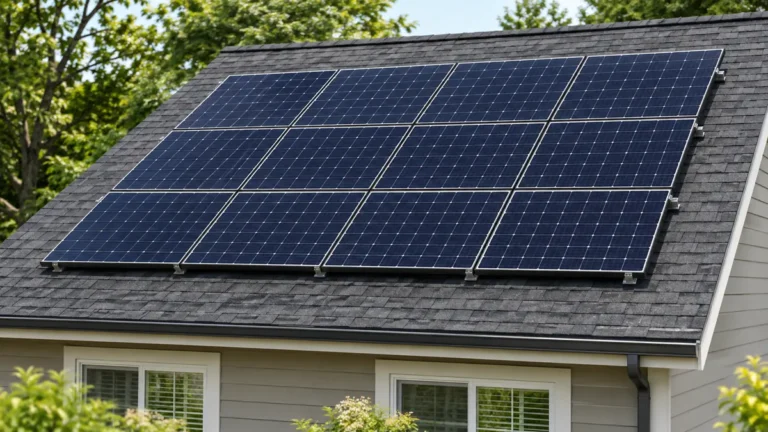

Solar Panel Dimensions: How to Plan Installation Space
Plan solar panel installation space from the exact module dimensions, then allow for mounting hardware, gaps, obstacles and service access. The panel’s length multiplied by its width gives its face area. It does not give the full installation footprint.
For an installer or equipment buyer, the useful question is how many approved modules fit in the usable space. Start with a measured drawing and the selected panel’s current datasheet. Compare layouts before confirming an order.
Key Takeaways
- Wattage does not define a universal solar panel size. Check the exact model and drawing revision.
- Measure usable length and width after excluding edges, equipment and required access areas.
- Test portrait and landscape layouts with the specified mounting gaps. Total area alone can overstate panel count.
- Confirm clamp positions, cable routing, ventilation and structural support before approving the layout.
Table of Contents
- What size are solar panels?
- Read the complete mechanical drawing
- How Much Do Solar Panels Weigh?
- Measure usable installation space
- Calculate how many panels fit in a rectangle
- Worked example: a 3000 × 2200 mm surface
- Compare larger modules on the same drawing
- Place obstacles onto the candidate layout
- Allow for tilted rows and installed height
- Check the layout before placing an order
- Standard Solar Panel Size & Frame Dimensions Reference
- Frequently Asked Questions
- Do all 100W solar panels have the same dimensions?
- How much space does one Honray 200W solar panel need?
- Can a solar panel be installed in landscape orientation?
- How much gap should be left between solar panels?
- Is total roof area enough to calculate panel quantity?
- What are the dimensions and weight of Honray 100W and 200W portable folding solar panels?
- What are the dimensions of Honray 100W and 200W flexible solar panels?
- How much space does a 100W rigid monocrystalline or bifacial solar panel take?
- How big are 400W to 550W residential and commercial solar panels?
- Can Honray manufacture custom solar panel dimensions for OEM enclosures or IoT devices?
What size are solar panels?
Solar panels have no single standard physical size. Compact modules for small installations and larger rooftop modules use different footprints, even when their intended applications overlap.
The examples below show actual published dimensions. They are reference points for planning, not interchangeable specifications.
| Published module | Length × width × thickness | Approximate inches | Panel face area |
|---|---|---|---|
| Honray MK02-100, 100W | 910 × 585 × 30 mm | 35.83 × 23.03 × 1.18 in | 0.532 m² / 5.73 ft² |
| Honray 200W rigid panel | 1340 × 770 × 30 mm | 52.76 × 30.31 × 1.18 in | 1.032 m² / 11.11 ft² |
Sources: Honray’s 100W rigid solar panel specifications and 200W rigid solar panel specifications.
A longer panel may offer more rated power but fit poorly between vents or roof fittings. Smaller panels can occupy separate clear spaces, although more modules also mean more mounting and wiring connections. Compare both the physical layout and the electrical design.
Read the complete mechanical drawing
Use the outside dimensions of the frame or laminate to check fit. Cell dimensions, mounting-hole spacing and shipping-carton dimensions describe different measurements.
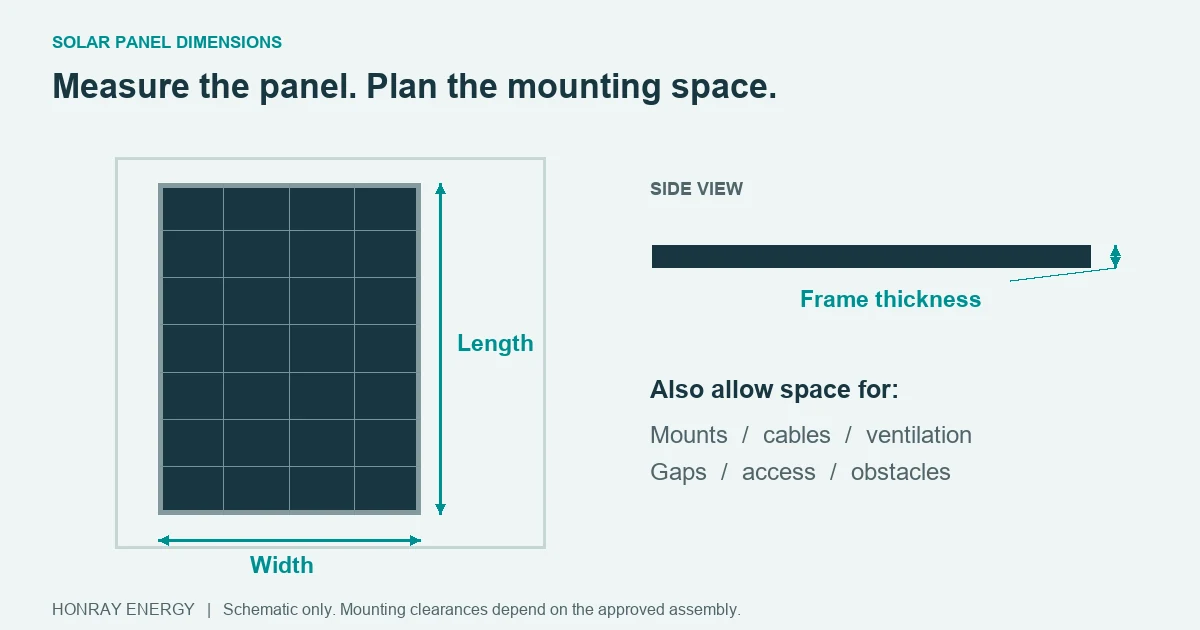
Check these details before drawing the panel onto the installation surface:
- Overall length and width: Include any stated manufacturing tolerance.
- Thickness and installed height: Add the mounting assembly’s height and the required clearance underneath.
- Mounting interface: Locate approved holes, clamp zones and support points.
- Rear equipment: Mark the junction box, cable exits and connector positions.
- Hardware envelope: Include brackets or rail ends that extend beyond the frame.
Do not assume every position along a frame can accept a clamp. The applicable module and mounting-system instructions must support the chosen arrangement. Canadian Solar’s installation manual illustrates why mounting, ventilation and frame spacing are separate design checks. Its requirements apply to the products covered by that manual; they do not establish Honray clearances.
How Much Do Solar Panels Weigh?
Solar panel weight must come from the exact model’s datasheet. Wattage, length and width do not establish module mass. Check the weight of each panel, then include rails, brackets, cables and any ballast when reviewing the complete installation load.
For a module-only comparison, divide panel weight by its external area, using kilograms and square meters or pounds and square feet consistently. A solar panel weight per square foot calculation describes distributed module mass; it does not show the concentrated forces at roof attachments or prove that a roof is suitable.
Send the panel schedule and proposed mounting layout to the project’s structural reviewer. Wind, snow, support spacing and the condition of the roof need their own assessment. Use the residential installation checklist alongside the dimensional layout.
Measure usable installation space
Draw the surface first, then mark every area that must remain clear. On a sloped roof, use measurements along the roof plane for a flush-mounted layout, rather than its horizontal map projection.
For an RV solar system, marine boat setup, or equipment enclosure, also check curvature and moving parts. A roof hatch may need more space when open than when closed. An antenna or raised vent can cast a shadow beyond its physical outline.
| Planning layer | What to mark | Information to confirm |
|---|---|---|
| Surface boundary | Roof edges, deck edges, enclosure outline | Measured dimensions and suitable support areas |
| Required exclusions | Access routes, edge zones, drains and equipment service areas | Applicable local requirements and project instructions |
| Physical obstacles | Vents, hatches, air conditioners and antennas | Full dimensions, opening movement and maintenance access |
| Shading | Trees, chimneys, parapets and raised equipment | Shadow position at relevant times and seasons |
| Mounting and wiring | Brackets, rails, cable routes and connectors | Approved component drawings and installation instructions |
PNNL’s solar orientation planning guidance explains the importance of orientation and shading assessment. A clear rectangle on a drawing may still be a poor solar location.
There is no universal roof-edge allowance suitable for every project. Establish the applicable requirements with the local authority and project designer. The U.S. Department of Energy’s rooftop solar permitting overview provides context for permitting and inspection in the United States.
Calculate how many panels fit in a rectangle
For a simple rectangular grid, calculate the count along each side separately. This method checks whether whole panels fit; dividing roof area by panel area does not.
Let U be usable width, V usable length, a the panel dimension across the width, b its dimension along the length, and g the gap between adjacent frames. Use the same units throughout.
Columns = floor((U + g) ÷ (a + g))
Rows = floor((V + g) ÷ (b + g))
Panel count = columns × rows
Here, “floor” means round down to a whole number. A row of n panels has n − 1 internal gaps. That is why the formula adds one gap to the usable dimension before dividing.
The resulting array width is n × a + (n − 1) × g. Check that width and the corresponding array length against the drawing. Account separately for hardware extending outside the grid.
Worked example: a 3000 × 2200 mm surface
Assume a flat rectangular surface measuring 3000 × 2200 mm. An illustrative 100 mm exclusion on every edge leaves a usable rectangle of 2800 × 2000 mm.
Use the Honray MK02-100 dimensions of 910 × 585 mm, with an assumed 20 mm gap between frames. Both the edge exclusion and gap are calculation inputs only. They are not installation requirements or mounting approval.
| Layout | Panel dimension across × along | Columns × rows | Array envelope, including internal gaps | Geometric count | Combined nameplate power |
|---|---|---|---|---|---|
| Portrait | 585 × 910 mm | 4 × 2 | 2400 × 1840 mm | 8 | 800W |
| Landscape | 910 × 585 mm | 3 × 3 | 2770 × 1795 mm | 9 | 900W |
For portrait: floor(2820 ÷ 605) × floor(2020 ÷ 930) = 4 × 2 = 8 panels.
For landscape: floor(2820 ÷ 930) × floor(2020 ÷ 605) = 3 × 3 = 9 panels.
The usable area is 5.6 m². Dividing it by the panel area of 0.53235 m² gives about 10.52. That ratio does not show that ten panels fit. The tested uniform grids hold eight or nine before obstacles and mounting constraints are considered.
These are two candidate layouts, not proof of the maximum possible packing. A mixed arrangement needs its own drawing and mounting review. Nameplate power is the sum of module ratings under standard test conditions, not an estimate of daily energy production.
Compare larger modules on the same drawing
Four of the listed Honray 200W panels form a 2700 × 1560 mm landscape grid with the same assumed 20 mm gap. That grid fits geometrically within 2800 × 2000 mm and totals 800W of nameplate power.
This comparison shows why watts per panel alone cannot settle a space decision. Nine smaller panels offer a higher nameplate total in this example, while four larger panels involve fewer individual modules. Mounting feasibility, shading and electrical compatibility still need separate checks.
Place obstacles onto the candidate layout
Overlay the full exclusion zone of each obstacle, rather than subtracting only its area. The location of a vent can prevent a complete panel from fitting even when plenty of unused area remains elsewhere.
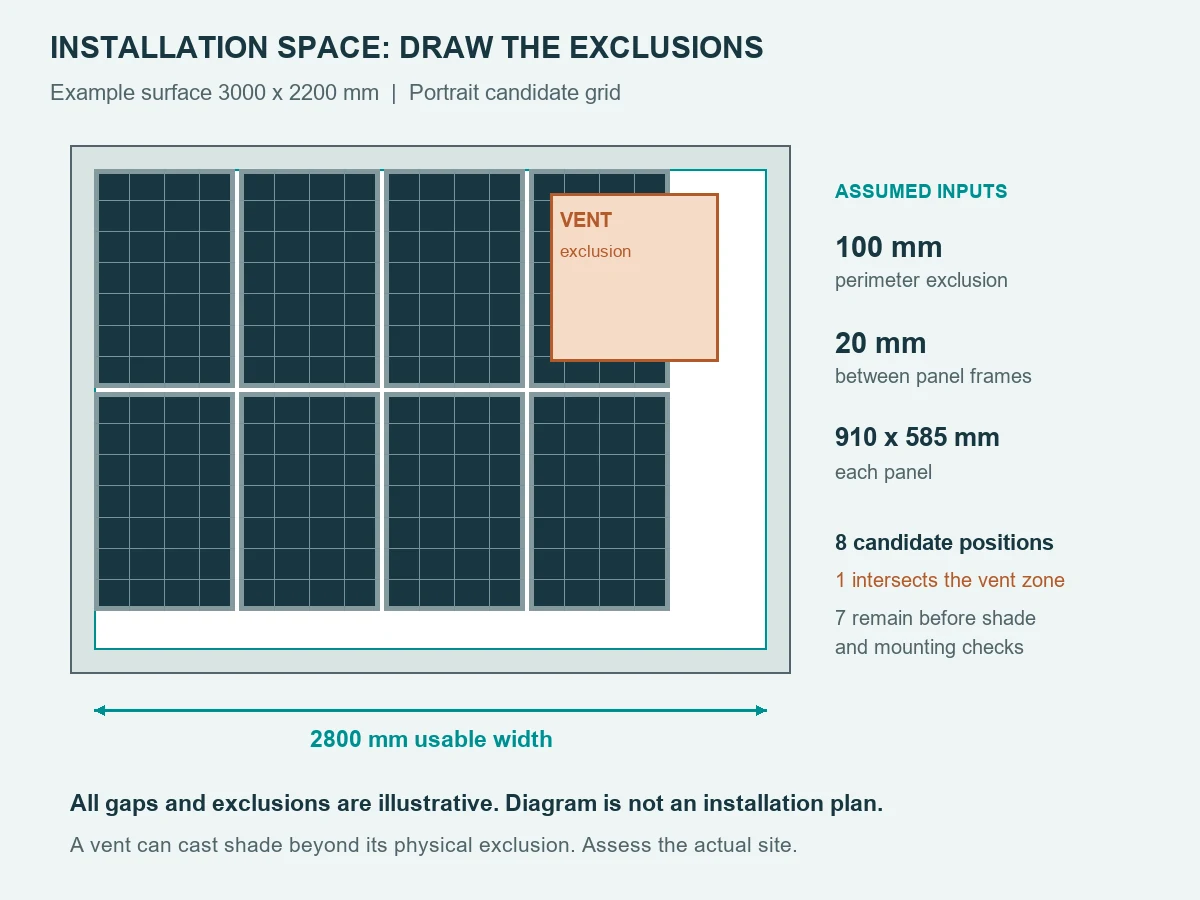
Illustrative portrait layout using the dimensions above. The vent exclusion overlaps one of eight candidate panels, leaving seven geometrically clear positions. All exclusions are assumptions, and the drawing is not an installation plan.
In this example, the vent’s expanded exclusion intersects the upper-right panel. Removing that candidate leaves seven positions before checking shadow movement, bracket access and cable routes.
Do not convert a percentage of shaded surface directly into the same percentage of power loss. Shading effects depend on the module’s cell arrangement, bypass diodes and system configuration. Assess the proposed array using the actual equipment and site conditions.
Allow for tilted rows and installed height
Tilted arrays need a separate spacing assessment. Tilting changes the horizontal footprint, raises the rear edge and can create shadows on the next row.
For a panel with dimension L along the tilt direction and tilt angle θ, its horizontal projection is L × cos(θ). The height difference between its two edges is L × sin(θ), excluding the mounting base height.
These geometric expressions do not determine a suitable row gap. Row spacing also depends on orientation, solar position, terrain and the design’s accepted shading conditions. The Australian government’s solar design considerations describe how site conditions and tilt affect a system layout.
For flush-mounted modules, confirm the required ventilation space and connector clearance beneath the panel. A frame thickness of 30 mm does not mean the completed assembly rises only 30 mm above the surface.
Check the layout before placing an order
Approve the mechanical layout together with the mounting and electrical specifications. A panel that fits physically can still be unsuitable for the proposed controller, inverter or support structure.
Before releasing a purchase order, record:
- The exact module model, drawing revision and dimensional tolerance.
- Usable surface dimensions and all exclusion zones.
- Panel orientation, quantity, internal gaps and complete hardware envelope.
- Approved fixing positions, support structure and applicable load checks.
- Installed height, ventilation space and equipment-opening clearance.
- Cable exit locations, connector access, routing and strain relief.
- Voltage and current compatibility with the selected electrical equipment.
- A physical fit check or sample trial where space is tight.
Use Honray’s solar panel range to shortlist module formats, then request the current drawing for the proposed model. Public product tables are a starting point for selection; the approved specification should govern the order.
For an enclosure that cannot accept a stock format, Honray’s custom small solar panels provide a route to discuss the available outline and charging requirements. Send the usable-space drawing, load requirements, mounting details and expected quantity. Available area still limits feasible output.
Standard Solar Panel Size & Frame Dimensions Reference
While there is no single universal typical solar panel size across manufacturers, buyers comparing solar panel length and width, solar panel frame dimensions, and roof fit usually sort modules into compact off-grid sizes (100W–200W) and standard residential or commercial sizes (400W–600W+). Always confirm the exact datasheet drawing before finalizing racking.
Need non-standard lengths or compact footprints that fit tight OEM housings? Explore our custom small solar panels or 100W–700W custom PV modules. To convert your available roof space and electricity consumption into panel count, run our solar panel calculator.
Frequently Asked Questions
Do all 100W solar panels have the same dimensions?
No. A 100W rating describes electrical power under specified test conditions, not a fixed length or width. Panel dimensions depend on cell efficiency, cell arrangement and construction. Check the exact model’s mechanical drawing before ordering a replacement.
How much space does one Honray 200W solar panel need?
The listed Honray 200W rigid panel measures 1340 × 770 × 30 mm, giving a face area of about 1.032 m². Its installation needs additional allowance for the approved mounting hardware, gaps, ventilation and access. Confirm those allowances for the selected assembly.
Can a solar panel be installed in landscape orientation?
A solar panel can use landscape orientation when its module and mounting-system instructions permit that arrangement. Check the approved clamp or hole positions, support requirements and cable reach. Rotating a drawing alone does not establish mounting approval.
How much gap should be left between solar panels?
Use the gap required by the applicable module instructions and mounting system. Also account for thermal movement and hardware dimensions. The 20 mm gap used in this article is an illustrative calculation input, not a general recommendation.
Is total roof area enough to calculate panel quantity?
No. Total roof area does not describe the shape, obstacles, exclusions or mounting positions available for solar panels. Draw the usable areas, test whole-panel layouts and assess shading before confirming quantity.
What are the dimensions and weight of Honray 100W and 200W portable folding solar panels?
Honray’s 100W portable solar panel measures 600 × 563 × 35 mm folded (1,126 × 600 × 25 mm unfolded) and weighs 3.8 kg, while the 200W portable solar panel measures 573 × 600 × 45 mm folded (2,148 × 600 × 25 mm unfolded) and weighs 6.5 kg. Confirm unfolded footprint clearance before setting up camp or vehicle side shading.
What are the dimensions of Honray 100W and 200W flexible solar panels?
The 100W flexible solar panel measures 860 × 685 mm (2.5 kg net), and the 200W flexible solar panel measures 1,350 × 780 mm (4.3 kg single-carton gross weight). Both support gentle roof curvature up to 30° without sharp creases.
How much space does a 100W rigid monocrystalline or bifacial solar panel take?
Both Honray’s 100W rigid monocrystalline panel and 100W bifacial solar panel measure 1,010 × 460 × 30 mm and weigh 4.9 kg. Add mounting clamp widths and junction-box cable clearance when fitting tight RV racks or boat arches.
How big are 400W to 550W residential and commercial solar panels?
Standard 400W–550W modules are substantially larger than 100W–200W off-grid panels—often roughly 1,720–2,280 mm long by 1,134 mm wide—so fewer modules reach a given kW rating, but tighter roof obstructions can reduce total fit. Verify the exact frame drawing on Honray monocrystalline solar panels before locking in a layout.
Can Honray manufacture custom solar panel dimensions for OEM enclosures or IoT devices?
Yes, Honray supports small custom solar panels (0.1W–100W) in rectangular, circular, polygonal, or strip profiles as well as custom 100W–700W modules. Share your mechanical CAD envelope, mounting hole pattern, voltage target, and cable exit location for feasibility review.
OEM & ODM Customization
100% Dual EL Tested
Export to 50+ Countries
TÜV · UL · CE · UN38.3
Looking for wholesale pricing or custom OEM/ODM solutions?
Connect directly with our engineering team for a tailored quote within 24 hours.