
How to Choose Solar Panels for a Portable Power Station
Choose solar panels for a portable power station by matching the station’s solar input voltage, current, connector and power limits first. Then size the array for the energy you need to replace each day and the sunlight available where you will use it.
A panel with the right wattage can still be incompatible. Its open-circuit voltage may exceed the station’s limit, or its operating voltage may be too low to charge reliably. Use the exact power station manual and panel datasheet before buying a panel or adding another one.
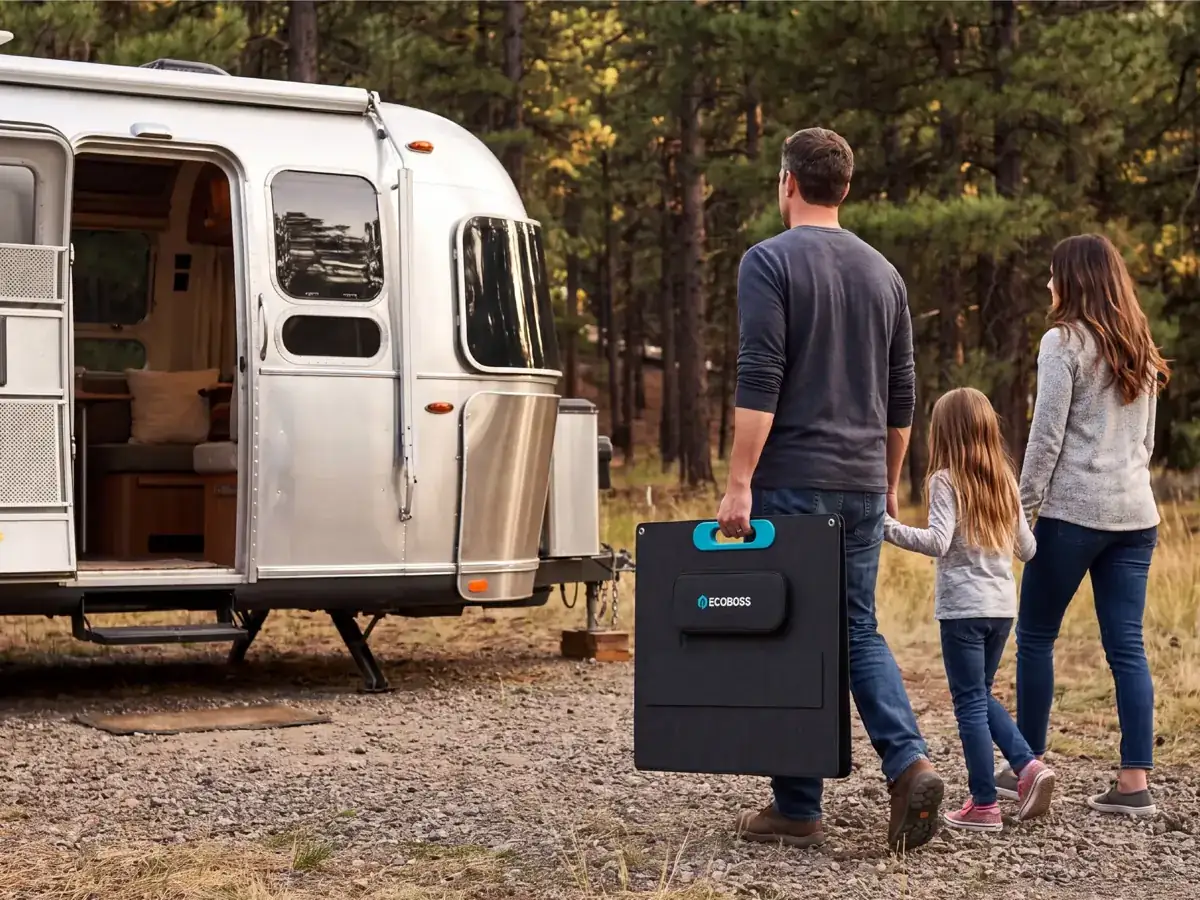
Table of Contents
- Key takeaways
- 1. Read the power station’s solar input specifications
- 2. Size the panel array for daily energy use
- What does that mean for charging time?
- 3. Check panel voltage before connecting more panels
- A hypothetical cold-weather voltage check
- 4. Match the connector, polarity and charging path
- Do you need an external charge controller?
- 5. Choose a format you will actually deploy
- 6. Test the complete combination before relying on it
- Pre-purchase checklist
- Frequently Asked Questions
- Can I use a different brand of solar panel with my portable power station?
- Is a 200 W solar panel enough for a portable power station?
- Can I connect a 400 W panel to a 200 W solar input?
- Why is the solar input lower than the panel’s rated watts?
- Can a portable solar panel charge through a window?
- Should I choose series or parallel connections?
- What are the exact specs and dimensions of Honray 100W and 200W portable solar panels?
- Which adapters come with Honray portable solar panels for power stations?
- Can I connect two 200W portable solar panels in parallel using a Y-branch MC4 connector?
- Should I choose a 200W portable folding panel or a 200W rigid panel for van life?
- Discuss a panel configuration with Honray Energy
Key takeaways
- Check the solar input specifications, not the power station’s AC output rating.
- Keep cold-weather array open-circuit voltage below the maximum permitted PV input voltage.
- Calculate daily energy in watt-hours; panel wattage alone does not predict recharge time.
- Confirm cable polarity, connector dimensions and any adapter identification requirements.
- Treat compatibility as specific to the station, panel model and wiring arrangement.
1. Read the power station’s solar input specifications
Start with the solar or PV input section of the manual. The AC inverter rating tells you how much load the station can supply; it does not tell you how much solar power the station can accept.
| Specification | What to check | Why it matters |
|---|---|---|
| Maximum PV input voltage | Absolute voltage ceiling for each input | Exceeding it can damage the charging electronics. |
| MPPT operating range and start voltage | Voltage needed to start and sustain solar charging | A panel can be below the maximum voltage yet still fail to charge. |
| PV input current | Operating-current limit and any stated short-circuit-current limit | These are separate limits; verify both where specified. |
| Maximum solar input power | Per-port limit and any combined limit | Extra panel wattage may be unused or prohibited. |
| Input connector | Connector type, pinout, polarity and approved cable | A plug that fits is not proof of compatibility. |
MPPT (maximum power point tracking) adjusts the operating point to harvest power efficiently. The controller adjusts the electrical operating point to collect power from the panel. If a station has two solar inputs, check whether they have independent trackers and whether a combined charging limit applies.
2. Size the panel array for daily energy use
Estimate the energy you need to replace in a typical day, including the station’s own consumption and conversion losses where relevant. Battery capacity in Wh describes stored energy; panel power in W describes an instantaneous rate.
For each appliance, multiply average watts by operating hours. A refrigerator cycles on and off, so use measured daily energy or a credible duty-cycle estimate rather than assuming its nameplate power runs continuously.
| Illustrative daily load | Assumption | Energy |
|---|---|---|
| Laptop | 60 W × 4 hours | 240 Wh |
| Lighting | 10 W × 5 hours | 50 Wh |
| Other DC devices | 20 W × 3 hours | 60 Wh |
| Total appliance demand | Hypothetical example, before station losses | 350 Wh |
If your daily recharge target is 500 Wh after allowing for losses, a simple planning equation is: panel watts = daily recharge target ÷ (peak sun hours × yield factor).
With an assumed four peak sun hours and an assumed 0.75 yield factor, 500 ÷ (4 × 0.75) is about 167 W. A compatible 200 W array is a candidate to evaluate. The 0.75 factor is an illustration, not a measured result or a universal efficiency value.
Peak sun hours express daily solar energy as equivalent hours at 1,000 W/m². They are not the hours between sunrise and sunset. Use location- and season-specific sunlight data, and allow for shade, clouds, setup angle and time spent packed away.
What does that mean for charging time?
Divide the energy you need to add by the average net charging power. Adding 600 Wh at an assumed average net 150 W takes about four charging hours. At 80 W it takes about 7.5 hours. These are arithmetic scenarios, not product charging-time claims.
Real charging takes longer if solar input falls, appliances run during charging, the battery is outside its allowed charging temperature, or charging slows near full capacity. Check whether the station supports simultaneous charging and discharge.
3. Check panel voltage before connecting more panels
Use open-circuit voltage, or Voc, to check the maximum-voltage boundary. Use operating voltage, or Vmp, to assess the MPPT operating range. A “12 V” or “24 V” marketing label does not replace either value.
Cold panels can produce a higher Voc than the datasheet value at standard test conditions. Use the panel’s Voc temperature coefficient and the design minimum temperature required by the manufacturer. Stay below the station’s maximum permitted input voltage with an appropriate margin.
A hypothetical cold-weather voltage check
Assume a panel has Voc of 24 V at a cell temperature of 25°C and a Voc temperature coefficient of −0.30%/°C. At an assumed cell temperature of −10°C, the temperature difference is 35°C. The estimated Voc becomes 24 × [1 + (0.003 × 35)] = 26.52 V per panel.
Two of these panels in series would reach about 53.04 V under that assumption. They are unsuitable for an input limited to 50 V, even though their combined nameplate Voc at 25°C is only 48 V. Actual selection must also account for tolerances and manufacturer requirements.
| Arrangement with two identical panels | Voltage behavior | Current behavior | Main check |
|---|---|---|---|
| Series | Voltages add | Current remains approximately that of one panel | Cold-weather total Voc and MPPT range |
| Parallel | Voltage remains approximately that of one panel | Currents add | Input current, Isc limit, cable and protection ratings |
Some stations limit the current they draw, but that does not mean every oversized array is permitted. Check the separate short-circuit-current limit and whether the manufacturer allows extra array wattage. Do not assume current limiting protects against excessive voltage.
4. Match the connector, polarity and charging path
Confirm the complete path from panel output to the station’s PV input. Check the panel connectors, adapter, cable conductor size, cable length, station plug and polarity.
- Verify exact barrel connector dimensions where applicable; similar-looking plugs may differ.
- Check whether connector requires a particular cable or identification arrangement.
- Use compatible connector pairs and cables rated for the proposed voltage and current.
- Keep extension cables as short as practical while placing the station in a shaded, ventilated location.
- Follow the manufacturer’s connection and disconnection sequence.
A passive adapter changes the connection; it does not make an unsuitable panel voltage safe. Do not feed a grid-tied inverter’s AC output into a station’s DC solar input.
Do you need an external charge controller?
Usually, a portable power station with a built-in solar controller accepts the panel’s unregulated PV output through its specified cable. A panel kit designed to charge a separate 12 V battery may include a controller that is unsuitable in this path. Use an approved connection arrangement rather than putting an extra controller in series by default.
5. Choose a format you will actually deploy
| Panel format | Suitable use | What to examine |
|---|---|---|
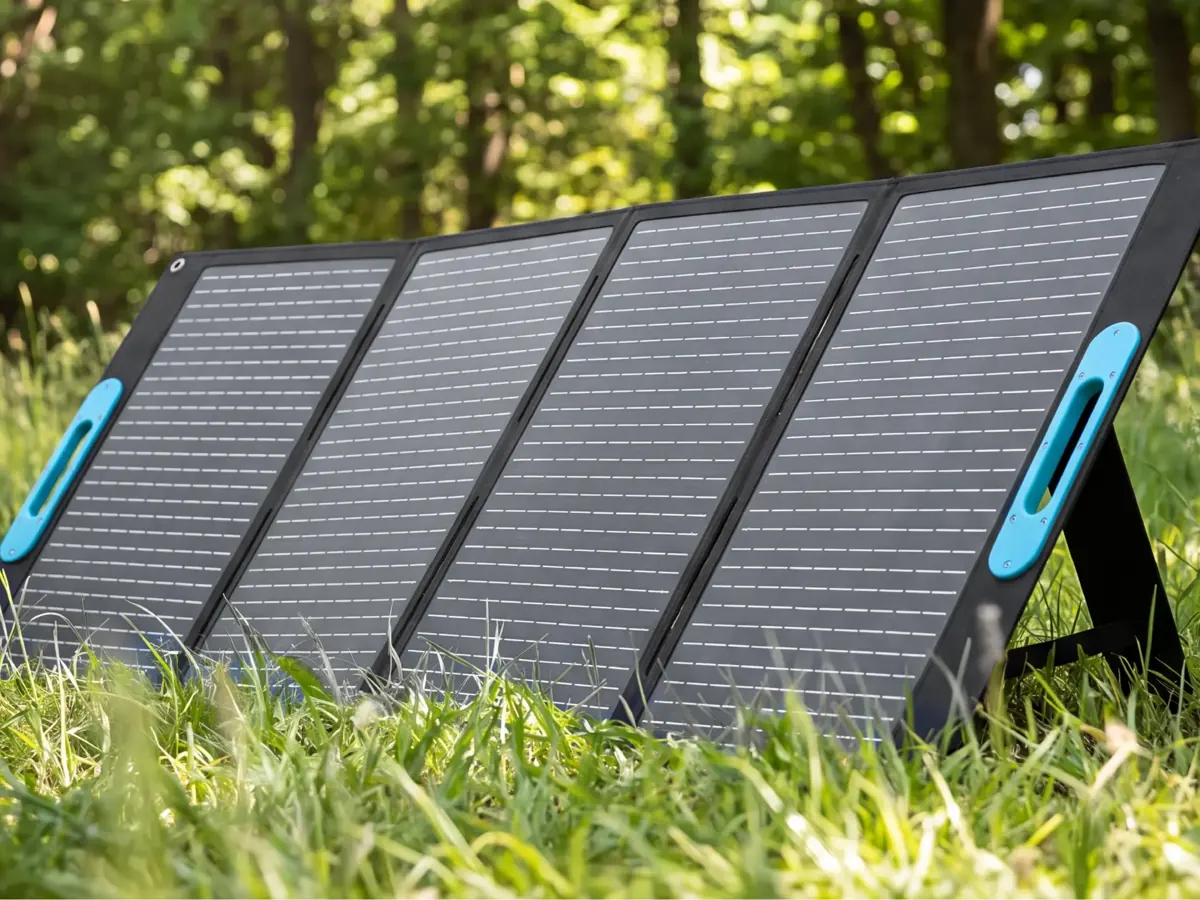
| Foldable portable panel | Camping, temporary backup and moving between locations | Folded size, carrying weight, kickstands and setup footprint |
| Rigid framed panel | Vehicle mounting or a longer-term fixed location | Mounting structure, wind loading, transport and cable route |
| Flexible panel | Weight-sensitive or curved installations where approved | Permitted bend radius, ventilation, mounting method and heat management |
Compare usable output per trip as well as rated watts. A large panel that stays packed away produces no energy. Check whether one person can carry it, whether its unfolded area fits your campsite, and whether the stand holds the intended angle.
6. Test the complete combination before relying on it
Commission the actual panel, cable and station together before a trip or a bulk order. A successful fit check does not replace an electrical compatibility check.
- Record the station model, firmware where relevant, panel model and wiring arrangement.
- Inspect cables and connectors; verify polarity using the approved procedure.
- Confirm array Voc and current ratings against all input limits before connection.
- Test in unobstructed sunlight with the battery able to accept charge.
- Record input watts, time, weather, panel angle, battery state of charge and any running load.
- Reposition the panel and check that input responds; investigate persistent low input or errors.
- Confirm stable operation over a representative charging session, not only a brief display reading.
For distributor or OEM purchases, request the current panel datasheet, connector drawing, cable specification and environmental documentation. Agree on sample acceptance conditions and retain the approved configuration for production checks.
Pre-purchase checklist
- Exact power station model and solar input manual obtained.
- Panel Pmax, Voc, Vmp, Isc, Imp and Voc temperature coefficient available.
- Cold-weather Voc below the permitted maximum; operating voltage suitable for MPPT.
- Operating and short-circuit currents checked for the complete array.
- Solar wattage and any per-port or combined limits confirmed.
- Connector, polarity, cable and controller arrangement approved.
- Daily energy target and seasonal sunlight assumptions recorded.
- Folded size, deployed footprint, weather restrictions and sample test reviewed.
Frequently Asked Questions
Can I use a different brand of solar panel with my portable power station?
Yes, if the power station manufacturer permits it and the complete panel-and-cable arrangement meets its electrical and connector requirements. Matching the plug or advertised watts alone is insufficient. Check warranty terms for third-party accessories.
Is a 200 W solar panel enough for a portable power station?
A compatible 200 W panel may be enough for modest daily energy needs, but battery size alone cannot answer the question. Calculate daily recharge demand and local peak sun hours, then account for losses and the station’s input limit.
Can I connect a 400 W panel to a 200 W solar input?
Only if the manufacturer explicitly allows that array configuration and all voltage, current and short-circuit-current limits are met. The station may cap accepted power, but this does not make excessive voltage or an otherwise prohibited array safe.
Why is the solar input lower than the panel’s rated watts?
Solar input can fall below the panel rating because of sunlight, shade, angle, panel temperature, cable losses or station limits. Battery temperature and state of charge can also restrict charging. Compare readings under documented conditions before concluding that a panel is faulty.
Can a portable solar panel charge through a window?
A portable solar panel may generate some power behind glass, but glazing, angle and shade can reduce output. Plan on outdoor deployment where the product allows it, with the power station protected according to its manual.
Should I choose series or parallel connections?
Choose the arrangement that keeps the full array within the station’s voltage and current limits. Series adds voltage; parallel adds current. Check cold-weather Voc, the MPPT range, cable ratings and manufacturer approval before choosing either arrangement.
What are the exact specs and dimensions of Honray 100W and 200W portable solar panels?
Honray’s 100W portable panel (23% cell efficiency, Vmp 21.24 V, Voc 24.48 V, Imp 4.71 A) folds to 600 × 563 × 35 mm at 3.8 kg, while the 200W portable panel (Vmp 21.24 V, Voc 24.48 V, Imp 9.42 A) folds to 573 × 600 × 45 mm at 6.5 kg.
Which adapters come with Honray portable solar panels for power stations?
Both 100W and 200W Honray folding panels include a 1.5 m MC4 lead and a 1 m 4-in-1 adapter cable (XT60, Anderson, DC5521, and DC7909), letting you verify plug polarity and connect to mainstream power stations once Voc (24.48 V) and amp limits are confirmed.
Can I connect two 200W portable solar panels in parallel using a Y-branch MC4 connector?
Yes, if your power station’s solar input current ceiling accepts ~18.84 A Imp (20.96 A Isc) and stays within a 20 A IP67 Y-branch MC4 connector pair. If your power station caps input at 10 A–15 A and allows 50–60 V Voc, wire the two 200W panels in series instead (cold Voc ~52–54 V).
Should I choose a 200W portable folding panel or a 200W rigid panel for van life?
Choose a portable folding panel if you park in the shade and want to chase the sun around camp, or choose a roof-mounted rigid/flexible panel if you want hands-free charging while driving and parked. Many travelers combine roof solar with one folding 100W–200W panel for extra winter boost.
Discuss a panel configuration with Honray Energy
You can review Honray’s portable solar panels range, 100W portable solar panel, and 200W portable solar panel product page as starting points—or check what a portable solar panel can charge. Request the current model-specific datasheet before selection; compatibility must be confirmed against your power station’s manual.
OEM & ODM Customization
100% Dual EL Tested
Export to 50+ Countries
TÜV · UL · CE · UN38.3
Looking for wholesale pricing or custom OEM/ODM solutions?
Connect directly with our engineering team for a tailored quote within 24 hours.