
Can a Vehicle Roof Solar Panel Extend Driving Range?
How much range does a solar roof actually add? Under clear-day conditions, a 200 W vehicle roof solar panel adds roughly 2 to 3 miles (about 2.4 miles / 3.9 km) across four equivalent peak sun hours—provided the vehicle can route that energy directly into its high-voltage traction battery. When the panel feeds a 12 V auxiliary battery or an RV solar system house bank, it powers onboard appliances rather than propulsion.
Key Takeaways
- A 200 W roof panel delivers roughly 0.6 kWh of stored pack energy over four peak sun hours (at 75% net yield), translating to about 2.4 miles at 250 Wh/mi.
- Aftermarket panels cannot tie directly into an EV traction pack; use a vehicle-approved interface or dedicate the roof array to a 12 V/24 V house battery.
- Roof area, curvature, aerodynamic drag, added mass, and daytime parking shade often limit real-world net range more than panel nameplate wattage.
Table of Contents
- Where Does the Solar Electricity Go?
- How Many Extra Miles Can a 200 W Solar Roof Add?
- What Do Factory Solar Roofs Actually Do?
- Comparing Vehicle Roof Panel Options: Flexible vs. Rigid vs. Custom
- What Should You Check Before Choosing a Vehicle Roof Panel?
- Frequently Asked Questions
- Can a vehicle solar roof charge the traction battery while parked?
- Can I connect an aftermarket solar panel directly to an EV high-voltage battery?
- Can a vehicle roof solar panel replace plug-in EV charging?
- Does a flexible solar panel add more range than a rigid solar panel?
- How much power can a 200 W roof panel add to an RV or camper van house battery?
- Does roof rack drag cancel out solar range gains on an EV?
- Do vehicle roof solar panels charge while driving?
- How hot do flexible solar panels get on a vehicle roof?
- How much bend can a flexible vehicle roof solar panel handle?
- What size solar panel fits on a standard camper van or SUV roof?
Where Does the Solar Electricity Go?
A vehicle roof solar panel routes DC power through a charge controller or DC-DC converter to the specific battery bank it is wired to support. Identify which electrical bus receives the energy before estimating added driving miles.
| Solar Energy Destination | What It Does | What to Measure |
|---|---|---|
| EV or plug-in hybrid traction battery | Stores DC energy the drive motor can use later. | Net kWh entering the traction pack and pack-side Wh/mi. |
| Low-voltage vehicle auxiliary system | Maintains the 12 V starter/accessory battery and sensors. | Wh delivered to the 12 V bus (indirectly lowers DC-DC draw). |
| Camper, van, or RV house battery | Runs parked loads such as a DC fridge, lights, fans, or router. | Daily usable Wh stored vs. daily appliance Wh demand. |
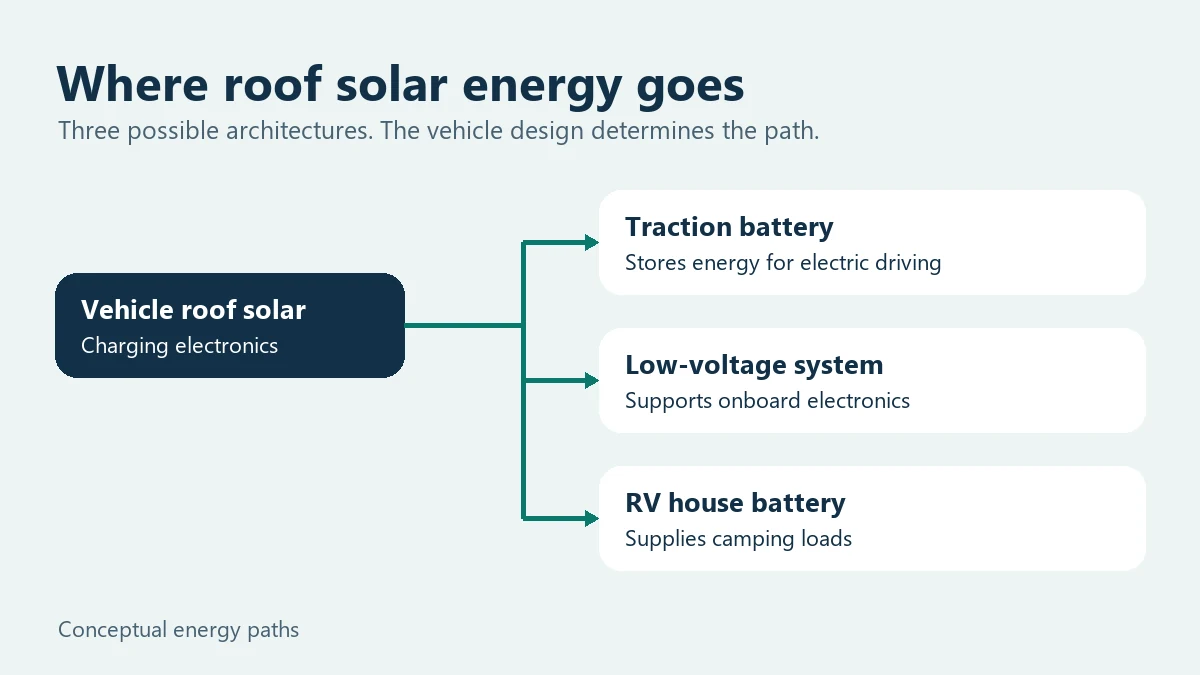
Supporting auxiliary electronics can slightly reduce the load placed on a vehicle’s main traction battery in certain architectures, but the module’s nameplate wattage alone never proves how much propulsion energy is saved. Measure net energy at the target battery under comparable routes and weather.
How Many Extra Miles Can a 200 W Solar Roof Add?
Across 1 to 4 equivalent peak sun hours, a 200 W solar roof adds roughly 0.6 to 2.4 miles (1.0 to 3.9 km) under the baseline calculation below. This model assumes the traction battery can accept the charge, 75% of nameplate energy reaches the pack after heat and conversion losses, and the vehicle consumes 250 Wh per mile (155 Wh/km).
Net solar energy stored (Wh) = rated panel power (W) × equivalent peak sun hours × net yield factor (0.75).
Estimated added miles = net solar energy stored (Wh) ÷ battery-side consumption (Wh/mi).
| Equivalent Peak Sun Hours on Roof | Estimated Net Energy Stored | Estimated EV Range Added (250 Wh/mi) |
|---|---|---|
| 1 hour | 150 Wh (0.15 kWh) | 0.6 mi (1.0 km) |
| 2 hours | 300 Wh (0.30 kWh) | 1.2 mi (1.9 km) |
| 4 hours | 600 Wh (0.60 kWh) | 2.4 mi (3.9 km) |
Four equivalent peak sun hours equals four hours of 1,000 W/m² irradiance—not simply four clock hours outdoors. Flat horizontal vehicle roofs receive lower winter sun angles and frequent partial shading from trees, buildings, roof racks, and antennas.
In real vehicles, roof cell temperatures often climb above 55°C–65°C in summer sun, reducing voltage and wattage, while DC-DC converters and battery management electronics draw standby power to stay awake during low-light charging.
What Do Factory Solar Roofs Actually Do?
OEM factory solar roofs are engineered specifically to integrate with high-voltage and auxiliary vehicle buses, yet they still provide supplemental rather than primary charging. For instance, Toyota’s optional 185 W solar roof on the 2023 Prius Prime XSE Premium is designed to charge the drive battery while parked and assist auxiliary functions while driving.
Similarly, Hyundai projected roughly 1,300 km (about 810 miles) per year—around 2 to 3 miles per sunny day—for its Sonata Hybrid solar roof assuming six hours of daily solar charging. Those factory figures align closely with the 200 W physics calculation above: roof area limits installed wattage, so daily range gains remain modest.
Comparing Vehicle Roof Panel Options: Flexible vs. Rigid vs. Custom
While aftermarket solar rarely replaces EV plug-in charging, it is one of the highest-value upgrades for camper vans, expedition trucks, marine cabins, and commercial fleet auxiliary power. Choosing between flexible solar panels, rigid glass panels, and custom OEM laminates comes down to roof curvature, weight limits, and airflow.
| Panel Type | Honray Example Specs | Best Vehicle Fit | Key Installation Trade-Off |
|---|---|---|---|
| 100W Flexible Panel | 860 × 685 mm, 2.5 kg net, Vmp 18 V, max bend ≤30° | Curved camper roofs, pop-tops, low-clearance vans | Needs clean bonding/venting; 5–10 yr expected service life. |
| 200W Flexible Panel | 1,350 × 780 mm, Vmp 21 V / Voc 25.2 V, max bend ≤30° | Larger curved RV or box-truck roofs | Avoid sharp creases and foot traffic; check roof heat dissipation. |
| 200W Rigid Mono Panel | 1,340 × 770 × 30 mm, 10.8 kg, aluminum frame | Flat van racks, trailers, heavy utility roofs | Higher weight and wind drag, but better underside airflow and longevity. |
| Custom OEM Roof Laminate | 0.1W–100W auxiliary or 100W–700W custom dimensions | OEM shuttle roofs, refrigerated vans, telematics | Engineered for exact curvature, harness, and voltage target. |
What Should You Check Before Choosing a Vehicle Roof Panel?
Evaluate daily parking patterns, usable roof geometry, and battery-system compatibility before purchasing modules. A commuter vehicle parked inside a garage during workdays collects very little solar energy compared with an outdoor delivery van or weekend camper.
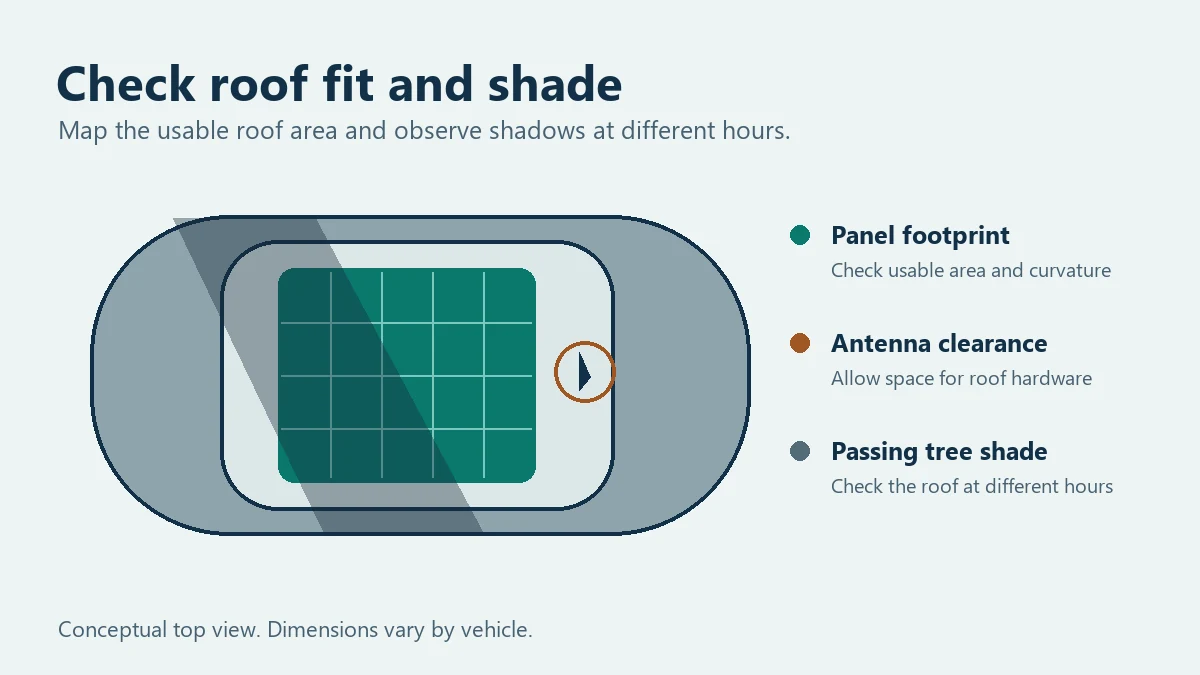
- Map usable roof area and shading: Mark roof ribs, curvature, vents, shark-fin antennas, and rack bars. Even small shadow strips from a roof fan or rack rail can sharply cut series-string output.
- Check aerodynamics and road vibration: Account for wind uplift, fastener pull-out strength, waterproof cable glands, and whether a raised rack’s aerodynamic drag offsets part of any EV range gain.
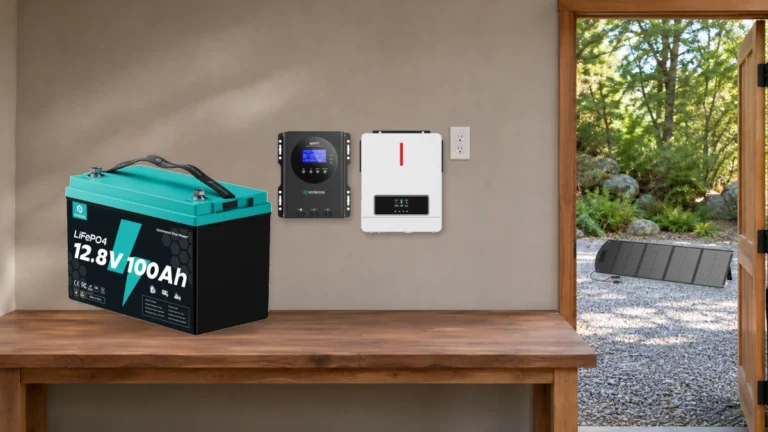
- Match controller and battery voltage: For camper and off-grid house banks, pair modules with an MPPT controller and deep-cycle RV LiFePO4 battery—or start from a matched 200W 12V RV solar kit or 400W RV solar kit.
- Log net Wh at the battery: Measure net watt-hours stored across representative sunny and cloudy days rather than relying on peak STC nameplate ratings.
For OEM vehicle or fleet integration, share your usable roof dimensions, curvature radius, controller input window, and target daily Wh with Honray’s custom solar panel engineering team.
Frequently Asked Questions
Can a vehicle solar roof charge the traction battery while parked?
Yes, if the vehicle was engineered from the factory with a solar-to-traction charging pathway and DC-DC step-up converter. Check the owner’s manual for state-of-charge thresholds and parking modes required for solar charging to activate.
Can I connect an aftermarket solar panel directly to an EV high-voltage battery?
No—never wire an aftermarket 12 V or 24 V solar panel or standard MPPT controller directly to an EV traction battery. High-voltage traction packs (typically 350 V–800 V DC) require OEM-approved BMS communication, isolation monitoring, and safety interlocks.
Can a vehicle roof solar panel replace plug-in EV charging?
No, for most electric vehicles a roof solar array only supplies a modest daily top-up of roughly 1 to 3 miles on sunny days. Longer commutes still depend on Level 1, Level 2, or DC fast charging.
Does a flexible solar panel add more range than a rigid solar panel?
Not automatically—flexible panels save weight and reduce aerodynamic drag, which helps vehicle efficiency, but rigid framed panels allow airflow underneath to run cooler at slightly higher efficiency. Compare net delivered Wh after accounting for added weight and drag.
How much power can a 200 W roof panel add to an RV or camper van house battery?
At four equivalent peak sun hours and 75% net system yield, a 200 W panel adds roughly 600 Wh (0.60 kWh) per day—about 47 Ah into a 12.8 V LiFePO4 house battery, enough to offset a 12 V compressor fridge and LED cabin lighting.
Does roof rack drag cancel out solar range gains on an EV?
At highway speeds, bulky raised crossbars and tilted rigid panels can increase aerodynamic drag enough to consume more than 2–3 miles of range per trip. Low-profile flush-mounted flexible panels minimize drag penalties when highway driving dominates.
Do vehicle roof solar panels charge while driving?
An RV house-battery solar system charges continuously whenever sunlight hits the panels, whether parked or driving. On factory solar-roof EVs, most OEM systems route solar power primarily to the 12 V auxiliary system while driving and to the traction pack while parked.
How hot do flexible solar panels get on a vehicle roof?
Because flush-mounted flexible panels sit directly on painted metal or fiberglass with no underside air gap, cell temperatures regularly reach 60°C–75°C in summer sun. Leaving a thin air channel or corrugated backing helps reduce thermal output loss.
How much bend can a flexible vehicle roof solar panel handle?
Honray’s 100 W and 200 W ETFE flexible solar panels support gentle roof curves up to a 30° bend arc without sharp creasing. Never fold them tightly or install them over sharp roof ribs.
What size solar panel fits on a standard camper van or SUV roof?
Most SUVs fit 100 W to 200 W around roof rails and sunroofs, whereas full-size camper vans commonly accommodate 200 W to 400 W (for example, one or two 200 W panels at 1,350 × 780 mm flexible or 1,340 × 770 mm rigid) around roof vents and air conditioners.
OEM & ODM Customization
100% Dual EL Tested
Export to 50+ Countries
TÜV · UL · CE · UN38.3
Looking for wholesale pricing or custom OEM/ODM solutions?
Connect directly with our engineering team for a tailored quote within 24 hours.