
How Much Can You Save With Solar Panels? A Worked Electricity Bill Example
Solar panels cut a $177 monthly electric bill by $69 to $126, depending on how the utility credits power sent to the grid. The same home uses 900 kilowatt-hours (kWh) and generates 700 kWh of solar electricity in both cases. The savings are on the utility bill, before any payment for the solar system—you can estimate the array size for your bill in our solar panel calculator.
Table of Contents
- A worked electric bill example: before and after solar
- Why the same panels can produce different savings
- Estimate solar savings from your own electric bill
- From bill savings to what you actually keep
- Frequently Asked Questions
- What is the average electric bill with solar panels, and how much do solar panels save on electricity bills?
- How much money can you make selling solar energy back to the grid?
- Do you still get an electric bill with solar panels?
- Why does my electric bill show less solar than my monitoring app?
- Can I divide my electric bill by kWh to estimate solar savings?
- How much does adding a LiFePO4 battery improve electric bill savings?
- What is the difference between 1:1 net metering and net billing for solar savings?
- Do solar panel savings drop over 25 years as panels age?
- Does shading on one roof section reduce monthly electric bill savings?
- How can I estimate solar bill savings before requesting an installer quote?
A worked electric bill example: before and after solar
Start with a home that uses 900 kWh in one billing month. The utility charges 18¢ per kWh for electricity and a $15 monthly service charge. The 18¢ rate is an assumption. For context, the U.S. Energy Information Administration reported a U.S. residential average price of 17.23¢ per kWh in 2025. Your utility’s rate schedule tells you which charges solar can offset.
After installation, the panels generate 700 kWh that month. The home uses 320 kWh as the panels generate it and sends the remaining 380 kWh to the grid. It still buys 580 kWh from the utility, including at night and whenever demand exceeds solar output. The example assumes no home battery storage and the same household usage before and after installation.
| Bill line | Before solar | Solar with full retail net metering | Solar with a 3¢/kWh export credit |
|---|---|---|---|
| Electricity bought from the grid | 900 kWh | 580 kWh | 580 kWh |
| Electricity sent to the grid | 0 kWh | 380 kWh | 380 kWh |
| Usage charge at 18¢/kWh, before credits | $162.00 | $104.40 | $104.40 |
| Export credit applied this month | $0.00 | −$68.40 | −$11.40 |
| Fixed monthly service charge | $15.00 | $15.00 | $15.00 |
| Total electricity bill | $177.00 | $51.00 | $108.00 |
| Savings compared with the original bill | $126.00 (71%) | $69.00 (39%) |
For this flat-rate example, the bill is grid purchases × purchase rate + fixed fee − export credit applied. At full retail, 380 kWh offsets 380 of the 580 kWh purchased, leaving 200 kWh × $0.18 + $15 = $51. With a 3¢ export credit, the bill is 580 kWh × $0.18 + $15 − 380 kWh × $0.03 = $108. Both rates are illustrative. The example applies the full credit that month and excludes taxes and other fees.
Why the same panels can produce different savings
The 320 kWh used at home avoids $57.60 of grid purchases under either plan. The 380 kWh exported is worth $68.40 at 18¢ per kWh or $11.40 at 3¢ per kWh. That $57 difference comes entirely from how the utility values exports.
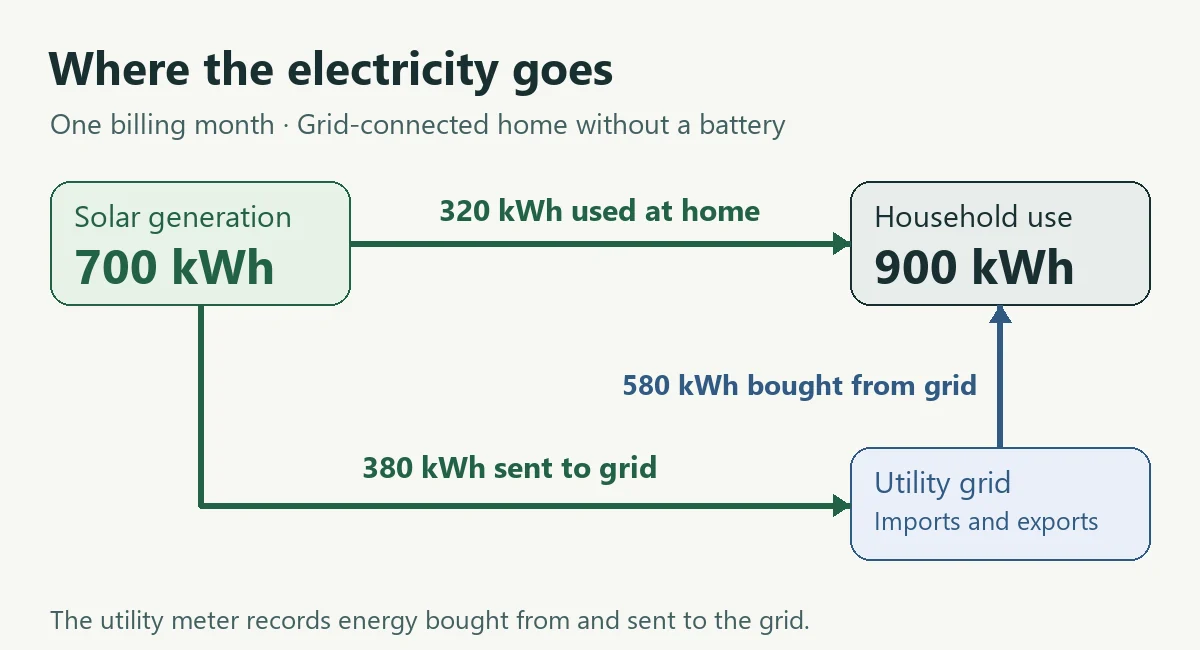
That split matters when you compare quotes. Even if a system produces as many kWh as you use over a year, you can still pay for grid electricity at night and receive a smaller credit for midday exports. Fixed fees and minimum bills can also leave an amount due. The California Public Utilities Commission’s explanation of net metering and net billing shows how export values can vary by tariff and time of day.
If exports earn less than you pay for imports, using some of that power at home can help. In the 3¢ example, moving 100 kWh of electricity use into hours with enough surplus solar would save another $15: $18 in avoided purchases, less $3 in export credits you give up. Running a dishwasher or scheduling EV charging during those hours can shift usage without increasing total consumption.
Estimate solar savings from your own electric bill
- Pull 12 months of electricity bills. Record the billing dates, kWh used, and fixed fees. Find the per-kWh charges that fall when you buy less power. If the solar plan changes your rates, keep both schedules so you can compare the plan you have now with the one you would move to.
- Get a production estimate for your roof. Use the installer’s estimate or download hourly output from PVWatts for a system that matches your roof. Compare production with utility usage data for the same hours. Without a battery, estimate grid purchases when your usage exceeds production and exports when production exceeds usage. Monthly totals alone cannot show that split.
- Confirm how the utility handles exports. Ask which charges credits can offset and what happens to any unused balance. If prices change by time of day, apply the purchase schedule to imports and the export schedule to exports. The two schedules can use different time windows.
- Compare bills over a full year. For each billing period, estimate the bill without solar and the bill with solar at the same household usage. Include fixed charges, any minimums, and credits the utility would actually apply. Account for any year-end settlement before adding up your savings.
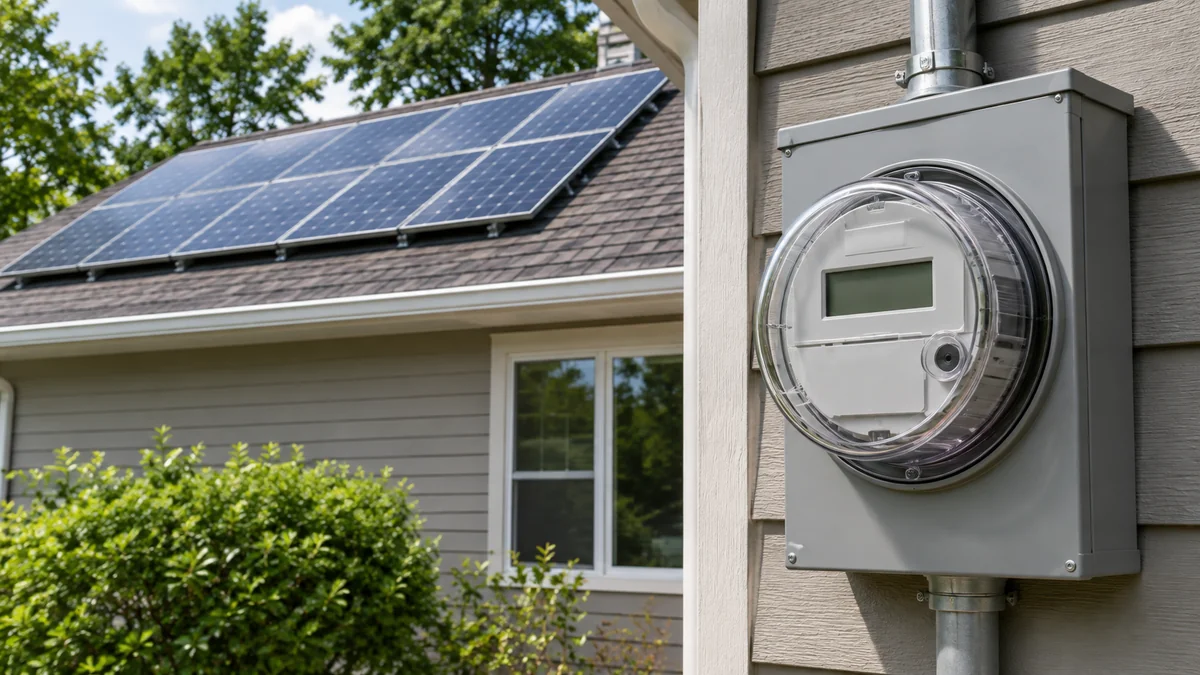
If you already have solar, use the same billing dates in your utility account and your monitoring app. A utility’s bidirectional meter can track power you buy and send back, while solar monitoring can show total generation. On a system without a battery, subtracting exports from generation over the same period estimates how much solar electricity you used directly.
From bill savings to what you actually keep
A lower utility bill can still leave you paying more each month if the solar payment is larger than the savings. With a $90 monthly loan payment, the $51 utility bill becomes $141 in combined payments, or $36 less than the original bill. Under the 3¢ export plan, $108 plus $90 comes to $198, or $21 more.
For a cash purchase, estimate simple payback by dividing the upfront solar installation cost by annual bill savings minus expected annual operating costs. Use a full year of modeled bills because both electricity use and solar production vary by season. If an installer gives you a savings figure with a quote for rooftop solar panels, ask which tariff and consumption data the calculation uses.
Frequently Asked Questions
What is the average electric bill with solar panels, and how much do solar panels save on electricity bills?
There is no single average electric bill with solar panels because how much is your electric bill with solar panels depends on monthly kWh usage, utility fixed fees, and export rules. In our worked 900 kWh/month example above, a $177 pre-solar bill drops to a monthly bill for solar panels of $51 under full 1-for-1 credit or $108 under a lower 4¢/kWh export rate—showing exactly how much do solar panels save on electricity bills ($69 to $126/month in that example). You can model how much do solar panels save on electricity for your own loads with home solar & battery storage or check average solar system costs.
How much money can you make selling solar energy back to the grid?
When homeowners ask how much money can you make selling solar energy back to the grid, most residential utilities issue bill credits rather than cash payouts. Under retail net metering, exported kWh offset power bought later at full retail value (18¢/kWh in the worked example), whereas under avoided-cost or net-billing tariffs, exports earn a smaller wholesale credit (such as 4¢/kWh)—making daytime self-consumption or battery storage more valuable than oversizing for grid export.
Do you still get an electric bill with solar panels?
Yes. A grid-connected home generally still gets an electric bill or statement, even in a month with little or nothing due. It can show grid purchases, export credits and charges that remain after solar, such as a base service fee.
Why does my electric bill show less solar than my monitoring app?
Your bill may show only the solar electricity you exported, while the monitoring app shows everything your system generated. Electricity you used as it was generated stayed in the home, so it did not register as an export. Check whether the utility and the app cover the same dates before comparing them.
Can I divide my electric bill by kWh to estimate solar savings?
Dividing the full electric bill by kWh gives you the average amount you paid per kWh, including fixed fees. It can overstate what you avoid by using one less kWh. For a flat rate, use the per-kWh charges that actually fall as you buy less power. With tiered or time-of-use rates, apply the relevant charges to the usage they cover.
How much does adding a LiFePO4 battery improve electric bill savings?
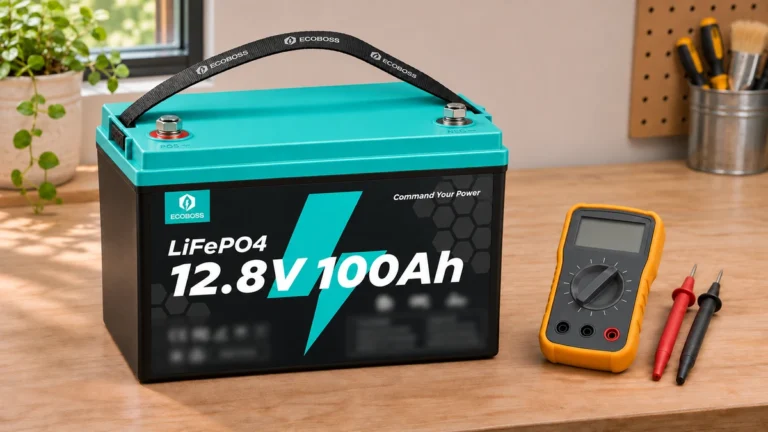
Under time-of-use (TOU) tariffs or low export credit rates, storing surplus daytime solar in a 51.2V 100Ah Server Rack LiFePO4 battery (5.12 kWh) or 5kW home solar system lets you offset expensive evening peak electricity instead of exporting at low wholesale rates.
What is the difference between 1:1 net metering and net billing for solar savings?
Under 1:1 net metering, each kilowatt-hour exported to the grid credits your bill at roughly the full retail rate, whereas net billing credits exports at a lower avoided-cost rate (often 25%–50% of retail), making daytime self-consumption and battery storage much more valuable.
Do solar panel savings drop over 25 years as panels age?
Yes, panels experience gradual annual output degradation (commonly covered by a 25–30 year linear performance warranty staying at ≥80% of rated STC output), though rising utility electricity rates over time often offset part of that gradual output decline.
Does shading on one roof section reduce monthly electric bill savings?
Yes, afternoon tree or chimney shading directly lowers peak-hour kWh production and can trigger higher grid imports during late-day TOU windows. Check our series vs. parallel wiring guide to minimize shade penalties.
How can I estimate solar bill savings before requesting an installer quote?
Gather 12 months of utility kWh usage and your tariff’s fixed vs. volumetric ($/kWh) charges, then use the Honray solar panel calculator to estimate array size and monthly generation before comparing itemized quotes.
OEM & ODM Customization
100% Dual EL Tested
Export to 50+ Countries
TÜV · UL · CE · UN38.3
Looking for wholesale pricing or custom OEM/ODM solutions?
Connect directly with our engineering team for a tailored quote within 24 hours.