
What Is a Lithium Battery? The Main Types and How to Identify Them
A lithium battery is any battery that uses lithium in its electrochemical system to store and release electrical energy, spanning two distinct groups: single-use primary lithium metal batteries and rechargeable lithium-ion batteries. While a CR2032 coin cell and a LiFePO4 energy storage battery both fall under the broad lithium umbrella, they differ fundamentally in chemistry, safety rules, rechargeability, and applications.
Key Takeaways
- Primary lithium (often marked Lithium or Do Not Recharge) identifies a single-use lithium metal cell; never attempt to charge it.
- Li-ion identifies a rechargeable family, and LiFePO4 (LFP) is a specific lithium-ion chemistry built for deep-cycle RV, marine, and solar storage.
- Shipping codes, voltage markings (such as 3 V vs. 12.8 V / 25.6 V / 51.2 V), and the full model number confirm the exact chemistry when a wrapper is brief.
Table of Contents
- Main Types of Lithium Batteries
- Single-Use Primary Lithium Metal Batteries
- Rechargeable Lithium-Ion (Li-Ion) Batteries
- How to Identify a Lithium Battery by Its Label and UN Code
- Common Lithium Storage Battery Voltage Classes and Form Factors
- Two Real Examples: CR2032 and an EcoBoss LiFePO4 Battery
- What If the Label Is Missing or Unclear?
- Frequently Asked Questions
- What is the difference between a lithium battery and a lithium-ion battery?
- Can you recharge any battery labeled “Lithium”?
- Is LiFePO4 considered a lithium-ion battery?
- Why do 12V LiFePO4 batteries list 12.8 V on the label?
- What do UN3480 and UN3090 mean on a lithium battery shipping label?
- Can a 12V LiFePO4 deep-cycle battery be used as a car starting battery?
- How long do LiFePO4 storage batteries last?
- What warranty applies to Honray LiFePO4 lithium batteries?
- Can you wire all LiFePO4 batteries in series to reach 48 V?
- How do you tell if a lithium battery has a built-in BMS?
Main Types of Lithium Batteries
Lithium batteries divide first by whether they can be recharged. Mixing up the two categories creates safety hazards, because applying a charger to a non-rechargeable cell can cause overheating, venting, or rupture.
Single-Use Primary Lithium Metal Batteries
A primary lithium battery uses metallic lithium as an electrode and is built for one discharge cycle only. Once the cell reaches its cutoff voltage, you replace and recycle it rather than recharging it.
Common examples include 3 V coin cells (such as CR2032 for car key fobs and motherboards) and 1.5 V lithium iron disulfide (Li/FeS₂) AA or AAA cells used in cold-weather sensors and flashlights. Because primary lithium cells share standard AA, AAA, or button shapes with other chemistries, physical size alone never confirms what is inside.
Rechargeable Lithium-Ion (Li-Ion) Batteries
A lithium-ion battery moves lithium ions reversibly between a positive and negative electrode during charge and discharge, making hundreds to thousands of cycles possible. Manufacturers may print Li-ion on the housing or name the exact cathode chemistry. For a deeper breakdown of label markings, see our guide on what Li-ion means on a battery label.
Several rechargeable Li-ion chemistries serve different jobs:
- LiFePO4 (Lithium Iron Phosphate / LFP): Uses a ~3.2 V nominal cell voltage, offers strong thermal stability, and serves deep-cycle RV lithium batteries, marine house banks, and solar energy storage.
- NMC / NCA (Nickel Manganese Cobalt / Aluminum): Uses a ~3.6–3.7 V nominal cell voltage and packs higher gravimetric energy density, making it common in electric vehicles and lightweight power tools.
- LCO / LiPo (Lithium Cobalt Oxide / Lithium Polymer): Common in smartphones, laptops, and compact drones where thin pouch packaging matters more than multi-thousand-cycle life.
When comparing rechargeable chemistries for off-grid power or backup storage, read our detailed comparison of LiFePO4 vs. NMC and lead-acid batteries. Honray Energy manufactures rechargeable LiFePO4 deep-cycle and energy storage packs rather than primary coin cells.
How to Identify a Lithium Battery by Its Label and UN Code
Start by reading the markings printed on the battery casing, shrink wrap, or carton. Look for the chemistry abbreviation, nominal voltage, watt-hour rating, and the exact model code rather than relying on the word Lithium alone.
Transport labels also provide a fast clue. Under UN dangerous goods classifications, primary lithium metal cells ship under UN3090 / UN3091, whereas rechargeable lithium-ion and LiFePO4 packs ship under UN3480 / UN3481. On a datasheet, check fields labeled Battery Chemistry, Chemical System, or Nominal Voltage.
| Marking or Code You See | What It Confirms | Next Verification Step |
|---|---|---|
| Primary Lithium / Do Not Recharge | Single-use lithium metal battery. | Match the exact model code (e.g., CR2032, L91) for replacement. |
| UN3090 / UN3091 | Lithium metal (non-rechargeable) transport class. | Treat as primary lithium; never connect to a charger. |
| Li-ion / UN3480 / UN3481 | Rechargeable lithium-ion battery family. | Check the datasheet for LFP vs. NMC and exact charge voltage. |
| LiFePO4 or LFP | Lithium iron phosphate, a deep-cycle Li-ion chemistry. | Confirm nominal voltage (12.8 V, 25.6 V, or 51.2 V) and BMS limits. |
| Lithium (alone) | Lithium-based cell, chemistry unspecified. | Look up the full model number before buying a charger or replacement. |
Common Lithium Storage Battery Voltage Classes and Form Factors
Once you confirm a battery is a rechargeable LiFePO4 storage pack, its nominal voltage and enclosure tell you which system class it fits. Unlike single 3.2 V cells, deep-cycle LiFePO4 packs wire cells in series inside an ABS or metal case protected by an integrated Battery Management System (BMS).
Keep two system boundaries in mind when reading storage specs: first, ABS deep-cycle packs are typically rated IP65 for enclosed compartments, whereas metal-case slim, server-rack, and wheeled units carry IP20 or IP21 ratings meant for dry indoor or protected cabin spaces. Second, Honray’s deep-cycle 12V–48V packs are built for storage and house loads rather than high-CCA engine cranking.
| System Class | Nominal Voltage | Typical Honray Form Factors | Max Expansion (Per Datasheet) |
|---|---|---|---|
| 12V LiFePO4 Class | 12.8 V (4 cells in series) | Standard ABS (100Ah–300Ah), Mini (fits Group 24 box), IP21 Slim (73 mm) | Up to 4P4S (max 16 units) |
| 24V LiFePO4 Class | 25.6 V (8 cells in series) | ABS 100Ah (2.56 kWh) & 200Ah (5.12 kWh) | Up to 4P2S (max 8 units) |
| 48V ABS Class | 51.2 V (16 cells in series) | ABS 100Ah (5.12 kWh) | 4P1S only (max 4 in parallel, no series) |
| 51.2V ESS Class | 51.2 V (16 cells in series) | EcoBoss 100Ah Server Rack (IP20/IP21) & 314Ah Wheeled ESS (IP21) | Up to 16P1S (parallel only, max 16 units) |
Two Real Examples: CR2032 and an EcoBoss LiFePO4 Battery
Looking at two real products side by side shows how quickly model codes and label markings resolve any ambiguity.
On a CR2032 coin cell, the alphanumeric code is the fastest identifier. Searching the model code confirms it belongs to the primary lithium manganese dioxide (3 V) category, which is strictly single-use and built for milliamps of backup current.
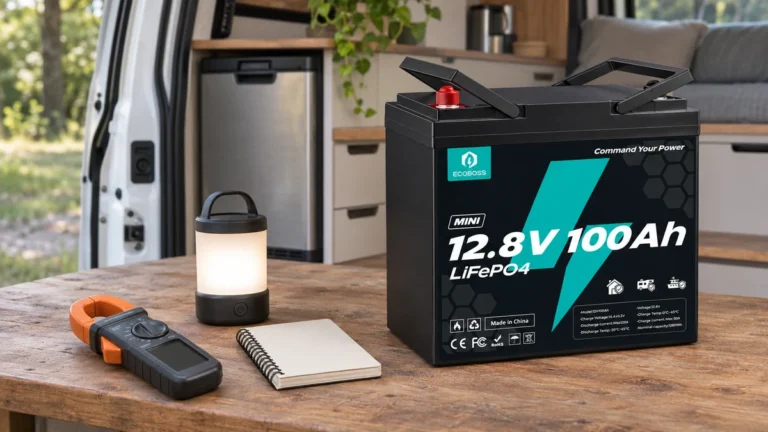
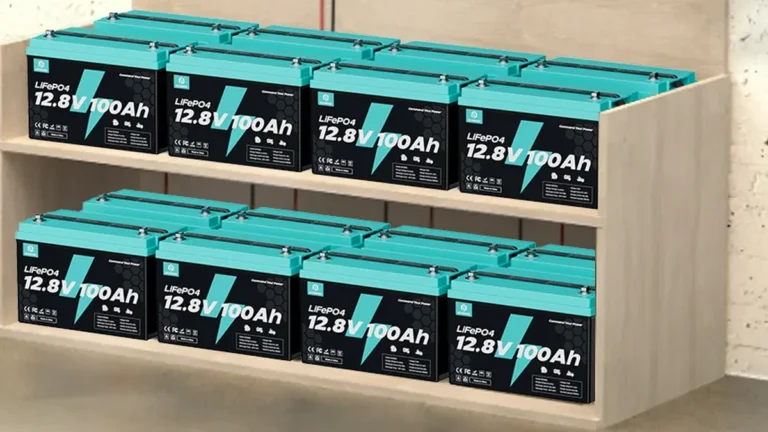
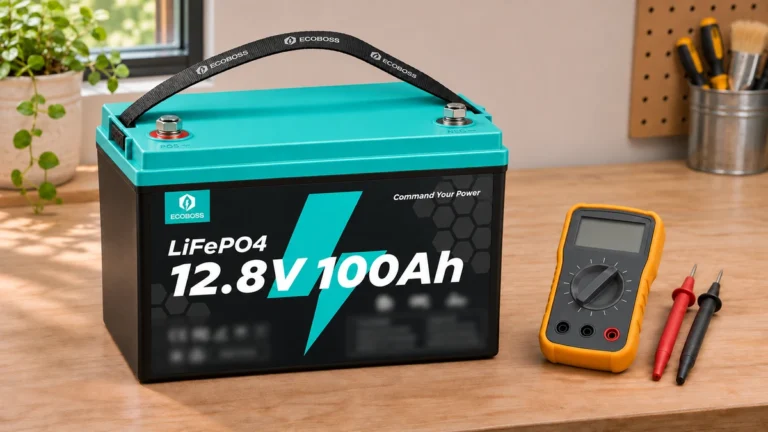
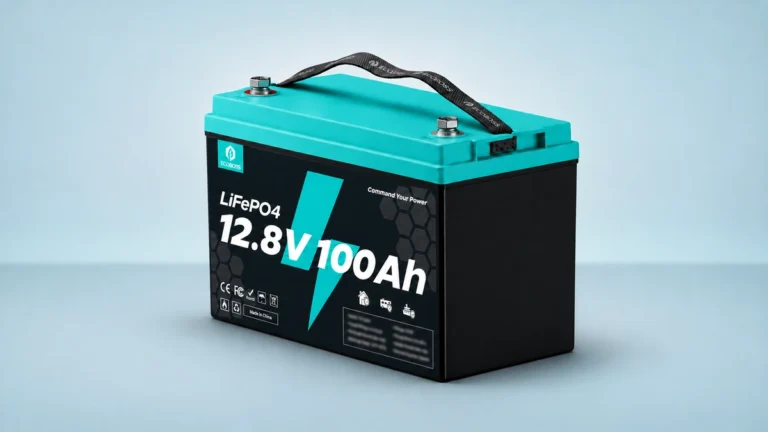
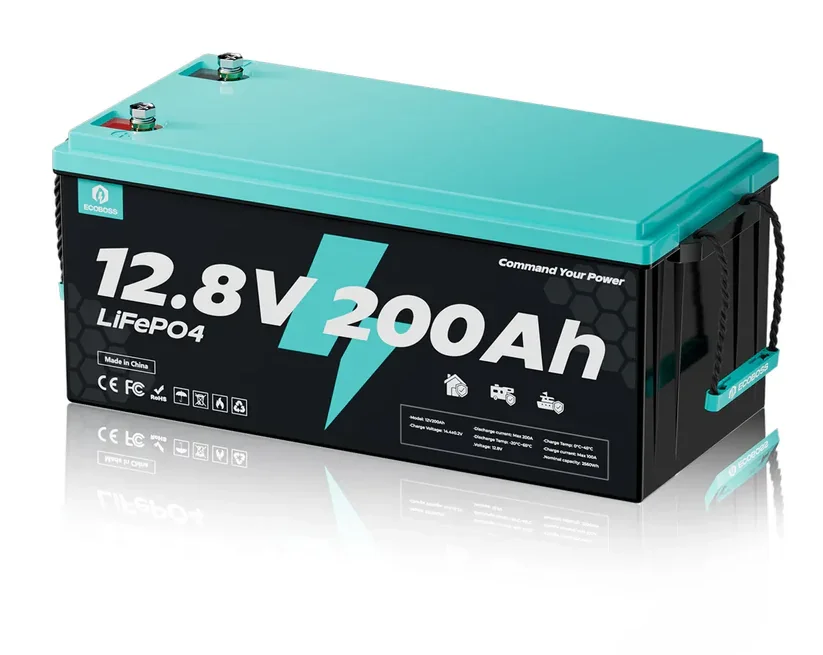
On the EcoBoss 12.8 V 200 Ah LiFePO4 battery, the front label prints LiFePO4 directly beneath 12.8 V and 200 Ah (2,560 Wh nominal energy). Checking its specification table confirms Grade-A LiFePO4 chemistry with a built-in JBD Smart BMS rated for 100 A continuous charge (0°C to 45°C), 200 A continuous discharge (-20°C to 65°C), 300 A peak output, and a 522 × 240 × 218 mm IP65 ABS enclosure weighing 20.6 kg.
What If the Label Is Missing or Unclear?
If a battery label is worn off or hidden inside an enclosure, start with the equipment manual or inverter battery-type menu rather than guessing from a multimeter reading alone. A resting voltage reading cannot reliably tell an LFP pack from a lead-acid pack at every state of charge, and it never reveals BMS continuous current limits.
For sealed commercial packs or OEM equipment, contact the supplier with the serial number or equipment model before connecting a charger. If your project needs custom dimensions, low-temperature heating, or specific inverter communication protocols (CAN/RS485), review Honray’s custom LiFePO4 battery options with your exact voltage and load profile.
Frequently Asked Questions
What is the difference between a lithium battery and a lithium-ion battery?
A lithium battery is the broad category covering both non-rechargeable lithium metal batteries and rechargeable lithium-ion batteries. When manufacturers say “lithium battery” for RVs, boats, or solar storage, they normally mean rechargeable lithium-ion—most often LiFePO4.
Can you recharge any battery labeled “Lithium”?
No, you can only recharge batteries marked as rechargeable, Li-ion, LiFePO4, LFP, or LiPo. Cells labeled Primary Lithium, Lithium Metal, CR2032, or Do Not Recharge are single-use and can vent or catch fire if connected to a charger.
Is LiFePO4 considered a lithium-ion battery?
Yes, lithium iron phosphate (LiFePO4 or LFP) is a specific chemistry within the rechargeable lithium-ion family. It uses an iron-phosphate cathode instead of cobalt or nickel, trading slightly lower energy density for higher thermal stability and longer cycle life.
Why do 12V LiFePO4 batteries list 12.8 V on the label?
A “12V” LiFePO4 battery uses four 3.2 V nominal LFP cells wired in series, which equals 12.8 V nominal (4 × 3.2 V). Always use 12.8 V—or 25.6 V for 24V and 51.2 V for 48V/51.2V packs—when calculating nominal watt-hours and setting charger thresholds.
What do UN3480 and UN3090 mean on a lithium battery shipping label?
UN3480 (standalone) and UN3481 (packed with or in equipment) identify rechargeable lithium-ion batteries, including LiFePO4 packs. UN3090 and UN3091 identify single-use primary lithium metal batteries.
Can a 12V LiFePO4 deep-cycle battery be used as a car starting battery?
No, standard 12.8 V LiFePO4 deep-cycle storage packs are not designed as high-CCA engine cranking batteries. Their internal BMS limits peak surge current to protect the cells, so use them for house loads, solar storage, and trolling motors rather than starter motors.
How long do LiFePO4 storage batteries last?
Per Honray model listings, 12V–48V ABS and Slim LiFePO4 packs are rated for 4,000–6,000 cycles and 51.2V Server Rack and Wheeled ESS models for 8,000 cycles, though actual service life depends on depth of discharge (DoD), charge/discharge rate, and operating temperature specified in the final datasheet.
What warranty applies to Honray LiFePO4 lithium batteries?
Honray provides a 3–5 year warranty on 12V–48V deep-cycle LiFePO4 models and a 5–10 year warranty on 51.2V Server Rack and Wheeled ESS units, with exact coverage governed by the formal SKU quotation and sales agreement.
Can you wire all LiFePO4 batteries in series to reach 48 V?
No, series capability depends on each pack’s BMS voltage rating. For example, Honray 12.8 V packs support up to 4P4S and 25.6 V packs support up to 4P2S, whereas 48 V ABS packs (4P1S max 4) and 51.2 V Server Rack/Wheeled packs (16P1S max 16) support parallel expansion only.
How do you tell if a lithium battery has a built-in BMS?
Check the specification sheet or product listing for over-charge, over-discharge, short-circuit, and temperature protection ratings, plus continuous charge/discharge amp limits. Single bare cells do not include a BMS, whereas 12.8 V, 25.6 V, and 51.2 V drop-in storage packs integrate one internally.
OEM & ODM Customization
100% Dual EL Tested
Export to 50+ Countries
TÜV · UL · CE · UN38.3
Looking for wholesale pricing or custom OEM/ODM solutions?
Connect directly with our engineering team for a tailored quote within 24 hours.