
Monocrystalline vs Polycrystalline Solar Panels: A Procurement Comparison
Monocrystalline solar panels are usually the stronger starting point when installation space is limited. Polycrystalline panels can still make sense when a verified offer meets the project specification at a lower total cost. Compare exact modules, their electrical characteristics and their delivery terms before choosing by cell type.
For distributors, installers and equipment brands, the purchasing decision extends beyond efficiency. A cheaper panel may need more mounting positions. A replacement module may fit the frame but mismatch the existing string. This comparison uses published technical guidance and clearly labeled calculations; it does not claim side-by-side product testing.
Table of Contents
- Key takeaways
- Monocrystalline vs polycrystalline: the purchasing differences
- Crystal type is only one part of the specification
- Amorphous vs Crystalline Solar Panels and Module Materials
- Which panel makes better use of limited space?
- Are polycrystalline panels actually cheaper to buy?
- Compare heat, shade and system compatibility by model
- Hot operating conditions
- Shade and low irradiance
- Electrical matching
- Quality and replacement supply can outweigh the cell label
- What to include in a comparable RFQ
- Frequently Asked Questions
- What is a mono solar panel, and how does polycrystalline solar panel vs monocrystalline compare?
- How does monocrystalline vs polycrystalline solar panel price compare?
- Are monocrystalline solar panels always the better purchase?
- Do equal-watt mono and poly panels generate the same electricity?
- Can mono and poly panels be mixed in one system?
- Do polycrystalline solar panels last less time?
- Is bifacial an alternative to monocrystalline?
- Why do monocrystalline cells convert more sunlight per square meter than polycrystalline cells?
- What efficiency and warranty do Honray standard monocrystalline panels offer?
- Should B2B distributors still stock polycrystalline panels or transition fully to monocrystalline?
- Choose the module that passes the project checks
Key takeaways
- Compare module watts per square meter when space limits the installation.
- Evaluate both offers at the same required capacity and on the same commercial basis.
- Use the exact datasheet for temperature behavior, voltage and current compatibility.
- Confirm sample acceptance, model documentation and repeat-order availability before approving production.
Monocrystalline vs polycrystalline: the purchasing differences
The practical advantage of monocrystalline panels is generally higher power density. Polycrystalline panels need a compelling, documented project-level reason to win the order. The table below gives selection guidance, not guaranteed specifications for every module.
| Purchasing factor | Monocrystalline panels | Polycrystalline panels | What to verify |
|---|---|---|---|
| Silicon structure | A single crystal structure in each wafer | Multiple crystal grains in each wafer | Exact cell and module identification |
| Power per area | Generally higher | Generally lower | Rated module power divided by external area |
| Purchase price | Obtain a current quotation | Do not assume a lower delivered price | Same quantity, delivery basis and specification |
| Installation footprint | Often useful where space is restricted | May require more surface area for equal capacity | A layout using actual dimensions and clearances |
| Heat and low-light performance | Depends on the specific module design | Depends on the specific module design | Temperature coefficients and relevant test data |
| Service life and warranty | Cannot be established from the crystal label | Cannot be established from the crystal label | Construction, qualification evidence and written warranty |
| Repeat orders | Confirm continuity for the proposed model | Confirm whether the offer is ongoing production or limited stock | Replacement strategy and substitution approval |
Crystal type is only one part of the specification
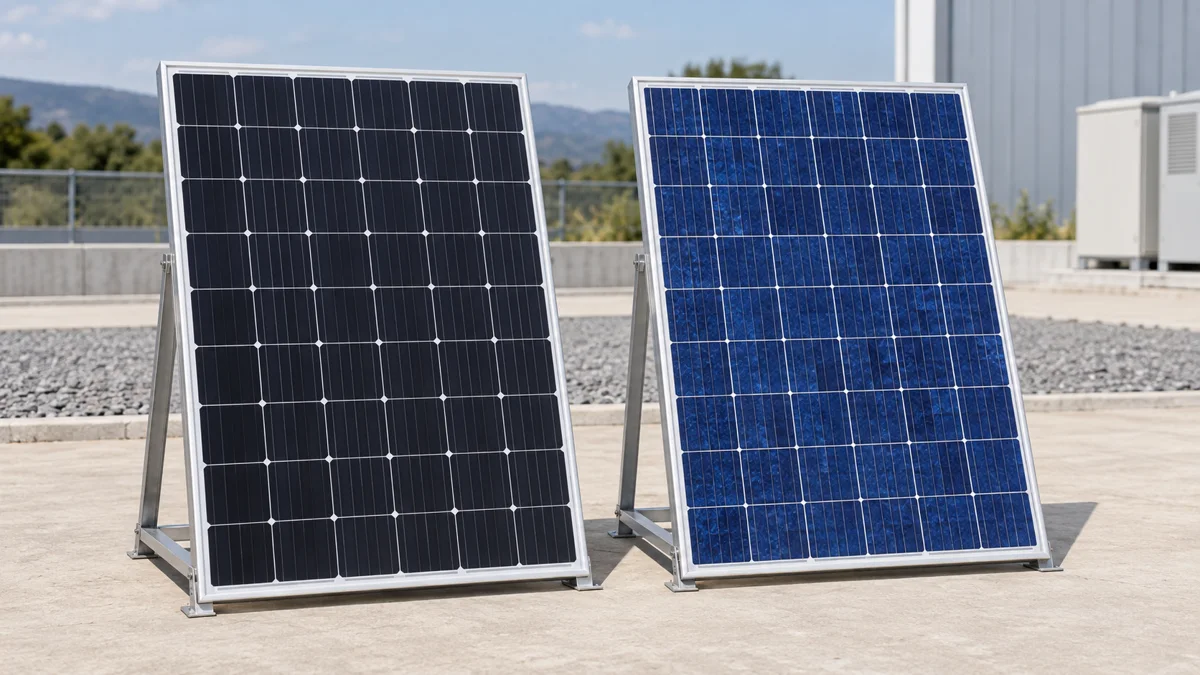
Monocrystalline and polycrystalline describe the silicon crystal structure. They do not describe the complete module. PERC, TOPCon and heterojunction describe cell technologies; bifacial describes the ability to collect light from both faces. A monocrystalline panel can also be bifacial. The DOE’s crystalline silicon research overview explains the different cell designs.
Avoid identifying products solely by their color. For incoming inspection, match the model label, approved drawings and electrical records to the purchase order. Appearance can support a visual check, but it cannot establish output or material quality.
Amorphous vs Crystalline Solar Panels and Module Materials
Monocrystalline and polycrystalline solar panels use crystalline silicon cells. Amorphous silicon is a thin-film technology; thin-film PV also includes other absorber materials. The DOE overview of PV cell technologies distinguishes these material families. A flexible panel’s shape alone does not identify its cell material.
When comparing an amorphous solar panel vs monocrystalline option, ask for the exact absorber technology, rated output, external area, substrate and test conditions. Compare thin-film solar panel prices using current quotations with the same capacity, construction, order quantity and delivery scope.
The structure of solar panels includes more than the cells. A typical crystalline module also uses protective layers, electrical interconnections and a junction box; the approved design determines its glass, encapsulant, backsheet or rear glass, and frame. Request the model’s construction details. These comparisons describe technology choices and do not establish that Honray supplies every thin-film or polycrystalline format.
Which panel makes better use of limited space?
The module with more rated watts per square meter makes better use of its own surface area. Calculate that figure from the complete module dimensions, rather than using cell efficiency or comparing wattage alone.
Module power density = rated power (W) ÷ external module area (m²).
Consider this hypothetical comparison. These are teaching assumptions, not Honray product specifications or market averages.
| Assumed specification | Mono option A | Poly option B |
|---|---|---|
| Rated module power | 400 W | 320 W |
| External module area | 2.0 m² | 2.0 m² |
| Calculated power density | 200 W/m² | 160 W/m² |
| Modules for an 8 kW DC target | 20 | 25 |
| Total module surface area | 40 m² | 50 m² |
In this example, option A needs 20% less module surface area than option B for the same rated capacity. These figures exclude setbacks, access routes, gaps and row spacing. A roof or equipment enclosure still needs a dimensioned layout.
For compact equipment, the outline, cable exit and mounting positions may decide feasibility before price does. Use Honray’s custom small solar panel options as a starting point for discussing an available footprint and required electrical output. Confirm the resulting design through drawings and samples.
Are polycrystalline panels actually cheaper to buy?
Do not assume polycrystalline panels have the lower purchase price. Compare current solar quotations for the same required capacity and delivery terms. A historic manufacturing-cost advantage does not establish today’s delivered price or the final cost of your project.
Normalize quotations in two steps:
- Calculate module cost per watt using the same currency, quantity and delivery basis.
- Add the costs that change with the proposed layout, including mounting, handling, wiring and installation work.
Using the same hypothetical modules, assume option A costs USD 72 per panel and option B costs USD 48. The module prices are USD 0.18/W and USD 0.15/W respectively. Now assume an additional USD 40 per module for selected handling and mounting-related costs, solely to demonstrate the arithmetic.
| Illustrative 8 kW order | Mono option A | Poly option B |
|---|---|---|
| Module purchase cost | 20 × USD 72 = USD 1,440 | 25 × USD 48 = USD 1,200 |
| Assumed extra cost per module | USD 40 | USD 40 |
| Total assumed extra cost | USD 800 | USD 1,000 |
| Compared subtotal | USD 2,240 | USD 2,200 |
The initial USD 240 module saving falls to USD 40 in this simplified comparison. Under these assumptions, the options reach the same subtotal at USD 48 of additional cost per module. Above that level, option A has the lower subtotal.
This is not an installed-system quotation. Freight, taxes, inverter selection, structural work and other costs need separate treatment. Replace every assumption with project figures; some costs scale with area or system capacity rather than panel count.
Compare heat, shade and system compatibility by model
Neither the mono nor the poly label establishes annual energy yield. The DOE distinguishes laboratory efficiency from energy harvested in operation, where heat, dirt and shade affect results.
Hot operating conditions
Compare the maximum-power temperature coefficient, expressed in %/°C, for each proposed module. For negative maximum-power temperature coefficients, a value closer to zero means a smaller relative power reduction for the same temperature rise, all else equal. Do not use ambient temperature as though it were cell temperature.
The DOE explains the effect of temperature on solar cell output. The European Commission’s PVGIS calculation methods also account for irradiance, module temperature and mounting conditions. Use a site-specific energy model when annual generation affects the purchasing decision.
Shade and low irradiance
Do not accept “works better in shade” without a defined test and comparable results. Ask what was shaded, how the modules were connected and which power electronics were used. A laboratory result under uniform low irradiance does not describe a branch shadow crossing part of a module.
Electrical matching
Review open-circuit voltage (Voc), maximum-power voltage (Vmp), short-circuit current (Isc) and maximum-power current (Imp). Check the proposed array against the inverter or charge controller’s input limits and operating range under the installation’s temperature conditions.
For replacement orders, the same wattage is insufficient evidence of compatibility. Have the string design and protection reviewed using the actual module and equipment manuals. Record connector manufacturer and type as well; similar-looking connectors should not be treated as a verified pair.
Quality and replacement supply can outweigh the cell label
A mono label does not guarantee better workmanship, and a poly label does not establish a shorter service life. Evaluate the proposed construction, production controls and written support terms.
Request qualification evidence applicable to the exact model and bill of materials. The IEC states that IEC 61215-1:2021 test results do not quantitatively predict module lifetime. A qualification report therefore cannot substitute for a warranty or prove a guaranteed operating life.
For an unusually low-priced offer, ask whether the stock is current production, discontinued stock or another clearly disclosed category. Record manufacture dates, storage history where relevant, warranty responsibility and the availability of matching replacements. Apply these questions to either crystal type.
Separate the product warranty from the power-output warranty. Check the responsible entity, exclusions, claim evidence and remedy. Confirm who pays transport and replacement labor instead of assuming those costs are covered.
What to include in a comparable RFQ
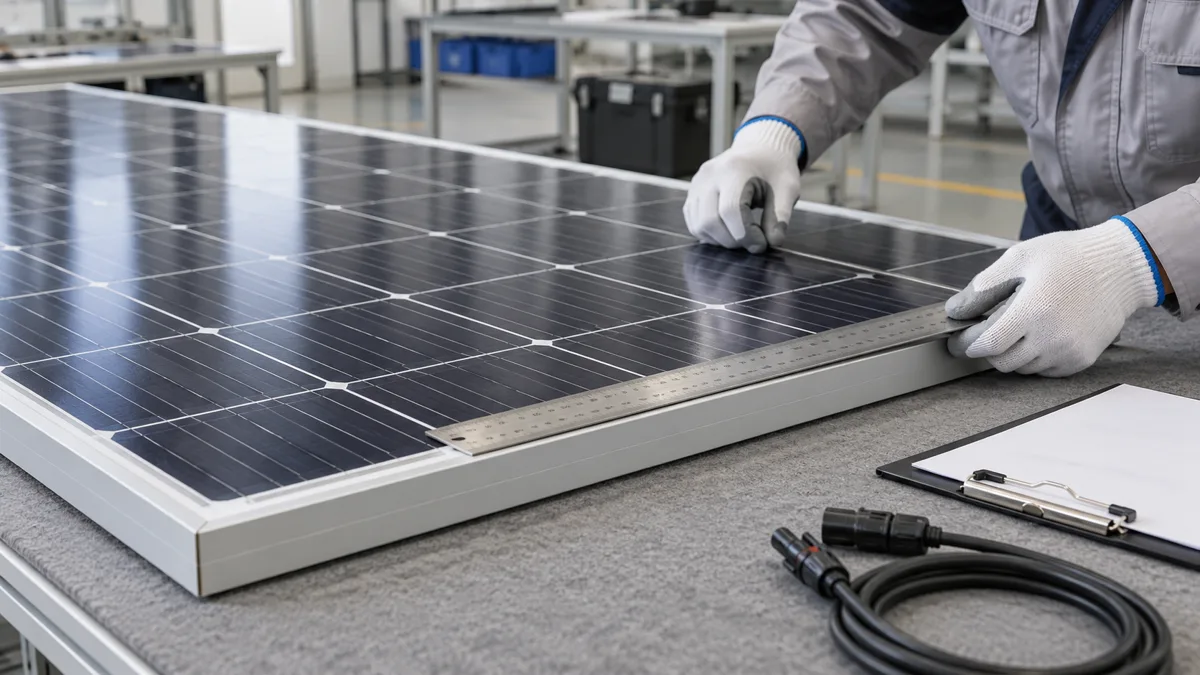
Give each supplier the same request for quotation (RFQ). Start with the required capacity or daily energy task, available footprint, installation location and receiving market. Then request the evidence needed to approve the exact model.
| RFQ or acceptance item | Required information |
|---|---|
| Identity and construction | Model, revision, cell technology and approved material specification |
| Mechanical fit | External dimensions, weight, mounting details and cable exit drawing |
| Electrical data | Pmax, Voc, Vmp, Isc, Imp, tolerances and temperature coefficients |
| Performance evidence | Datasheet, traceable flash-test records and any application-specific test data |
| Inspection plan | Agreed visual criteria, dimensions, electrical acceptance and electroluminescence (EL) records where specified |
| Documentation | Model-specific reports and destination-market documentation requirements |
| Commercial terms | Quantity, currency, delivery basis, packing, lead time and warranty responsibility |
| Change control | Written approval before changing materials, connectors, cells or model revision |
Name the test conditions when comparing ratings. The DOE’s PV performance guidance identifies 1,000 W/m² irradiance and 25°C cell temperature as key standard-test conditions. A rating under those conditions is not a promise of continuous outdoor output.
For OEM equipment, evaluate samples with the intended charging circuit, battery and enclosure. Check mechanical fit, polarity and charging behavior under the conditions that matter to the application. Freeze the accepted specification before approving the batch.
Frequently Asked Questions
What is a mono solar panel, and how does polycrystalline solar panel vs monocrystalline compare?
If you are wondering what is a mono solar panel, it is a photovoltaic module made from single-crystal silicon wafers (such as PERC or N-type TOPCon cells) for higher conversion efficiency per square meter. Comparing polycrystalline solar panel vs monocrystalline—or polycrystalline solar panels vs monocrystalline in bulk procurement—monocrystalline modules fit tighter rooftops, RVs, and commercial projects with fewer modules per kW, while legacy polycrystalline offers slightly lower $/W only where mounting area is abundant. Browse current monocrystalline solar panels for OEM specs.
How does monocrystalline vs polycrystalline solar panel price compare?
When evaluating monocrystalline vs polycrystalline solar panel price, look at installed cost per system rather than cell price alone: slightly higher-efficiency monocrystalline modules often reduce racking, roof labor, and shipping volume per kW. Compare full installed benchmarks in our solar panel installation costs guide.
Are monocrystalline solar panels always the better purchase?
No. Monocrystalline solar panels are generally attractive where power per area matters, but the exact model must still meet electrical, mechanical and commercial requirements. A verified polycrystalline offer can be suitable when space is available and its total project cost is favorable.
Do equal-watt mono and poly panels generate the same electricity?
Equal rated watts do not guarantee equal annual energy. Temperature response, irradiance, shading, orientation and long-term efficiency aging influence energy yield. Compare a site-specific model using both modules’ actual data.
Can mono and poly panels be mixed in one system?
Sometimes, but crystal type alone cannot establish compatibility. Voltage, current, string arrangement and controller or inverter limits must be checked. Separate maximum power point tracking (MPPT) inputs may help accommodate different groups, subject to the equipment design and manuals.
Do polycrystalline solar panels last less time?
The polycrystalline label alone does not establish a shorter service life. Review construction, qualification evidence, operating conditions and the actual warranty. Passing a qualification test does not quantify lifetime.
Is bifacial an alternative to monocrystalline?
No. Bifacial and monocrystalline describe different features, so one panel can be both. If a quote includes rear-side energy gains, ask for the installation assumptions and compare front-side ratings on the same basis.
Why do monocrystalline cells convert more sunlight per square meter than polycrystalline cells?
Monocrystalline cells are sliced from a single continuous silicon crystal ingot, eliminating the crystal grain boundaries in polycrystalline wafers that trap electrons and reduce conversion efficiency.
What efficiency and warranty do Honray standard monocrystalline panels offer?
Honray standard monocrystalline solar panels (spanning 100W–700W standard and C&I modules, alongside 0.1W–100W small custom panels) use high-efficiency Grade-A monocrystalline cells (23%–26% cell efficiency depending on series) backed by a 12-year product warranty and 25–30 year linear power warranty (≥80%).
Should B2B distributors still stock polycrystalline panels or transition fully to monocrystalline?
Most distributors have transitioned to monocrystalline PERC and N-type modules because wafer scale has eliminated poly’s old price advantage while mono delivers higher watts per container and per roof square meter. See Honray wholesale solar panels for current mono container options.
Choose the module that passes the project checks
Shortlist monocrystalline options first when your footprint is restrictive. Consider a polycrystalline offer when the verified cost advantage survives the layout, compatibility and support checks. Approve the specific product and supply arrangement rather than the crystal label alone.
For a new purchase, review Honray’s solar panel range or wholesale solar panels. For an application-specific design, share your footprint drawing, electrical requirements, destination market and expected quantity through the custom solar panel inquiry page. Request the proposed model’s datasheet and sample plan before making a purchasing commitment.
OEM & ODM Customization
100% Dual EL Tested
Export to 50+ Countries
TÜV · UL · CE · UN38.3
Looking for wholesale pricing or custom OEM/ODM solutions?
Connect directly with our engineering team for a tailored quote within 24 hours.