
Solar Panel Warranties: Product vs Performance Coverage
A solar panel product warranty covers eligible defects in materials and workmanship—commonly 12 years on standard rigid modules—while a performance warranty guarantees minimum STC power output over 25 to 30 years (typically at least 80% of nameplate rating). Neither warranty automatically covers site labor, shipping, or guaranteed annual kilowatt-hour production.
For distributors, EPC installers, and OEM buyers, comparing warranty durations is only the starting point. You also need to verify what triggers a valid claim, which laboratory or field test proves power loss, and who pays for removal, freight, and replacement compatibility.
Key Takeaways
- Read product coverage (materials and manufacturing) and performance coverage (linear output floor) separately before signing an order.
- Honray standard rigid monocrystalline and bifacial modules carry a 12-year product warranty and 25–30 year linear power warranty (≥80%), subject to the formal SKU datasheet and quotation.
- A power warranty percentage refers to module output under Standard Test Conditions (STC: 1,000 W/m², 25°C cell temperature), not daily site kWh yield.
- Confirm freight, removal labor, flash-test requirements, and serial-number traceability before shipment.
Table of Contents
- Product vs. Performance Warranty: What Is the Difference?
- What Does a Solar Panel Product Warranty Cover?
- What Does a Solar Panel Performance Warranty Guarantee?
- Worked Example: Reading a Linear Degradation Schedule
- Why Low Daily Generation Does Not Automatically Prove a Warranty Fault
- Which Costs and Claim Conditions Should Buyers Check?
- A Warranty Checklist for Distributors and OEM Buyers
- Frequently Asked Questions
- What does a 25-year solar panel warranty actually cover?
- What is Honray’s standard solar panel warranty?
- Can a performance claim still be filed after the 12-year product warranty expires?
- Does a solar panel performance warranty guarantee daily electricity production?
- Do flexible and portable solar panels have the same 25-year warranty as rigid panels?
- Are removal labor and shipping covered under a solar panel warranty?
- What commonly voids a solar panel warranty?
- How do manufacturers test a panel for a performance warranty claim?
- Can a solar panel warranty transfer when a property or RV is sold?
- Do OEM/ODM custom solar panels come with a warranty?
Product vs. Performance Warranty: What Is the Difference?
Even when both guarantees appear in one PDF, they protect against different failure modes on different timelines. The product warranty protects the physical module assembly, whereas the performance warranty sets a floor on electrical degradation.
| Comparison Point | Product Warranty | Performance (Linear Power) Warranty |
|---|---|---|
| What it covers | Eligible defects in frame, glass, laminate, backsheet, junction box, or solder joints. | Module STC power falling below the warranted annual degradation curve. |
| Typical duration | Often 12 years on standard rigid glass modules (varies by flexible/portable series). | 25 to 30 years (commonly ≥80% of rated STC power at end of term). |
| Required evidence | Purchase invoice, serial number, clear photos, and defect assessment. | Purchase record, serial ID, and accepted flash-test or calibrated I-V curve data. |
| Not automatically covered | Installation faults, roof damage, hail/storm impact, or site labor. | Shading, soiling, inverter losses, or lower-than-expected utility bill savings. |
| Typical remedy | Repair, replacement module, or pro-rated/agreed credit per terms. | Additional module capacity, replacement, or compensation per contract. |
What Does a Solar Panel Product Warranty Cover?
A solar panel product warranty addresses manufacturing and material defects that impair normal operation—such as premature delamination, junction box failure, broken internal interconnects, or corroded frames under approved operating conditions. It does not cover mechanical impact, unapproved bending, or site wiring errors.
Always separate manufacturing workmanship from installation workmanship. Manufacturing defects stem from factory lamination, soldering, or sealing; installation faults stem from loose clamps, unsupported cables, or improper roof penetrations. Ask your installer for a separate workmanship warranty covering mounting and wiring.
Also note that flexible and portable modules have different mechanical limits than aluminum-framed glass panels. For example, Honray’s flexible solar panels specify a maximum 30° bend radius and a 5–10 year expected service life with no foot traffic, so confirm the exact product-line warranty rather than assuming rigid-glass terms apply.
What Does a Solar Panel Performance Warranty Guarantee?
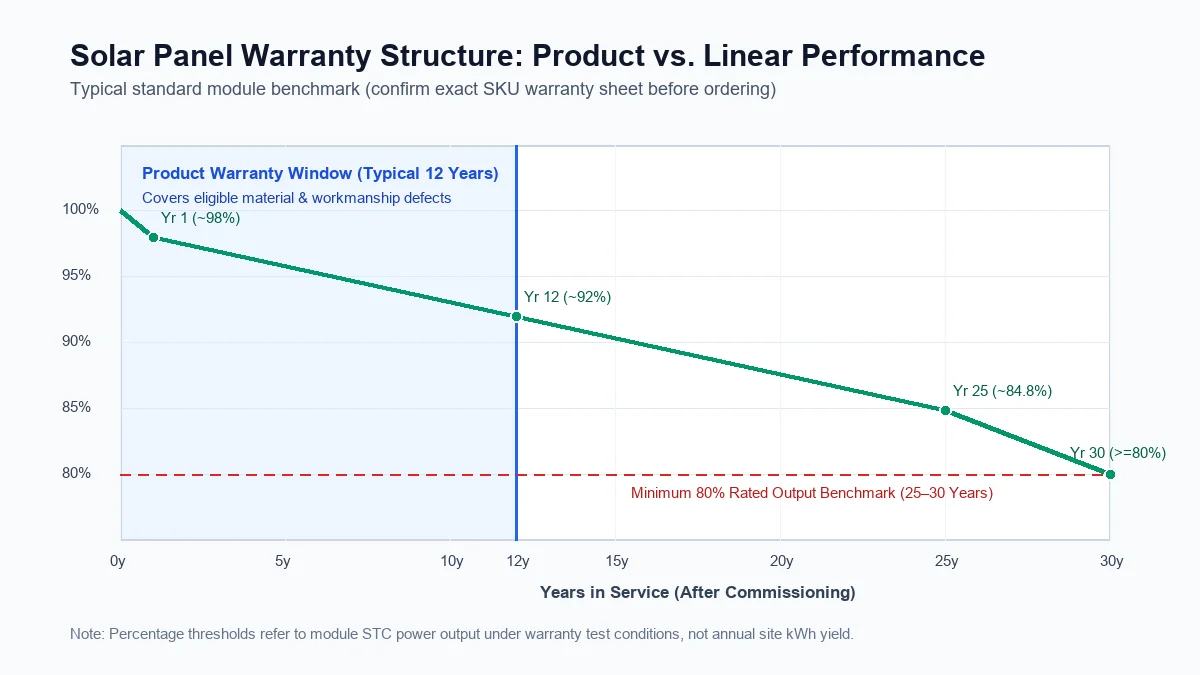
A solar panel performance warranty sets a minimum DC power percentage at stated intervals—typically allowing a small first-year adjustment followed by a steady linear decline to at least 80% over 25 to 30 years. Most manufacturers define this floor relative to the module’s nameplate STC rating minus measurement tolerance.
Worked Example: Reading a Linear Degradation Schedule
Suppose a 500 W monocrystalline module guarantees 98.0% minimum STC output at the end of year 1, followed by a maximum 0.55 percentage-point annual decline through year 25 (ending at 84.8%), or 80.0% at year 30. Under that illustrative schedule, minimum warranted STC power is 98% − [0.55% × (n − 1)] for years 1–25.
| End of Year | Illustrative Warranted Floor | Equivalent STC Power (500 W Example) |
|---|---|---|
| Year 1 | 98.0% | 490.0 W |
| Year 10 | 93.05% | 465.3 W |
| Year 25 | 84.8% | 424.0 W |
This table is an educational calculation model—not a fixed guarantee for every SKU. Always check the formal warranty schedule and measurement uncertainty allowance (often ±3% lab tolerance) in your purchase contract.
Why Low Daily Generation Does Not Automatically Prove a Warranty Fault
A drop in daily kilowatt-hours (kWh) from your inverter app does not establish a module power shortfall. According to the U.S. Department of Energy, module wattage ratings are measured under Standard Test Conditions (1,000 W/m² irradiance and 25°C cell temperature), whereas field roofs routinely run hotter and see variable irradiance.
Before filing a performance claim, rule out shading, dust or bird droppings, loose MC4 connectors, tripped breakers, and inverter derating. Review our solar panel efficiency over time guide for practical field checks.
Which Costs and Claim Conditions Should Buyers Check?
An approved module claim and a zero-cost service visit are two different things. Clarify five commercial terms in writing before placing a bulk or project order:
- Testing & diagnosis: Who pays for third-party flash testing or on-site I-V curve tracing if the module passes spec?
- Site labor & access: Are scaffolding, roof removal, and reinstallation excluded from the factory module warranty?
- Freight & customs: Does the supplier ship replacement panels FOB/CIF with the next container or cover air freight for urgent single-unit claims?
- Replacement compatibility: If a 10-year-old panel size is discontinued, how are voltage, current, and frame dimensions matched?
- Warranty start & transfer: Does the clock start on the bill-of-lading date, commissioning date, or invoice date, and is coverage transferable?
A Warranty Checklist for Distributors and OEM Buyers
Maintain a dedicated warranty dossier for every shipment so your after-sales team can verify claims quickly without delays:
- Archive the exact PDF warranty tied to the SKU, wattage range, and quotation number—for example, standard monocrystalline solar panels vs. custom OEM solar modules.
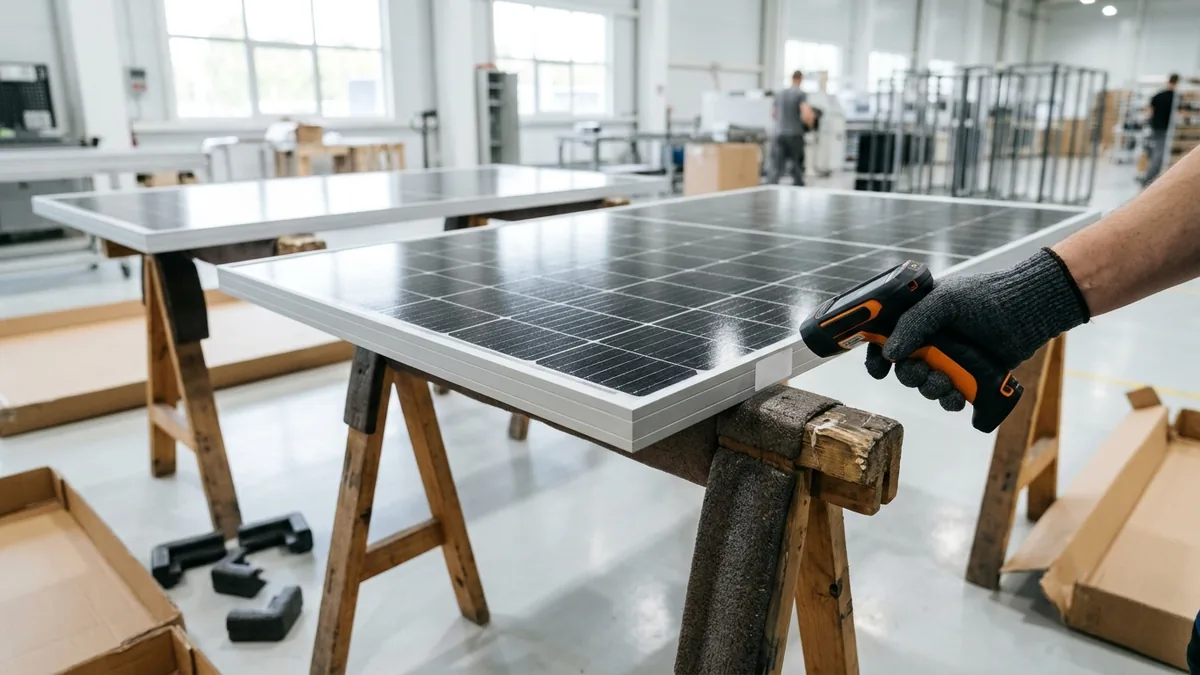
- Record serial numbers and flash-test reports at factory dispatch or warehouse receiving so every pallet is traceable.
- Specify claim evidence upfront—clarify whether high-resolution photos, Voc/Isc multimeter checks, or EL images suffice for initial RMA triage.
- Confirm spare-module policy—for large C&I or container orders, consider adding 0.5%–1% spare modules on the initial shipment to eliminate long-tail downtime.
- Save the official support channel via the Honray after-sales support page and retain your roof/commissioning records alongside the installation checklist.
Frequently Asked Questions
What does a 25-year solar panel warranty actually cover?
A 25-year solar panel warranty almost always refers to the linear performance warranty, guaranteeing that module DC output stays above a stated percentage (commonly ≥80% to 84.8% depending on cell type) under Standard Test Conditions. Physical manufacturing defects are covered separately under the product warranty, which is typically 12 years on standard rigid modules.
What is Honray’s standard solar panel warranty?
Honray standard rigid solar modules carry a 12-year product warranty and a 25–30 year linear power output warranty (≥80%), while specialized flexible, portable, or custom small-wattage panels follow the terms stated on their formal SKU quotation and warranty document.
Can a performance claim still be filed after the 12-year product warranty expires?
Yes, if the 25–30 year performance warranty is still active and the verified STC power loss exceeds the allowed degradation curve without an excluded cause (such as physical impact or improper wiring). Check both the exclusions list and the required test method in your contract.
Does a solar panel performance warranty guarantee daily electricity production?
No, a module performance warranty measures DC power at STC (1,000 W/m², 25°C) rather than daily site kilowatt-hours or utility bill savings. Site yield depends on local sunlight, tilt, shading, temperature, and inverter efficiency.
Do flexible and portable solar panels have the same 25-year warranty as rigid panels?
No, lightweight ETFE/polymer flexible and foldable portable panels use different encapsulation than tempered-glass rigid panels and carry shorter model-specific warranties (for example, Honray flexible panels list a 5–10 year expected service life). Always verify the exact warranty sheet for flexible or portable SKUs.
Are removal labor and shipping covered under a solar panel warranty?
Usually not automatically—standard factory module warranties cover repair, replacement, or agreed compensation for the panel itself, while roof labor, scaffolding, and local freight are often excluded or capped unless negotiated in an EPC or distributor contract.
What commonly voids a solar panel warranty?
Common exclusions include exceeding the maximum system voltage, bending flexible panels tighter than their rated radius, walking on modules, unauthorized junction box modifications, missing serial labels, and storm/hail or fire damage covered by property insurance.
How do manufacturers test a panel for a performance warranty claim?
Claims are evaluated by comparing the suspect module’s measured power on a calibrated solar simulator (flash tester) corrected to STC—accounting for the factory measurement tolerance (typically ±3%)—against the warranted output floor for that year of service.
Can a solar panel warranty transfer when a property or RV is sold?
Transferability depends on the specific warranty terms; many stationary rooftop warranties remain with the original installation site if serial numbers and invoices are preserved, whereas moving panels to a new site or reselling loose modules may require written supplier approval.
Do OEM/ODM custom solar panels come with a warranty?
Yes, custom OEM/ODM modules (from 0.1W–100W IoT panels up to 100W–700W C&I modules) carry warranty terms defined in the signed engineering specification and sales contract, tailored to the agreed lamination materials, operating environment, and testing standards.
OEM & ODM Customization
100% Dual EL Tested
Export to 50+ Countries
TÜV · UL · CE · UN38.3
Looking for wholesale pricing or custom OEM/ODM solutions?
Connect directly with our engineering team for a tailored quote within 24 hours.